


A curved LED display is a screen made of angled cabinets or flexible modules that bend into an arc, cylinder, pillar wrap or 90° corner. Choose a curve for stages and lobbies, a cylinder for atriums, a pillar wrap for columns and an L-shape for corners. Price sits above flat panels because of custom cabinets and structure.
Flat screens struggle with round columns, curved facades and corner walls. You get gaps, stretched images and awkward framing. Lumn Lab has delivered 1000+ LED installations across India since 2015, and this guide covers the shapes, pricing factors and planning mistakes we see before a project reaches site.
What Is a Curved LED Display and How Is It Built?
A curved LED display is a modular screen whose cabinets or modules join at an angle, or flex, to form one continuous curved surface. There are two ways to build it:
• Tapered rigid cabinets. Each cabinet has slightly angled edges, so a row of them closes into an arc. Best for permanent stages, control rooms and lobby walls.
• Flexible modules. Soft-board modules, usually magnet-mounted, bend around tighter radii. Best for columns, small cylinders and decorative builds.
Rigid cabinets are sturdier and easier to service. Flexible modules go where rigid ones can’t, but the frame behind them needs careful design.
Curved LED Display Module vs Panel
A module is the small tile carrying the LEDs and driver circuitry. A curved LED display panel (or cabinet) holds several modules in a frame with power and receiving cards. Cylinders and pillars usually need flexible modules; arcs and walls run on panels.
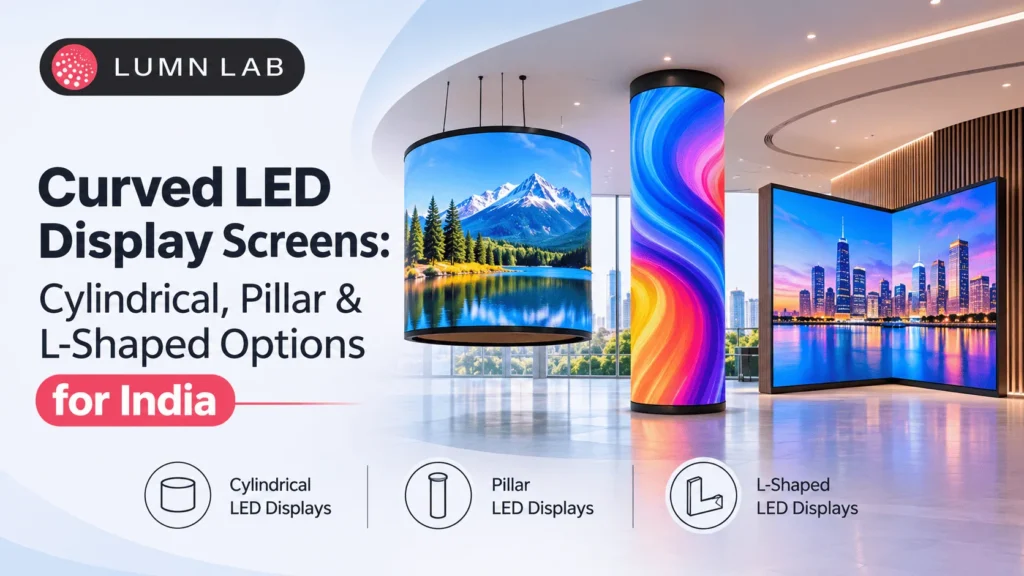
Curved, Cylindrical, Pillar and L-Shaped LED Displays Compared
| Type | Shape | Best for | Main watch-out |
| Curved | Concave or convex arc | Stages, control rooms, lobby feature walls | Radius sets cabinet design and cost |
| Cylindrical | Full 360° or large arc | Atriums, showrooms, brand launches | Content must be mapped to the wrap |
| Pillar | Wrap around a column | Malls, hotels, airports, metro stations | Measure the finished column diameter |
| L-shaped | 90° inside or outside corner | Showroom corners, reception, exhibition stands | Corner cabinet needed to avoid a dark seam |
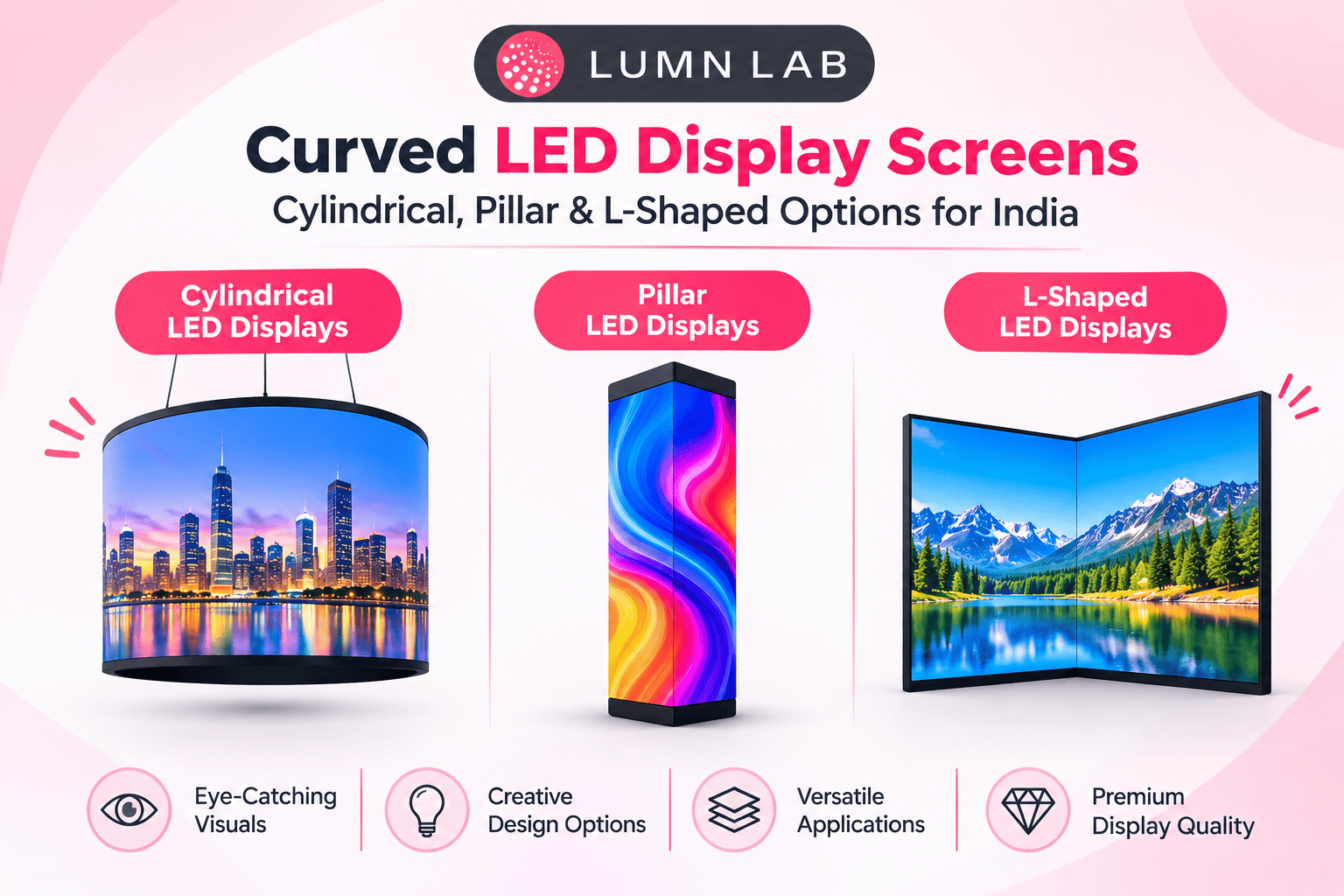
Curved LED Display Wall
Concave arcs pull viewers in and suit control rooms, experience centres and lobbies in Gurgaon or Bangalore. Convex arcs push content outward on stage fronts and building corners. We ask for the radius first, because it changes the cabinet design, structure and price.
Cylindrical LED Display
A cylindrical LED display wraps a full 360° or a large arc, so people see it from every side. Mall atriums, car showrooms and brand launches use it as a centrepiece. Standard widescreen video looks wrong on a cylinder, so content has to be built for the wrap.
Pillar LED Display
A pillar LED display covers an existing column, usually with flexible modules. Hotel lobbies, Mumbai malls and airports use them to turn dead structure into screen space. Measure the finished column, not the structural drawing, because cladding changes the diameter.
L-Shaped LED Display
An L-shaped LED display wraps an inside or outside 90° corner with two walls joined by a corner cabinet. It suits showroom corners, reception areas and exhibition stands in Noida and across Delhi NCR. Without a proper corner cabinet, you get a dark seam exactly where the eye lands.
A bend isn’t always worth it. If everyone views from one spot, straight on, a flat wall costs less and is simpler to service.
Have a column, corner or arc in mind? Send Lumn Lab the dimensions, and we’ll tell you which build fits. Talk to our team
Outdoor Curved LED Display: What Changes
An outdoor curved LED display needs higher brightness, an IP65 weatherproof cabinet and a structure that handles wind load along the curve. Typical sites are building corners, hotel porches and curved facades. Three things matter:
• Brightness. Sunlight washes out indoor-grade panels. Outdoor modules run at several thousand nits.
• IP65 rating. It means the cabinet is dust-tight and protected against water jets, as defined in the IEC IP rating system.
• Heat and wind. Delhi NCR summers and Mumbai monsoons stress seals and cooling in different ways.
For rate references, see our outdoor LED display price guide.
LED vs OLED Curved Display: Which Should You Buy?
Modular LED suits large, bright or custom-shaped installations. OLED suits small, premium, TV-sized screens. Some people search for a hybrid “LED OLED curved LED display”, but in commercial signage these are separate technologies. Choose by:
• Size: OLED comes in fixed panel sizes. Curved LED scales from a single pillar to a stage-wide wall.
• Brightness: LED copes with bright lobbies and outdoor sites. OLED works best under controlled lighting.
• Shape: Only modular LED builds cylinders, pillar wraps and corners.
Curved LED Display Price in India: What Drives the Number
Curved LED display price starts from the flat panel rate for your pixel pitch, then adds a premium for custom cabinets, structure and engineering. For reference, our flat-panel starting points (panels only, November 2026) are indoor P2.5 from ₹6,800 and P1.8 from ₹9,000 per sq ft, and outdoor P4 from ₹6,500 per sq ft. Treat these as baselines, not curved quotes. The full breakdown is in our indoor LED display price page.
What moves the number:
• Pixel pitch. Finer pitch costs more per sq ft.
• Radius and cabinet count. Tighter curves need more custom or flexible modules.
• Structure. Steel frame, cladding and mounting are often underestimated.
• Indoor or outdoor. Outdoor adds IP65 cabinets, extra brightness and cooling.
• Site and content. Access, lifting equipment and content mapped to the curve add cost.
These are market estimates. Quotes exclude GST, and the rate depends on classification, so confirm it on the GST portal or with your accountant.
How to Choose the Right Flexible LED Display: Five Questions
1. What is the radius or diameter? It decides whether you need rigid cabinets or flexible modules.
2. How close will people stand? Pixel pitch in mm should roughly match your closest viewing distance in metres. AVIXA publishes guidance on image size and viewing distance, and our pixel pitch calculator gives a quick check.
3. Indoor or outdoor? Outdoor means IP65 and higher brightness.
4. What will play on it? Plan content for the curved shape, not a flat 16:9 frame.
5. How will it be serviced? Cylinders and pillars need front-access modules or a service door.
Start With the Shape, Then Pick the Screen
A curved LED display works when it is designed around the space: the radius, the viewing distance and how people move past it. Get those right, and the choice between curved, cylindrical, pillar and L-shaped builds mostly makes itself.
Lumn Lab has completed 1000+ installations since 2015, from Delhi NCR (Gurgaon and Noida) to Mumbai and Bangalore. Send us your drawing or site photos, and we’ll recommend a build and a quote.
Ready to plan your curved LED display? Talk to Lumn Lab’s team about your site. Get a free consultation
Frequently Asked Questions
What is a curved LED display?
A curved LED display is a modular screen built from angled cabinets or flexible modules. It forms a concave, convex or wrapped surface with one continuous image.
How much does a curved LED display cost in India?
More than a flat wall of the same size and pixel pitch. For reference, Lumn Lab flat indoor P2.5 panels start from about ₹6,800 per sq ft (panels only, GST extra). Curved builds add custom cabinets and structure, so a firm price needs your drawing.
Can you use a curved LED display outdoors?
Yes. It uses IP65-rated cabinets, high-brightness modules and a frame built for wind load. It suits facades, building corners and entrance pillars.
What is the difference between a curved LED display module and a panel?
A module is the small tile with the LEDs and driver circuit. A panel, or cabinet, holds several modules in a frame with power and control cards. Panels build arcs; flexible modules wrap tighter shapes.
Is LED or OLED better for a curved display?
For commercial spaces, usually modular LED. It scales to any size, handles bright and outdoor sites, and forms cylinders, pillars and corners. OLED suits small, premium screens in controlled lighting.
How tight can a curved LED screen bend?
It depends on the module type. Flexible modules bend tighter than rigid tapered cabinets. Share your radius or column diameter, and the supplier can confirm what is possible.
What pixel pitch should I choose for a curved LED wall?
Roughly match the pixel pitch in millimetres to the closest viewing distance in metres. P2.5 suits viewers about 2.5 m or more away; P1.8 suits closer viewing.
Can an LED display wrap a pillar or an L-shaped corner?
Yes. Flexible modules wrap pillars, and a corner cabinet joins two walls at 90° for L-shaped builds. Measure the finished column or corner, not the structural drawing.
Keep Reading