


If you’ve asked three vendors for a digital billboard quote, you’ve probably gotten three very different numbers. That’s not because anyone’s overcharging you — it’s because digital billboard pricing depends on variables most advertisers never get explained clearly: location, screen size, ad duration, and whether you’re buying media space or an entire LED unit.
This guide breaks down what digital billboard advertising actually costs in India in 2026, city by city, format by format, so you can budget a campaign without the guesswork. We’ll also cover what drives those costs up or down, and where you’re likely to get the best return.
Whether you’re a brand manager planning a launch in Mumbai or a local business owner looking at a digital hoarding in Noida, the numbers below should give you a realistic starting point.
What Is Digital Billboard Advertising?
Digital billboard advertising uses LED screens installed at high-traffic locations — highways, malls, transit hubs, city centers — to display rotating video or static ad content. Unlike traditional printed hoardings, digital billboards (also called DOOH, or Digital Out-of-Home) let advertisers change creative remotely, run multiple brands on the same screen, and target specific times of day.
This flexibility is exactly why digital billboard adoption in India has grown steadily — DOOH revenue in India reached ₹700 crore in 2024 and is projected to grow at a 24% CAGR through 2027, particularly across metro and tier-1 cities where advertisers want measurable, schedule-based campaigns instead of a fixed 30-day print booking.
Digital Billboard Advertising Cost in India: The Real Numbers
There are two very different ways to buy digital billboard advertising, and mixing them up is where most first-time advertisers get confused.
1. Renting Ad Space on an Existing Digital Billboard
This is the most common route for brands running a campaign. You pay a media owner or agency for airtime on a screen they already own and operate.
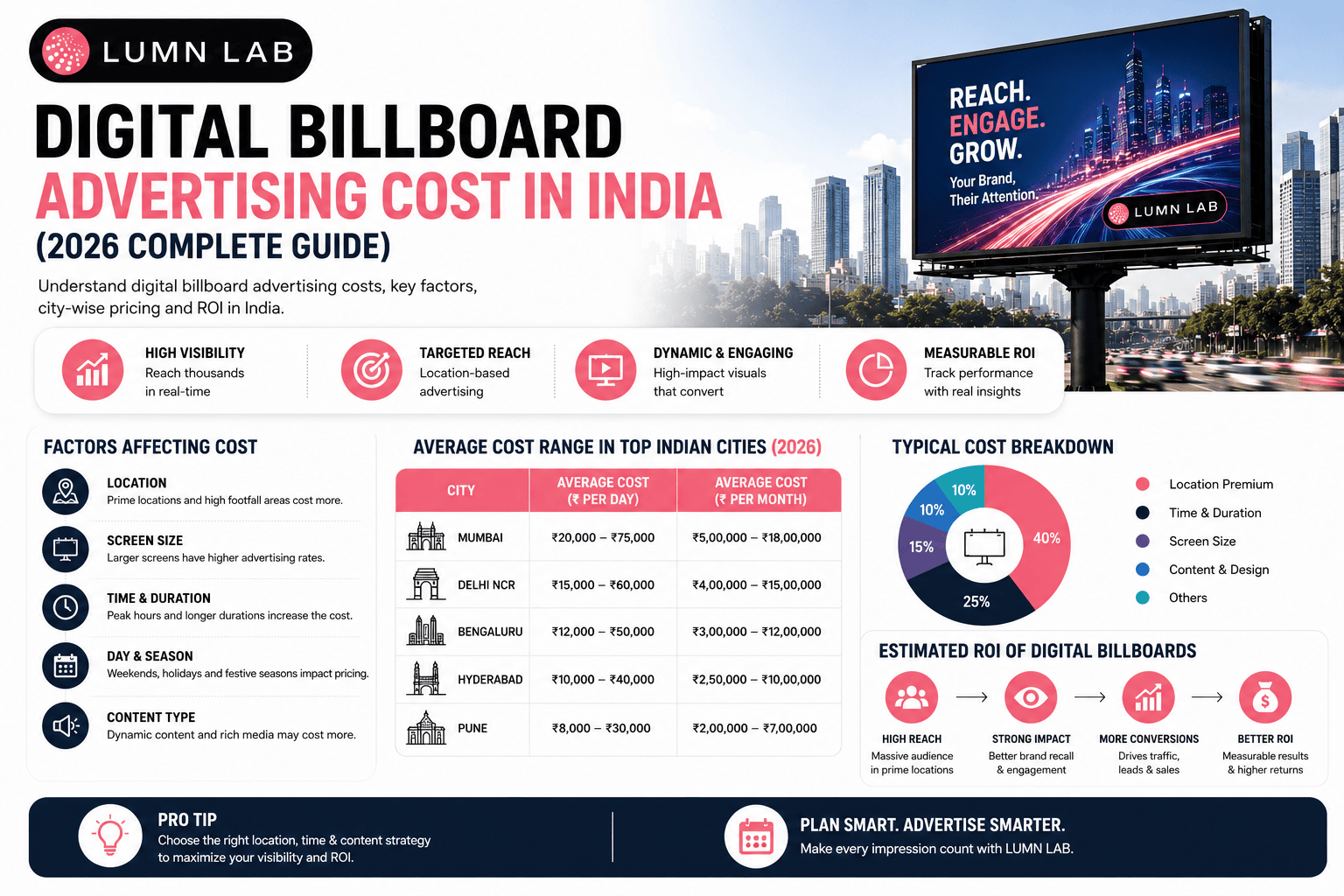
| City | Typical Location Type | Approx. Monthly Cost (10-15 sec slot) |
| Mumbai | Prime highway/junction | ₹1,50,000 – ₹6,00,000+ |
| Delhi / Gurugram | Arterial roads, malls | ₹1,00,000 – ₹5,00,000 |
| Noida | Expressway, sector markets | ₹60,000 – ₹2,50,000 |
| Bangalore | Tech corridors, ring road | ₹80,000 – ₹3,50,000 |
| Tier-2 cities | City center, highway | ₹30,000 – ₹1,20,000 |
Note: These are indicative market ranges based on typical media-buying patterns for prime versus secondary locations. Actual rates depend on the specific site, screen visibility, footfall, and the media owner’s inventory. Always request a site-specific quote before budgeting.
2. Buying and Installing Your Own Digital Billboard
If you own a retail chain, a commercial property, or want a permanent branded screen, buying your own LED billboard is a one-time capital investment followed by low ongoing costs (power, content management, maintenance).
Key cost factors for owning a digital billboard:
- Screen size — Larger panels cost more per square foot but reduce cost-per-impression over time.
- Pixel pitch — Tighter pixel pitch (better clarity, ideal for closer viewing distances) costs more than a coarser pitch suited for highway viewing distances.
- Outdoor-grade components — Weatherproofing, brightness (nits), and IP-rated cabinets add to the base price.
- Structure and installation — Civil work, mounting structure, and electrical setup vary by site.
- Content management system — Software to schedule and remotely update your display.
Because these factors interact, the fairest way to estimate an installation cost is a site-specific quote rather than a flat per-square-foot number — a highway-facing screen in Gurugram and a mall-facing screen in Bangalore can have completely different structural and viewing-distance requirements even at the same size.
What Actually Drives Digital Billboard Cost Up or Down
Location and footfall. A screen on a Mumbai expressway with lakhs of daily vehicle passes will always cost more than one in a quieter tier-2 market — you’re paying for eyeballs, not just square footage.
Screen size and resolution. Bigger isn’t always better. A well-placed, well-calibrated mid-size screen often outperforms an oversized one with poor visibility angles.
Ad slot duration and frequency. A 10-second loop that plays every 2 minutes costs less than a 30-second slot playing every 30 seconds. Frequency directly affects impressions delivered.
Content complexity. Static images are cheaper to produce and display than full-motion video, though video typically drives higher recall.
Seasonality. Festive periods (Diwali, New Year, IPL season) see higher demand and premium pricing on prime sites in cities like Delhi, Mumbai, and Bangalore.
Also Read: How to Set Up Digital Signage for Your Business
Digital Billboard vs Traditional Hoarding: A Quick Comparison
| Factor | Digital Billboard | Traditional Print Hoarding |
| Creative changes | Remote, instant | Requires physical reprint/reinstall |
| Multi-brand rotation | Yes, same screen | No, one advertiser per hoarding |
| Upfront cost | Higher (installation) | Lower |
| Ongoing cost | Power + content mgmt | Printing per campaign |
| Visibility at night | High (self-lit) | Depends on external lighting |
| Best for | Repeat campaigns, multiple brands, dynamic offers | Long single-message campaigns |
Where Digital Billboards Are Being Used Across India
Digital billboard advertising has moved well beyond just consumer brand campaigns. In practice, we see demand from:
- Retail and QSR chains running location-specific offers and time-of-day promotions
- Real estate developers advertising project launches near their site locations
- Automotive brands running high-impact video creative near dealerships and highways
- Corporate parks and IT hubs in Gurugram, Noida, and Bangalore using screens for both internal wayfinding and external advertising
- Event and entertainment promoters running countdown-style creative ahead of ticket sales
An LED display partner who understands both the media side and the hardware side — screen calibration, brightness for daylight visibility, and remote content scheduling — makes a meaningful difference in how well a digital billboard actually performs, not just how much it costs to put up.
Getting the Best Value From Your Digital Billboard Budget
A few practical pointers we’d give any advertiser or business owner budgeting for digital billboard advertising in 2026:
- Get quotes for at least 2-3 site options before committing — visibility varies more than people expect within the same city.
- Ask for footfall or traffic data for the specific site, not just the general area.
- If you’re installing your own screen, prioritize brightness (nits) and IP rating for outdoor durability over raw screen size.
- Budget separately for content production — a poorly designed creative underperforms even on a premium site.
- For long-term brand presence, compare the total cost of ownership (installation + power + maintenance) against 12-18 months of rented ad space — the crossover point is often earlier than expected for high-traffic locations.
Lumn Lab has been designing, manufacturing, and installing LED display solutions across India since 2015, working with businesses on everything from indoor video walls to large-format outdoor digital billboards. If you’re evaluating whether to rent space or invest in your own screen, our team can walk you through site requirements, pixel pitch selection, and realistic cost estimates based on your location and goals.
Thinking about installing a digital billboard for your brand or property?
Get in touch with Lumn Lab for a site assessment and a straightforward quote — no inflated numbers, no guesswork.
Frequently Asked Questions
Q1. How much does a digital billboard cost in India?
Renting space on an existing digital billboard typically ranges from ₹30,000 to over ₹6,00,000 per month depending on city and location prominence. Installing your own LED billboard is a separate, one-time investment that depends on screen size, pixel pitch, and site requirements — best estimated with a site-specific quote.
Q2. What is the difference between a digital billboard and a traditional hoarding?
A digital billboard uses an LED screen to display remotely updatable video or image content, allowing multiple advertisers and instant creative changes. A traditional hoarding is a static printed banner that requires physical reprinting and reinstallation for any change.
Q3. Which cities in India have the highest digital billboard advertising costs?
Mumbai and Delhi/Gurugram generally command the highest rates due to traffic density and footfall at prime sites, followed by Bangalore. Tier-2 cities and secondary locations within metros offer significantly lower rates.
Q4. Is it cheaper to rent ad space or install my own digital billboard?
Renting is cheaper for short-term or occasional campaigns since there’s no upfront hardware cost. Owning your own screen becomes more cost-effective for businesses that need a permanent, high-visibility presence over the long term, since ongoing costs are limited to power and maintenance.
Q5. What factors affect the price of a digital billboard installation?
Screen size, pixel pitch, brightness (nits) for outdoor visibility, IP rating for weatherproofing, mounting structure, and site-specific civil and electrical work all affect the final installation cost.
Q6. How long does a digital billboard ad slot typically run?
Ad slots commonly range from 8 to 15 seconds per loop, with the screen rotating between multiple advertisers. Slot duration and rotation frequency are both negotiable and affect pricing.
Q7. Do digital billboard costs change during festive seasons?
Yes. Prime sites in major cities typically see premium pricing during high-demand periods like Diwali, New Year, and major sporting events such as IPL season, due to increased advertiser demand.
Q8. Who uses digital billboard advertising in India?
Retail and QSR chains, real estate developers, automotive brands, corporate parks, and event promoters are among the most common users, typically for location-specific offers, launches, and high-visibility brand campaigns.
Keep Reading