


A typical LED display uses about 250–350 watts per square metre on average, and 700–1,000 W/m² at full-white peak. That is roughly 23–33 W per sq ft on an ordinary day. For a 10×6 ft indoor screen running 12 hours daily, LED display power consumption works out to around ₹5,000 a month at ₹10 per unit.
Most buyers ask about price first and power second. Then the first bill arrives, or the electrician says the 3 kW point you planned needs to be 8. Here is how to calculate LED screen power, size the power supply and estimate your monthly bill before you order.
How Much Power Does an LED Display Use?
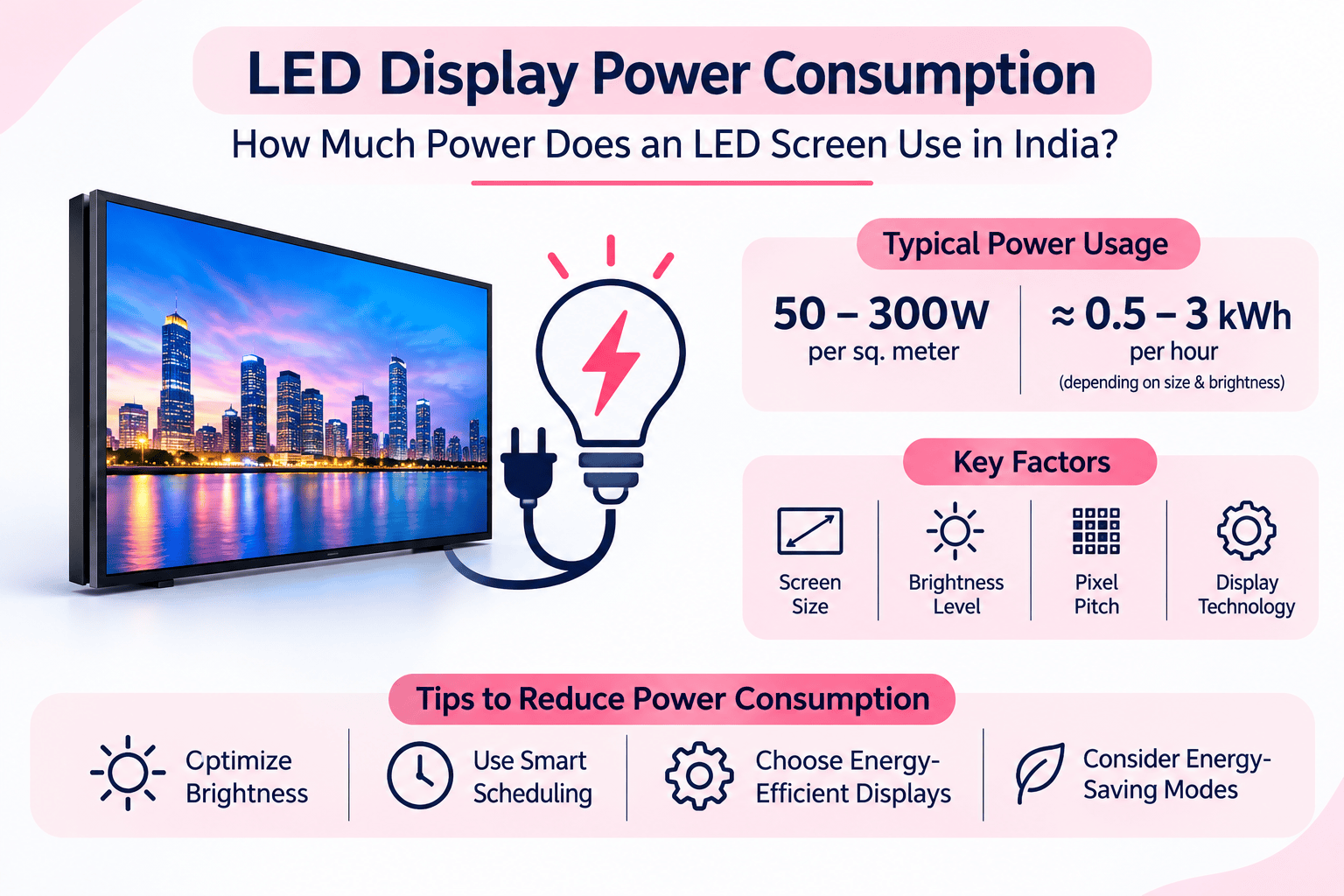
Most commercial LED displays draw 250–350 W/m² on average and 700–1,000 W/m² at peak. Peak is the number your electrician cares about. Average is what shows up on your bill.
The gap exists because real content rarely lights every LED at full white.
| Screen type | Average draw (W/m²) | Peak draw (W/m²) | Average per sq ft |
| Indoor fine pitch (P1.2–P2.5) | 200–300 | 500–750 | 19–28 W |
| Indoor standard (P3–P4) | 250–350 | 600–800 | 23–33 W |
| Outdoor (P4–P10) | 300–450 | 800–1,000 | 28–42 W |
Treat these as indicative market ranges. Your cabinet datasheet has the real figures, and it should list both average and maximum consumption. If a quote gives only one “power” number, ask which one it is.
Smaller boards follow the same maths. A 4×2 ft indoor LED display board is 8 sq ft, which works out to roughly 190–260 W on average. That is less than a typical window air conditioner.
How to Calculate LED Screen Power
Power (W) = screen area (m²) × watts per square metre. Then convert watts into monthly units and rupees:
Power (kW) = Area (m²) × W/m² ÷ 1,000
Monthly units (kWh) = Power (kW) × hours per day × days
Monthly cost (₹) = Monthly units × tariff per unit
Step 1: Get the area in square metres
Multiply width by height in feet, then by 0.0929. A 10 × 6 ft screen is 60 sq ft, or 5.57 m².
Step 2: Pick the right W/m² figure
Use average consumption for the bill and maximum consumption for wiring and power supplies. A common mistake is sizing cables for the average, then tripping the breaker on the first all-white test pattern.
Step 3: Add hours and your tariff
Take the indoor example at 250 W/m² average. 5.57 m² × 250 = 1,393 W, or 1.39 kW. Over 360 hours (12 hours, 30 days) that is 502 kWh. At ₹10 per unit, that is ₹5,020 a month.
LED Display Power Consumption and Monthly Electricity Cost in India
A 10×6 ft indoor LED screen running 12 hours a day costs about ₹5,000 a month on average content. The same size outdoors costs about ₹7,000. The table assumes 360 running hours and ₹10 per unit.
| Scenario | Power draw | Monthly units | Monthly cost |
| Indoor, average content (250 W/m²) | 1.39 kW | 502 kWh | ₹5,020 |
| Indoor, peak (700 W/m²) | 3.90 kW | 1,405 kWh | ₹14,050 |
| Outdoor, average (350 W/m²) | 1.95 kW | 702 kWh | ₹7,020 |
| Outdoor, peak (900 W/m²) | 5.02 kW | 1,806 kWh | ₹18,060 |
Peak rows are a ceiling, not a forecast.
Which tariff should you use?
Commercial rates in India vary by state, distribution company and connected load. Many businesses land between ₹8 and ₹12 per unit once fixed charges and surcharges are included, and Delhi bills can run higher. The Central Electricity Authority publishes tariff data that shows how widely state rates differ.
The reliable shortcut: take your last commercial bill and divide the total amount by the units consumed. Use that number. Each ₹1 change in tariff moves our indoor example by about ₹500 a month.
This matters in the cities where most of our clients operate. Delhi NCR, Gurgaon, Noida, Mumbai and Bangalore each fall under different tariff orders, so the same screen costs a different amount to run in each.
Example: a 10×10 ft P4 retail storefront
Take a screen the size of our HOCCO Ice Cream Delhi installation: 10×10 ft, P4 pitch. That is about 9.3 m². At 350 W/m² average, it draws roughly 3.25 kW, or about 1,170 kWh a month at 12 hours a day. At ₹10 per unit, that is around ₹11,700. This is arithmetic on the screen size, not a metered reading from that site.
Want this calculated for your screen? Send us the size, city and daily running hours. The Lumn Lab team will come back with a power and monthly cost estimate. Request an estimate
How to Calculate LED Driver Wattage (Power Supply Sizing)
Required power supply wattage = cabinet maximum power ÷ 0.8. Running a supply at 70–80% of its rating keeps heat down.
In an LED wall, “driver” usually means the switch-mode power supply feeding each cabinet. The driver ICs on the modules are matched by the manufacturer, so you do not size those.
PSU wattage ≥ Cabinet max watts ÷ 0.8
Example: 150 W ÷ 0.8 = 188 W → use a 200 W supply
Supply current at 5 V = Watts ÷ 5 → 200 W ÷ 5 V = 40 A
That is where the common “5V 40A” label comes from.
Check the mains side too
Total amps = total watts ÷ (230 V × power factor). Our 10×6 ft indoor screen at 3,900 W peak and a 0.9 power factor draws about 19 A on a single phase. Put it on a dedicated circuit, not a shared socket, and have a licensed electrician confirm cable and breaker sizes. Larger video walls should be split across three phases with the load balanced.
What Makes LED Display Power Consumption Go Up or Down
Brightness
Outdoor screens run at 5,000+ nits to beat sunlight. Indoor screens usually sit around 800–1,500 nits. Brightness is the biggest lever you control. Industry bodies like AVIXA publish guidance on viewing conditions if you want a reference point.
Content
White backgrounds light more LEDs. A dark-theme dashboard can draw noticeably less than a white menu board, because black pixels are essentially off.
Pixel pitch
Finer pitch packs more LEDs into each square metre, but that does not automatically mean higher power, because fine-pitch screens are usually run at lower brightness. Our pixel pitch guide explains how to match pitch to viewing distance.
Environment and cooling
Outdoor cabinets in Delhi NCR summers or Mumbai humidity work harder to stay cool, and sealed indoor rooms need AC. Outdoor cabinets also need a proper ingress rating. The IEC IP rating explainer covers what IP65 means in practice.
Control hardware
Sending cards, processors and media players draw little, but they run whenever the screen is on. Add them in.
Expert Recommendations: How to Keep the Electricity Bill Down
• Wire for peak, budget for average. Size supplies, cables and breakers on maximum consumption. Estimate the bill on average.
• Leave 20–25% headroom on circuits. A screen that is maxed out at commissioning will struggle in peak summer.
• Use auto-brightness on outdoor screens. A light sensor can lower output at night, when full daytime brightness is wasted and glaring.
• Schedule shutdown. Running a mall screen 16 hours instead of 12 adds a third to the monthly units.
• Stagger power-on. Switching on every cabinet at once creates inrush current that can trip breakers. Power groups of cabinets up in sequence.
• Design content for the bill. Dark backgrounds with bright accents cost less than full-white slides.
• Ask for datasheet figures in every quote. Compare average and maximum W/m² side by side, alongside price. Our LED display price in India 2026 guide covers what else to compare, and the Bureau of Energy Efficiency has broader guidance on commercial energy use.
Comparing options? See current rates for indoor LED display price in India and outdoor LED display price in India.
Plan the Power Before You Buy the Screen
LED display power consumption is easy to estimate and expensive to ignore. Area × watts per m² gives the load. Hours × tariff gives the bill. Maximum ÷ 0.8 gives the power supply. Five minutes with those three formulas prevents most of the usual surprises: tripped breakers, undersized cables and a monthly bill nobody budgeted.
Lumn Lab has been building and installing LED displays across India since 2015, with 1,000+ installations in Delhi NCR, Gurgaon, Noida, Mumbai, Bangalore and beyond. Our products carry BIS and ISO certifications, and our outdoor range is IP65 rated.
Get a power and running-cost estimate for your LED screen. Share your screen size, city and daily running hours, and the Lumn Lab team will send a realistic load and monthly cost figure along with a recommendation. Talk to Lumn Lab
Frequently Asked Questions
How much electricity does an LED display use per hour?
Most LED displays use about 250–350 watts per square metre on average, which is 0.25–0.35 kWh per m² per hour. A 10×6 ft (5.57 m²) indoor screen uses about 1.4 kWh per hour on average and up to 3.9 kWh at peak brightness.
How to calculate LED screen power?
Multiply the screen area in square metres by the watts per square metre on the cabinet datasheet. Power (W) = area (m²) × W/m². Use the average value for your electricity bill and the maximum value for wiring and power supplies. A 5.57 m² screen at 250 W/m² draws about 1,390 W.
How to calculate LED driver wattage?
Divide the cabinet’s maximum power draw by 0.8 to get the minimum power supply wattage. A 150 W cabinet needs at least a 188 W supply, so a 200 W unit fits. In LED walls the “driver” usually means this cabinet power supply. The driver ICs on the modules are matched by the manufacturer.
How much does it cost to run an LED display per month in India?
A 10×6 ft indoor LED display running 12 hours a day costs about ₹5,000 a month at ₹10 per unit, based on average power draw. An outdoor screen of the same size costs about ₹7,000. Your actual bill depends on your state tariff and fixed charges.
Does an outdoor LED display board use more power than an indoor one?
Usually, yes. Outdoor boards run at much higher brightness to stay visible in sunlight, so they typically draw 300–450 W/m² on average against 200–350 W/m² indoors. Cooling also adds load in hot cities like Delhi NCR.
Can I run an LED display on a single-phase connection?
Small screens, yes. A 10×6 ft indoor screen peaks around 3.9 kW, which is about 19 A on a single phase and needs a dedicated circuit. Larger video walls should use three-phase supply with the load balanced across phases. A licensed electrician should confirm the circuit.
Does an LED display use power when the screen is black?
Yes, but far less. Black pixels are off, so LED draw falls sharply. The power supplies, sending card and processor still draw some power, so switch off the whole system overnight to save units.
Keep Reading