


Most businesses that buy the wrong LED panel don’t realise it until six months later – when the screen looks washed out in afternoon light, modules need replacing, or the supplier stops picking up the phone.
It’s not because they didn’t do their research. It’s because the research focused on price and size, and skipped the five things that actually determine whether a display works for your space.
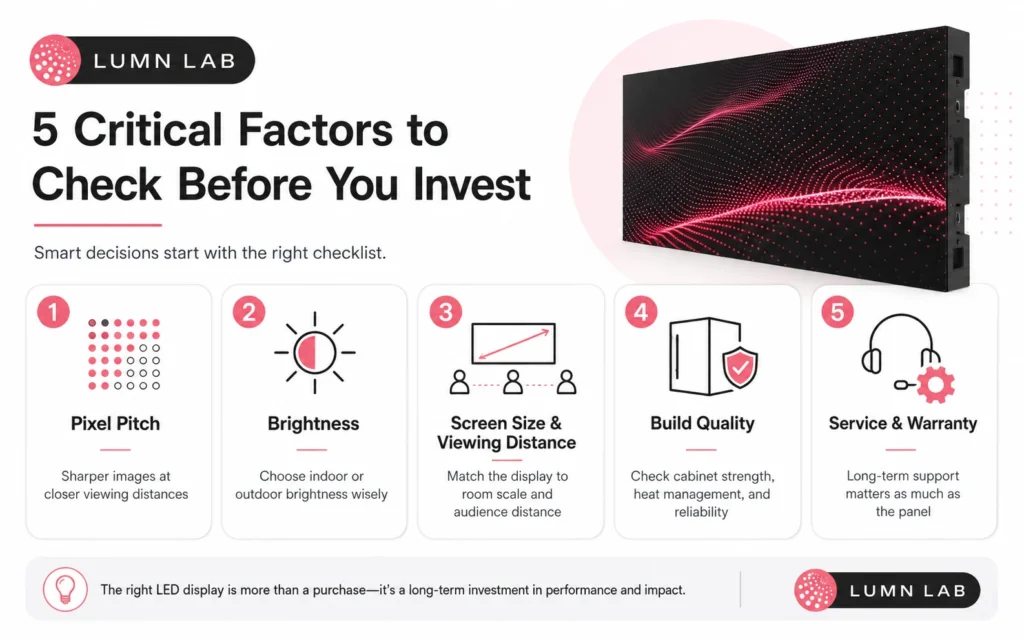
This LED panel buying guide covers exactly those five factors. Whether you’re setting up a corporate lobby in Bangalore, a retail facade in Mumbai, or an outdoor display in Delhi NCR, these are the questions worth asking before you commit.
Factor 1: Pixel Pitch – The Clarity Question
Pixel pitch is the distance (in millimetres) between the centre of one LED cluster and the next. Smaller number = more LEDs per square metre = sharper image.
Where buyers go wrong is treating it as a “bigger is better” spec. It isn’t. The right pixel pitch for your space depends almost entirely on two things: how far your viewers stand from the screen, and what kind of content you’re showing.
Here’s a quick reference:
- P1.2 – P2.5: High-resolution indoor environments – boardrooms, control rooms, broadcast studios, premium retail. Viewers typically 2–5 metres away.
- P2.5 – P4: Corporate lobbies, hotel atriums, auditoriums, conference halls. Viewing distance 4–8 metres.
- P5 – P10: Larger indoor venues – warehouses, large scoreboards.
- P10 and above: Outdoor billboards and building facades. Viewing distance 10 metres or more.
Over-investing in P1.2 for a space that only needs P3 is a waste. Under-investing in a close-range application looks bad on day one and worse over time.
Quick calculation: Multiply your minimum viewing distance (metres) by 1,000, then divide by 3,400. That gives you the maximum workable pixel pitch. For a 5-metre room: (5 × 1,000) ÷ 3,400 ≈ P1.5.
Factor 2: Brightness and Ambient Light Compatibility
Here’s a scenario that plays out more often than it should: a client approves a display in a dim showroom. Looks excellent. They install it in a sun-drenched retail storefront. Looks terrible. The panel didn’t change – the light did.
LED brightness is measured in nits (cd/m²). Match it to your environment, not to what looks impressive on a spec sheet.
| Environment | Recommended Brightness |
| Indoor (controlled lighting) | 800 – 1,500 nits |
| Indoor (near windows/natural light) | 1,500 – 3,000 nits |
| Semi-outdoor (covered canopy) | 3,000 – 5,000 nits |
| Outdoor (direct sunlight) | 5,000 – 10,000+ nits |
Ask your supplier for the brightness spec sheet and verify it against your actual site – not peak lab conditions.
One more thing: uniformity matters as much as peak brightness. A panel rated at 5,000 nits with poor uniformity will show hot spots and dimmer corners within months. That’s not a visibility problem -it’s a brand problem.
Factor 3: Indoor vs Outdoor Rating
An indoor LED panel placed outdoors even under a partial canopy will fail faster than you’d expect. The issue isn’t the rain or the sun in isolation. It’s the combination: heat, humidity, dust, water ingress, and temperature swings.
IP Rating (Ingress Protection) is the spec that tells you how protected a panel is:
- IP43 / IP54: Fine for indoor use with low dust exposure.
- IP65: Dust-tight and water jet-resistant – the minimum for any outdoor or semi-outdoor install.
- IP67 / IP68: Full waterproofing – needed near water features or in high-rainfall zones.
India’s climate makes this more complicated than a single number. A display in Hyderabad needs to handle 45°C summers. The same display in Chennai has to survive monsoon humidity. Look for panels rated to operate between -20°C and 60°C, and specifically ask about conformal coating on PCBs – it’s the difference between a display that corrodes in two years and one that doesn’t.
For outdoor installs, also check:
- Anti-glare surface treatment
- Active or forced-air cooling
- Lightning surge protection
- Tamper-resistant cabinet design
Factor 4: Build Quality, Certifications, and After-Sales Support
Certifications are easy to overlook when you’re focused on display specs. That’s a mistake.
BIS certification is not optional. Under India’s Electronics and IT Goods (Requirement for Compulsory Registration) Order, LED display products sold in India must carry valid BIS registration. If a supplier can’t show you this, stop the conversation there.
Beyond BIS, here are the certifications worth checking:
- ISO 9001: Confirms consistent manufacturing quality – not a guarantee of a good product, but a reasonable baseline.
- IP65 or higher (for outdoor): As covered above.
- CE / RoHS: European safety and hazardous substances compliance – useful as an indicator that the manufacturer operates to global standards.
Now, the part most buyers skip: after-sales support.
Ask these questions before signing anything:
- Does the warranty cover parts, labour, or both?
- Is there a local service team in your city – or does someone fly in from the manufacturer’s base?
- How long does it take to get a replacement module?
- Can individual modules be swapped, or does the whole cabinet go back?
A display that costs ₹2 lakh less upfront but comes with a 30-day repair turnaround and no local presence can become the more expensive choice very quickly – especially if it fails mid-campaign or during an event.
Factor 5: Total Cost of Ownership, Not Just Purchase Price
The purchase price is what you pay once. The total cost of ownership is what you pay over 5–10 years. For most commercial LED installations, those two numbers look very different.
A quality LED panel is rated for 50,000 to 100,000 hours of operational life. What happens inside those hours matters:
- Energy consumption: A poorly-specified panel can consume 30–40% more power than an efficient equivalent at the same brightness level. For a 10 sqm video wall running 10 hours a day, that gap compounds fast.
- Cooling costs: High-brightness outdoor panels with active cooling add to both your power bill and your maintenance schedule.
- Module degradation: Cheaper LEDs lose brightness faster. Quality manufacturers publish luminosity degradation curves – ask to see them.
- CMS licensing: Does the panel include content management software, or is that an annual fee on top?
- Installation complexity: Lightweight, modular cabinets cost less to install and less to service. Older, heavier designs often need specialist labour every time.
Over five years, energy and maintenance can easily exceed the original hardware cost on a mid-range install. Specify correctly upfront and you spend less overall – not just less on paper.
Industry Applications: Which LED Display Is Right for You?
Corporate Offices
Reception areas, boardrooms, and command centres benefit most from fine-pitch panels in the P1.5–P2.5 range — sharp enough for data-heavy presentations, clean enough for brand messaging. Mumbai and Bangalore corporate campuses have moved significantly toward seamless LED video walls as a replacement for dated projection systems.
Retail Stores
Retail displays need to compete with ambient light and stop foot traffic. P2.5–P4 covers most retail environments well. Premium flagship stores — particularly in fashion and electronics — are increasingly moving to P1.8 or finer for genuinely immersive product displays.
Educational Institutions
The needs vary widely: lecture halls have different requirements from seminar rooms, and campus wayfinding boards are different again. Schools and universities across Pune and Hyderabad are replacing projectors with LED panels — the improvement in visibility, especially in bright classrooms, is significant, and the maintenance overhead is lower.
Events
Event and exhibition rental LED panels live and die by how fast they go up and how reliably they perform. P3.9 and P4 panels dominate the Indian events circuit — product launches, concerts, corporate summits. Look for front-access servicing and tool-free module replacement if rental use is on your list.
Hospitality Sector
Hotels across Delhi NCR and Chennai use LED displays across a surprising range of applications: lobby ambience screens, conference facilities, digital menu boards, façade lighting. Hospitality clients tend to prioritise aesthetics as much as performance — slim-profile panels with clean finishes get specified here more than anywhere else.
Other Industries
Airports, metro stations, healthcare facilities, and smart city projects each carry their own specifications. Industrial environments often need dust-proof, vibration-resistant enclosures. Public transport hubs require high brightness, 24/7 ratings, and vandal-resistant front glass. There is no generic LED panel for these use cases — custom specification is the norm.
Expert Recommendations
A few things that consistently separate LED projects that go well from those that don’t:
Audit the space before you specify. Brightness requirements, viewing angles, and installation constraints are site-specific. A spec that works for a Bangalore boardroom won’t automatically work for a semi-outdoor Mumbai retail façade.
Don’t treat certifications as a checkbox. BIS is a legal requirement. ISO and IP ratings are quality baselines. Skipping or accepting substitutes to shave cost is a trade-off that usually shows up in year two.
Ask for a demo at your site, not in their showroom. Showroom lighting is controlled to make panels look good. Your space isn’t. The only useful demo is one conducted under your actual conditions.
Plan your content before you finalise the hardware. The spec of your content — resolution, frame rate, data feeds — should inform your panel spec, not the other way around. Hardware bought before the content brief is a gamble.
Choose a supplier on service record, not just quote. A company with 1,000+ installations across multiple cities in India has encountered your edge case before. A company that hasn’t is learning on your project.
Planning your next LED installation? Lumn Lab offers free site assessments and detailed technical proposals across India — no obligation, no sales pitch until you’re ready.
Conclusion
Get the pixel pitch wrong and your display looks pixelated from day one. Underestimate brightness and it’s invisible in summer. Skip IP ratings and it fails in its first monsoon. Ignore TCO and you pay twice what you expected over five years.
None of these are obscure technical pitfalls. They’re the same mistakes that come up in project after project — because the buying conversation focuses on size and price, and these five factors get left for later.
This LED panel buying guide exists to change that sequence.
Lumn Lab has delivered over 1,000 LED display installations across India since 2015 – corporate offices, retail brands, hotels, educational institutions, and large-scale events. Their displays carry BIS, ISO, IP65, and other certifications, and their teams provide on-ground support across Delhi NCR, Mumbai, Bangalore, Hyderabad, Chennai, Pune, and beyond.
If you’re specifying a display and want to get it right the first time, talk to someone who’s done it at scale.
Request a Free Consultation with Lumn Lab →
Frequently Asked Questions
Q1: What pixel pitch is best for a conference room LED display?
For a room where the nearest viewer sits 3–4 metres away, P1.8 to P2.5 is the practical range. It delivers sharp text and data without the cost premium of ultra-fine pitch. Going finer than P1.5 in a conference room is rarely money well spent.
Q2: How long do LED panels last?
Quality commercial panels are rated for 50,000 to 100,000 hours — roughly 17–34 years at 8 hours a day. Real-world lifespan depends on operating temperature, how hard you push the brightness, and how consistently the display is maintained.
Q3: What’s the difference between an LED panel and an LED video wall?
An LED panel is a single cabinet. A video wall is multiple panels tiled together to create one large, seamless display. The terms get used interchangeably in conversation, but they refer to different scales of installation.
Q4: Is BIS certification mandatory for LED panels in India?
Yes, it’s a legal requirement under the Electronics and IT Goods (Requirement for Compulsory Registration) Order. Always ask for the BIS registration certificate before finalising any purchase.
Q5: How do I work out the right display size for my space?
A useful starting point: display height (metres) should be roughly 1/6th of the maximum viewing distance. A lobby where the farthest viewer stands 12 metres away needs a display at least 2 metres tall for comfortable readability.
Q6: What does an LED video wall typically consume in power?
Indoor panels at normal brightness: 300–600 W/m². High-brightness outdoor panels: 600–1,200 W/m². Factor this into your electrical planning from day one — it’s not a detail to discover during commissioning.
Q7: Can commercial LED panels run 24/7?
Commercial-grade panels are built for it. Just confirm the spec sheet explicitly says 24/7 — some budget options are only rated for 16–18 hours of daily use, which becomes a problem fast if you need continuous operation.
Q8: What after-sales service should a good LED supplier provide?
Minimum: 2–3 year warranty covering parts and labour, local technical support, spare modules available within 48–72 hours, and a dedicated contact for your installation. Anything less is a risk — especially at scale.
Keep Reading