

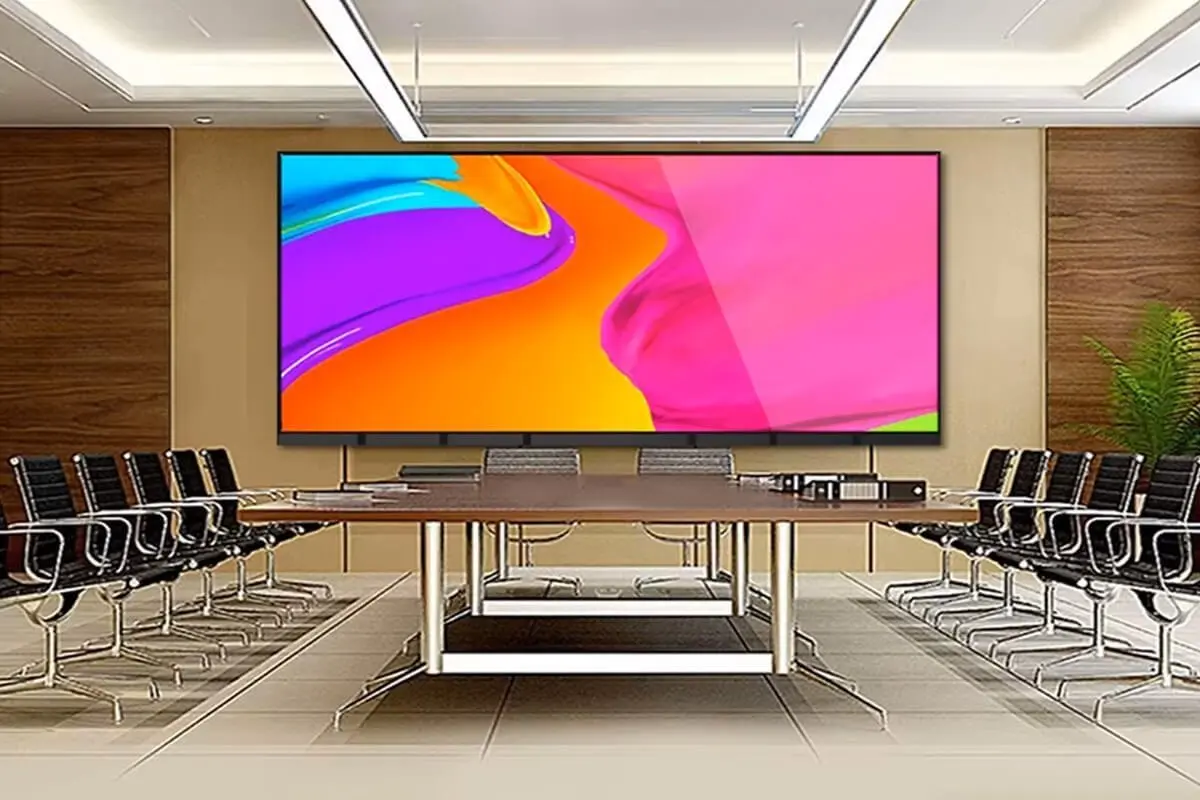
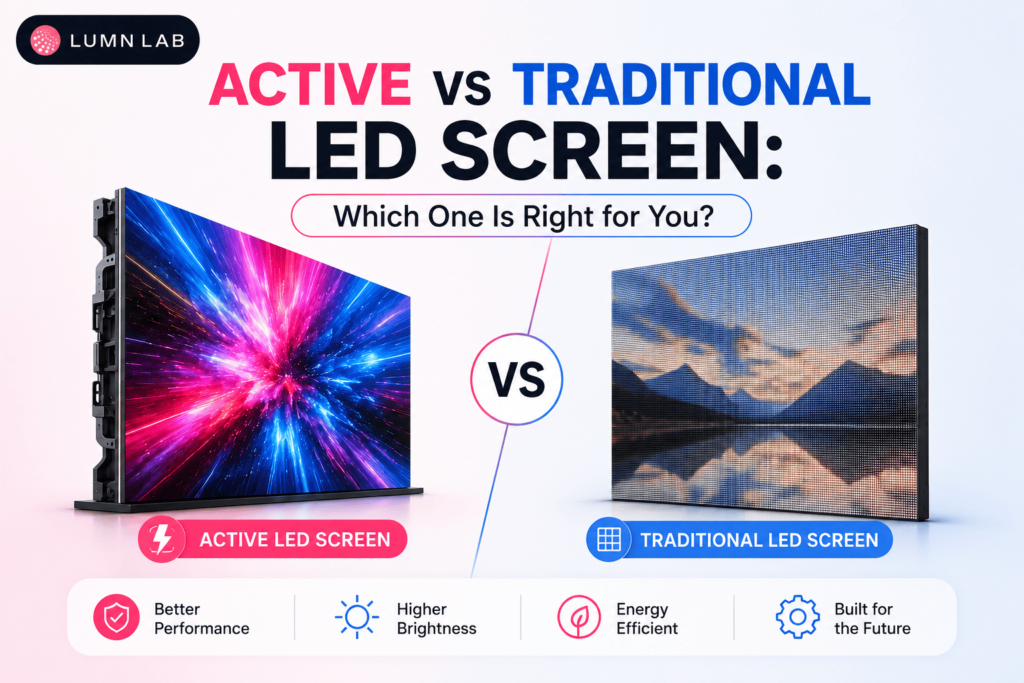

Walk into a retail flagship, a corporate lobby, or an event stage today and you’ll usually see one of two setups: an LED wall with colours that seem to glow off the panel, or a familiar LCD screen or projector that’s been the default for years. That’s really what the active vs traditional LED screen question comes down to — not which one sounds more modern, but which one solves the problem in front of you, whether that’s outdoor sunlight, a meeting-room budget, or a stage that has to survive three days of load-in and load-out.
Here’s the breakdown — no marketing gloss, just what actually changes when you pick one technology over the other.
What Is an Active LED Display?
An active LED display is a screen built from LED modules where every pixel is its own light source, driven directly by an integrated chip. There’s no backlight sitting behind the image and no lamp projecting it from a distance — the diode itself is the pixel. This is also called a direct-view LED display, and it’s the technology behind the video walls you see in stadiums, retail storefronts, and outdoor billboards.
Because each module is self-contained, active LED screens are built by tiling panels together, which means the final size and shape isn’t fixed at the factory — it’s decided by how many modules you install.
What Are Traditional Display Screens?
Traditional displays cover LCD panels, plasma screens, and projectors — technologies that create an image by passing light through a filter (LCD), exciting phosphors inside a sealed panel (plasma), or projecting light onto a separate screen surface (projector). None of these generate light at the pixel level the way an LED wall does, which is the root cause of most of the differences in this guide.
Active vs Traditional LED Screens: Key Differences
Here’s a side-by-side view of how the two technologies compare on the factors that matter most to buyers:
| Factor | Active LED Display | Traditional Display (LCD / Projector) |
| Light source | Self-emissive — every pixel produces its own light | Backlit (LCD) or lamp-projected (projector) |
| Brightness in daylight | Built to stay readable in direct sunlight | Image washes out under strong ambient light |
| Seams and bezels | Seamless when tiled correctly | Visible bezels on multi-panel LCD walls |
| Scalability | Modular — build almost any size or shape | Fixed panel sizes; limited shape options |
| Lifespan | Rated for tens of thousands of hours with proper maintenance | Projector lamps typically need replacement every 1–2 years of regular use |
| Upfront cost | Higher, scales with size and pixel pitch | Generally lower for a single screen or panel |
| Best fit | Large-format, outdoor, high-visibility, video-heavy content | Smaller rooms, close viewing distance, budget-first projects |
Brightness and Visibility: Which One Handles Ambient Light Better?
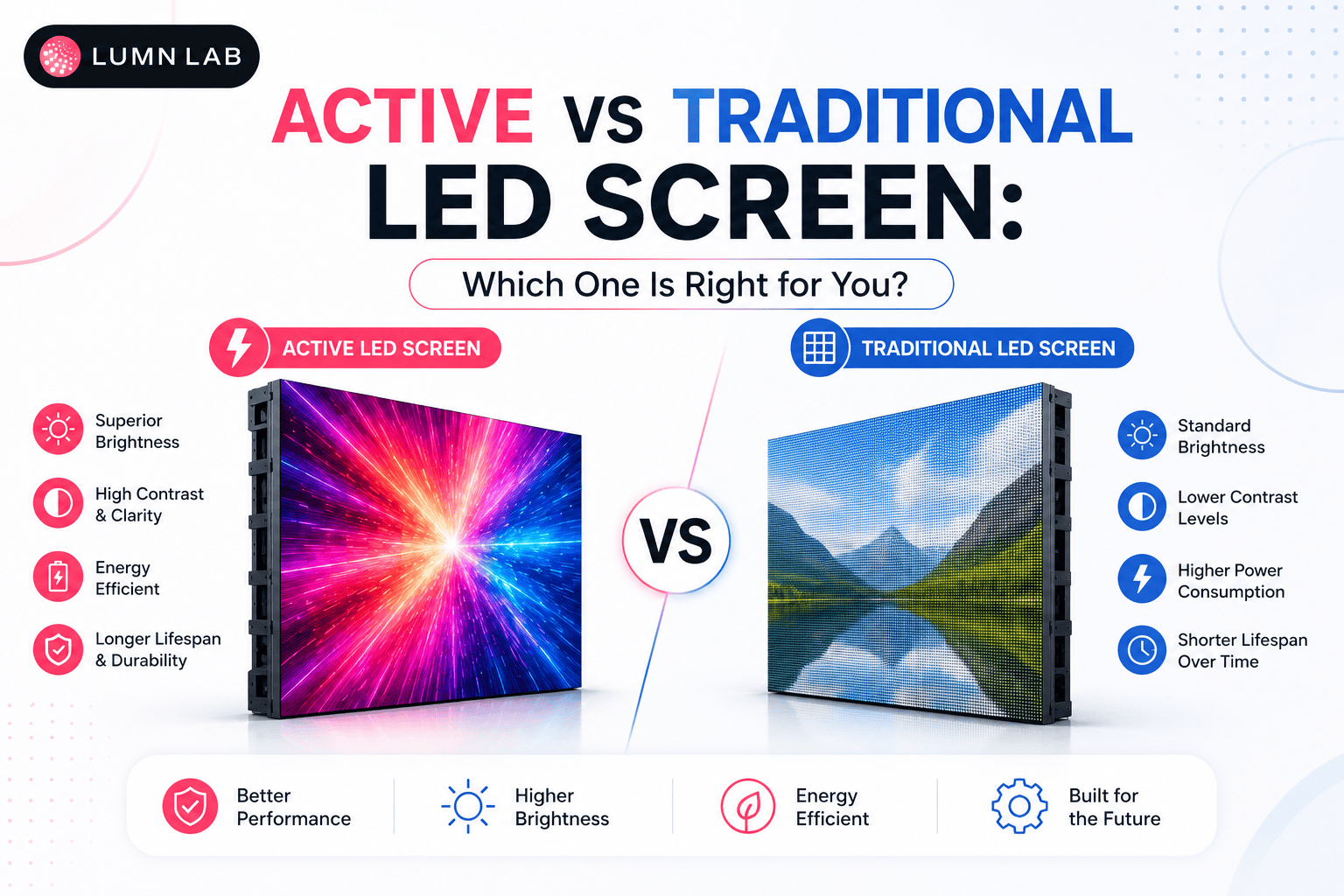
Active LED wins on brightness by a wide margin. Because each pixel emits its own light instead of relying on a backlight or a projector bulb, LED walls are built to stay legible even when sunlight is hitting the screen directly — which is exactly why you see them on storefronts, stadium fascias, and highway billboards rather than LCD panels or projectors.
Traditional displays, by contrast, are engineered for controlled indoor lighting; take an LCD screen or a projector outdoors, or place it opposite a glass storefront, and the image contrast drops fast.
Cost: What You Pay Upfront vs What You Pay Over Time
This is where the decision usually gets real. Active LED costs more upfront — pricing depends heavily on size, pixel pitch, and installation complexity, so we’d rather point you to a proper quote than a number that doesn’t fit your project.
Traditional displays are typically cheaper for a single screen, which is why they still make sense for a meeting room or a small retail counter.
Where the maths often flips is over the display’s working life. LED modules generally don’t need lamp or bulb replacement, so a well-maintained wall can run for years without the recurring service costs projectors and some LCD setups carry.
For a full cost breakdown by size and pixel pitch, see our LED display cost guide.
Durability and Lifespan
LED modules are sealed units with no moving parts, which is why manufacturers commonly rate them for tens of thousands of hours of operation — and why outdoor-rated panels are built to handle heat, humidity, and dust that would damage a projector or LCD panel over time.
Projector lamps dim and eventually fail with regular use, and LCD panels can develop backlight issues after years of continuous operation. If a display runs 10–12 hours a day, every day, that difference in duty cycle adds up.
Where Each Technology Fits Best: Real-World Use Cases
The right choice depends heavily on where the screen will live and who’s meant to see it. A few patterns we see repeatedly across our installations:
• Retail storefronts and flagship stores (Delhi, Mumbai): Active LED for window-facing displays that need to hold up against direct sunlight and grab attention from the street.
• Corporate lobbies and command centres (Gurgaon, Bangalore): Fine pixel pitch LED for a seamless, bezel-free video wall, or a traditional LCD video wall where budget matters more than a perfectly continuous image.
• Events, weddings, and outdoor stages (Noida and the wider Delhi-NCR circuit): Active LED for its brightness, modularity, and ability to be rigged and de-rigged quickly across different stage shapes.
• Classrooms and training rooms: Often a smaller interactive LCD or LED panel is enough, since viewing distance is short and content is mostly static or text-heavy.
• Transportation hubs, airports, and highway signage: Active LED for large-format, always-on visibility under mixed daylight and artificial lighting.
• Government and public information displays: Depends on the site — outdoor and high-footfall locations lean LED; indoor, controlled-lighting counters can work well with LCD.
We cover industry-specific deployments in more depth in our guide to LED displays across retail, corporate, events, hospitality, sports, transportation, government, and education.
Active vs Traditional: Which One Should You Choose?
As a quick rule of thumb:
• Choose active LED if your screen faces sunlight or bright ambient light, needs to scale beyond a standard panel size, or runs long hours daily.
• Choose a traditional display if the room has controlled lighting, viewing distance is short, and budget is upfront-constrained.
Match the display technology to the environment first and the budget second — an LED wall in a dim, close-range meeting room is often overkill, and an LCD panel on a sunlit storefront rarely holds up once it’s next to a competitor’s LED display.
Conclusion
Active vs traditional LED screens isn’t really a question of which technology is “better” — it’s about matching the display to the light, distance, and budget of the space it’s going into. Active LED wins where brightness, scale, and long-term durability matter most; traditional displays still hold their own in smaller, controlled-lighting settings where upfront cost is the priority.
Lumn Lab has been manufacturing and installing LED display solutions across India since 2015, and we help clients make this exact call every week — from retail storefronts in Mumbai to event stages in Noida to corporate lobbies in Gurgaon and Bangalore.
If you’re weighing active LED against a traditional display for your next project, get in touch with our team for a site-specific recommendation and quote.
Frequently Asked Questions
Q. What is the difference between active and traditional LED screens?
Active LED screens are self-emissive — each pixel is an individually driven LED. Traditional displays like LCD panels and projectors rely on a backlight or lamp instead of generating light at the pixel itself.
Q. Which is brighter, active LED or a traditional LCD screen?
Active LED is brighter and holds up far better in direct sunlight or high ambient light. LCD and projectors are built for controlled indoor lighting and lose contrast quickly under strong light.
Q. How long do active LED displays last compared to LCD panels?
Active LED modules are commonly rated for tens of thousands of hours with proper maintenance, while projector lamps typically need replacement every 1–2 years of regular use.
Q. Why are active LED screens more expensive upfront?
The cost reflects the number of LED modules, the pixel pitch, and custom installation. In exchange, buyers get a seamless, scalable display with lower long-term maintenance.
Q. When should I choose a traditional display over an LED wall?
When the room has controlled lighting, viewing distance is short, and the budget is upfront-constrained — for example, a meeting room screen or a small in-store counter display.
Q. What is direct-view LED, and is it the same as active LED?
Yes. Both describe displays where the viewer looks directly at the LED pixels, with no separate screen surface or backlight in between.
Q. Can active LED displays be used outdoors?
Yes — outdoor-rated active LED panels handle sunlight, heat, humidity, and dust, which is why they’re the standard choice for billboards, stadium screens, and storefront displays.
Q. How do I choose the right display for my business?
Start with the environment — ambient light, viewing distance, screen size — then factor in daily runtime and budget. Our team at Lumn Lab does this assessment as part of every project.
Keep Reading