

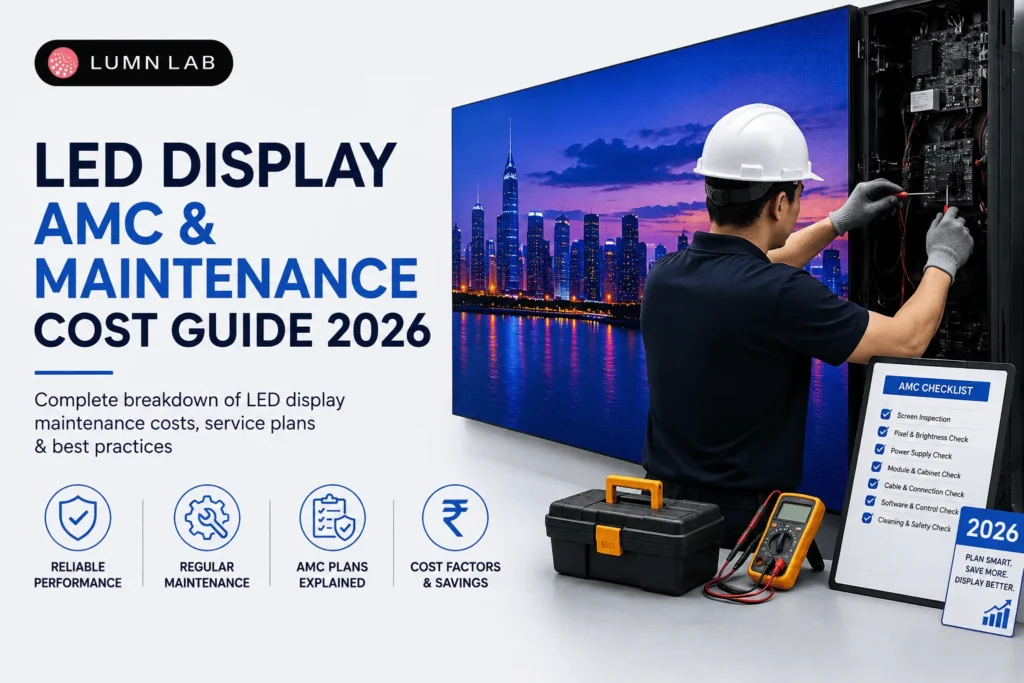

Nobody budgets for LED display maintenance until a wall of dead pixels shows up mid-presentation, or a retail storefront screen starts flickering in front of customers. By then, you’re paying emergency rates instead of planned ones. An LED display AMC cost typically runs 8–15% of the original installation value per year in India — but that number swings hard depending on screen size, location, and whether you signed a comprehensive contract or a bare-bones one. This guide breaks down what you’re actually paying for, what a fair AMC should include, and when repair stops making financial sense.
What Is an LED Display AMC?
An Annual Maintenance Contract (AMC) is a service agreement where a vendor handles preventive checks, cleaning, part replacement, and emergency repairs for your LED display over a fixed period — usually 12 months, renewable. It exists because LED walls aren’t “install and forget” hardware. Dust, humidity, power fluctuations, and constant heat cycling wear down modules and power supplies over time, and catching a failing driver board before it takes down an entire panel row is a lot cheaper than replacing that row after it fails.
LED Display AMC Cost Breakdown for 2026
Pricing depends on three things: screen size (in square feet), indoor vs outdoor installation, and contract tier. Rough India-market ranges, to be verified against current vendor quotes:
| AMC Tier | What It Covers | Approx. Annual Cost (per sq. ft.) |
| Basic | Scheduled cleaning, visual inspection, remote diagnostics | ₹150–₹300 |
| Standard | Basic + module-level repairs, up to 2 free site visits | ₹300–₹550 |
| Comprehensive | Standard + parts replacement, power supply coverage, 24-48 hr response SLA | ₹550–₹900+ |
Outdoor installations in Delhi NCR, Mumbai, and coastal cities generally sit at the higher end — heat, dust, and monsoon exposure mean more frequent servicing. Indoor displays in retail or corporate settings in Gurgaon, Noida, or Bangalore offices tend to land closer to the Basic-to-Standard range.
What’s Included in a Fair Maintenance Contract
Before signing anything, check the contract actually names these:
- Scheduled preventive visits (quarterly, minimum)
- Module and driver board replacement — labor and parts, not just diagnosis
- Power supply and receiving card checks
- Dust and moisture cleaning for outdoor, IP-rated enclosures
- Response time SLA in writing, not “as soon as possible”
- Spare parts availability guarantee — this matters more than people think, since discontinued module batches are the reason AMC repairs drag on for weeks
For a full breakdown of what each IP digit actually certifies, IEC’s ingress protection standard is the definitive reference most vendor claims trace back to.
A vague “maintenance included” line with no specifics is a red flag. Ask the vendor to itemize it.
Essential LED Display Maintenance Tools
Front-serviceable LED walls — the kind you’ll find in most retail stores, lobbies, and control rooms — need one specific piece of equipment: a vacuum suction front maintenance tool. A technician presses it onto the module face, engages the suction, and pulls the panel straight out without touching the structure behind the wall. This is standard practice across the industry — models like the NB-001 LED display front maintenance tool show up in nearly every AMC technician’s kit because pulling modules by hand or prying them with a screwdriver cracks the plastic edges and damages the magnetic mounts.
A complete LED display front maintenance toolkit typically includes:
- Vacuum suction cup tool (for module removal)
- Compressed air blower — for dust between pixel pitches, which is the single biggest cause of dim or dead pixel clusters
- Anti-static brush for driver boards and PCBs
- Digital multimeter for power supply diagnostics
- Spare ribbon cables and jumper wires
- A calibration device, if your contract includes color uniformity checks
If your current vendor shows up with none of this, that’s worth asking about.
Also Read: How to Design a Custom LED Screen Cabinet (2026)
LED Display Maintenance Tips That Actually Work
A handful of habits cut emergency repair calls significantly:
- Clean monthly, not annually. Dust buildup on the module surface and inside the cabinet is the leading cause of overheating and premature LED degradation.
- Keep ambient temperature in check. Indoor displays running in poorly ventilated spaces fail faster — heat is harder on LED chips than almost anything else.
- Run a burn-in test after any repair. A module can look fine at power-on and still fail within 48 hours if it wasn’t tested under load.
- Log every fault. A pattern of repeat failures in the same zone usually points to a wiring or power distribution issue, not a bad batch of modules.
- Don’t skip firmware updates. Outdated receiving card firmware causes sync issues that get misdiagnosed as hardware failure.
Repair vs Replace: Making the Call
Not every fault is worth fixing. As a rule of thumb: if repair costs exceed 40% of what a new module or power supply would cost, or if the screen is past 6–7 years of near-continuous use, replacement is usually the better spend. A single dead module on an otherwise healthy 5-year-old wall is a repair. Recurring failures across multiple zones on an 8-year-old outdoor screen is a sign the whole panel is nearing end of life.
An LED display is a long-term asset only if it’s maintained like one. Since 2015, Lumn Lab has kept 1,000+ installations across Delhi NCR, Gurgaon, Noida, Mumbai, and Bangalore running at full brightness with AMC plans built around each client’s actual usage — not a one-size-fits-all contract.
If your current maintenance plan hasn’t been reviewed in a while, or you’re installing a new display and want AMC pricing upfront, get in touch with Lumn Lab’s team for a straightforward quote.
Frequently Asked Questions
Q1. Can an LED display be repaired?
Yes, in most cases. LED displays are built in modular panels, so a faulty section can usually be repaired or swapped out without replacing the entire screen. Common repairs include module replacement, power supply swaps, and driver board fixes. Full-screen failure — driven by water damage or a major electrical fault — is the exception where repair may not be cost-effective.
Q2. How much does an LED TV display panel cost?
For consumer LED TV panels, cost depends on screen size: a 32-inch panel typically runs ₹3,000–₹6,000, while a 42-inch panel falls in the ₹6,000–₹12,000 range, depending on resolution and brand. These figures are for standard consumer LED TVs, not commercial LED video walls, which are priced per square foot and involve different module technology entirely.
Q3. Is a LED screen repairable?
Yes. Commercial LED video walls are designed for module-level servicing, meaning individual panels can be pulled, repaired, or replaced without dismantling the full display. This is a key advantage over traditional LCD screens, where a single crack usually means replacing the entire panel.
Q4. How do you know when to replace an LED display?
Signs it’s time to replace rather than repair: color inconsistency across multiple zones that persists after calibration, brightness dropping noticeably even at full power, recurring module failures in different sections, and the screen crossing 60,000–100,000 hours of use (roughly 6-8 years of daily operation).
Q5. How to check LED display quality?
Check for uniform brightness and color across the full screen at various viewing angles, look for dead or flickering pixels under close inspection, test the response time with fast-moving content, and confirm the pixel pitch matches what was specified in your contract. If the display looks dim, patchy, or shows visible seams between modules, flag it during your next AMC visit.
Q6. What is the price of a 42-inch LED TV display panel?
A 42-inch LED TV display panel typically costs between ₹6,000 and ₹12,000 in the Indian market, depending on the manufacturer and panel technology. For a full 42-inch commercial display unit rather than a replacement panel, expect a different, higher price point since it includes the frame, driver electronics, and assembly.
Q7. What is the lifespan of an LED display?
A well-maintained commercial LED display typically lasts 60,000 to 100,000 hours — roughly 8 to 10 years of continuous use, or longer with moderate daily hours. This tracks with Samsung’s research on LED display longevity, which notes real-world lifespan depends more on drive current and maintenance discipline than the spec sheet number alone. Actual lifespan depends heavily on maintenance frequency, operating environment, and whether the display is indoor or outdoor.
Q8. How do you identify an LCD vs LED display?
LED displays use light-emitting diodes as the light source and are typically thinner, brighter, and more energy-efficient than LCD screens, which rely on fluorescent backlighting (CCFL). A quick way to tell: LED displays generally have better contrast and deeper blacks, while older LCD panels tend to show more backlight bleed at the edges, especially in dark scenes.
Keep Reading