


A retail brand in Noida found out the hard way. Their storefront LED display started showing a column of dead pixels eight months after installation. The vendor’s response: warranty void, because the panel had been power-washed by the mall’s cleaning crew during a routine facade clean. Nobody had told the cleaning contractor that direct water jets on an LED display are different from wiping down a glass storefront.
That’s the real problem with LED display warranty coverage — most buyers only read the fine print after something breaks. This guide covers what a standard warranty on an LED display or LED video wall in India actually includes, what voids it, how long coverage typically lasts, and what to do if a claim gets rejected.
What’s Covered Under a Standard LED Display Warranty
A standard LED display warranty covers manufacturing defects in the panel, controller, and power components — not damage from misuse or the environment.
In practice, that means:
- LED modules and PCBs — dead pixels, color drift, or module failure not caused by physical impact
- Power supply units — failures under normal voltage conditions
- Receiving cards and sending cards — the components that sync content across panels
- Controllers and processors — defects in the units that drive the display
- Workmanship — issues from the manufacturer’s own assembly or calibration, not the installer’s site work
Certifications matter here. A panel certified by the Bureau of Indian Standards (BIS) has passed electrical safety testing, which is a separate thing from the warranty itself but usually sits alongside it in the documentation a vendor should hand over at delivery.
Typical LED Display Warranty Periods in India
Most LED displays sold in India carry a 1 to 3 year warranty, with premium COB (Chip-on-Board) panels sometimes extending to 5 years. Fine-pitch commercial video walls typically sit at 2 to 3 years, extendable through an AMC.
| Display Type | Typical Warranty | What’s Usually Included |
| Standard indoor SMD panels | 1–3 years | Modules, power supply, receiving cards, workmanship |
| Standard outdoor panels | 1–3 years | Same, plus weatherproof housing — subject to correct IP rating for the site |
| Premium/COB indoor panels | 3–5 years | Modules, power supply, calibration support |
| Fine-pitch commercial video walls | 2–3 years, extendable via AMC | Panel, controller, processor, on-site technician visits |
| Rental LED panels | Governed by the rental agreement, not a standard warranty | Equipment condition at handover; in-use damage billed separately |
A warranty period and an AMC (Annual Maintenance Contract) are not the same thing. The warranty covers defects for free. An AMC is a paid service contract that covers preventive maintenance, cleaning, and repairs — often taken up once the warranty period ends, or run in parallel for faster response times.
If you’re weighing whether to rent equipment for a short event or buy outright, the coverage terms are one of the bigger differences — our rental vs. buying guide breaks down where warranty responsibility sits in each case.
How Warranties Handle Pixel Failure and Screen Burn-In
LED displays don’t suffer burn-in the way OLED screens do, because each diode is an independent light source rather than part of an organic layer that degrades unevenly. The real coverage question is pixel failure — individual LEDs going dark or shifting color.
Most manufacturers set a dead-pixel threshold before a panel qualifies for warranty replacement, commonly in the range of a handful of pixels per 50,000. That threshold isn’t standardized across the industry, so it’s worth getting your vendor’s specific number in writing rather than assuming a figure you saw in a buying guide applies to your panel.
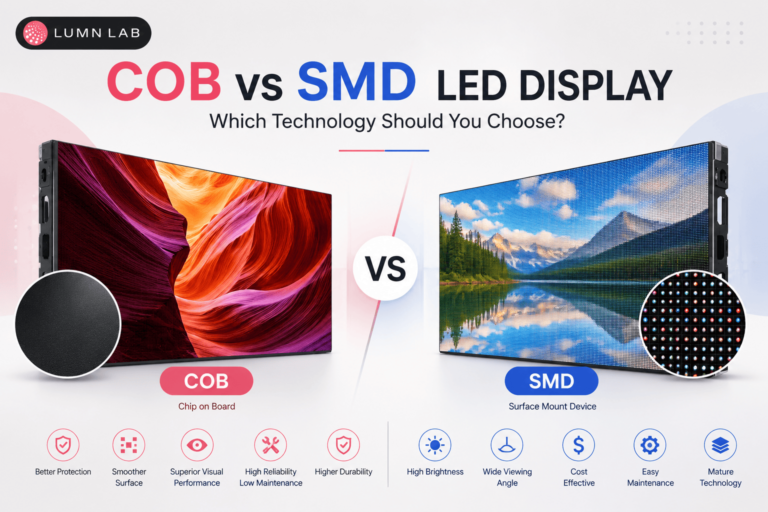
The technology underneath also affects failure patterns. COB and SMD LED technology handle heat and physical stress differently, which is part of why COB panels often carry longer warranties — fewer solder points and a more durable surface mean fewer failure points to begin with.
What Voids an LED Display Warranty
Physical damage, water exposure, and unauthorized repairs are the three most common reasons LED display warranty claims get rejected. Here’s the fuller list:
- Water or moisture damage beyond what the panel’s IP rating covers — an indoor-rated panel exposed to rain, or an outdoor panel exposed to conditions beyond its rated protection level
- Physical damage from impact, drops, or improper handling during installation or moving
- Unauthorized repair or modification — opening the panel or having anyone other than the manufacturer’s authorized technician service it
- Improper installation — incorrect mounting, inadequate structural support, or ignoring the manufacturer’s installation manual
- Power issues — voltage spikes or unstable power without proper surge protection
- Non-genuine replacement parts — using third-party modules, power supplies, or cables not approved by the manufacturer
- Operating outside rated specifications — running the display in temperature or humidity conditions beyond what it’s built for
- Missed maintenance requirements — some manufacturers make basic cleaning and inspection a condition of keeping the warranty active
The water damage exclusion is where most disputes happen, and it’s directly tied to IP rating. Getting the correct IP rating for your installation site — not just the highest number available — is the single biggest thing you can do to avoid a rejected claim later. An outdoor billboard in Mumbai during monsoon season needs a different rating than a semi-covered atrium screen, and installing the wrong one for the environment is exactly what voids coverage. India’s IP classification system follows the IEC standard, which is worth understanding before you sign off on a spec sheet.
Filing a Claim: Authorized Service Centers and Process
To file an LED display warranty claim, contact the original vendor or manufacturer directly with your proof of purchase, installation date, and panel serial numbers — don’t route it through a third-party repair shop first.
A few things that make claims go faster:
- Keep the original invoice and installation completion certificate
- Note the panel serial numbers at the time of installation, not after something fails
- Photograph the issue before touching the panel
- Contact the vendor’s own service team rather than a local repair shop — even a well-meaning third-party technician opening the unit can void the claim
Can you claim a repair after the warranty period ends? No, not under the original warranty — but many vendors offer paid out-of-warranty repair or an AMC that covers exactly this gap. How much does an out-of-warranty panel replacement cost? It varies widely by pixel pitch and panel type, but expect it to run a meaningful percentage of the original per-square-foot price, since modules, shipping, and labor are billed individually rather than bundled into a warranty replacement. Is there a limit on how many times you can claim? Most warranties don’t cap the number of claims, but they do cap the total coverage period — once the term ends, so does eligibility, regardless of how many times you’ve claimed.
If a claim gets wrongly denied and the vendor won’t budge, the Consumer Protection Act, 2019 gives commercial buyers in India a formal route to dispute it through the National Consumer Helpline or district consumer commission — most disputes get resolved before it reaches that point, but it’s worth knowing the option exists.
Expert Recommendations
Before signing off on any LED display purchase, get these in writing:
- Ask for the exact warranty document, not a verbal assurance. A vendor’s sales pitch and the actual warranty card can differ — get the written terms before you pay.
- Confirm the dead-pixel threshold and IP rating in the same document. These two numbers are where most disputes originate later.
- Ask whether the vendor has a local service team or relies on the manufacturer’s support chain based elsewhere — local service means days, not weeks, when something needs attention.
- Separate the warranty conversation from the AMC conversation. Know exactly where one ends and the other begins, especially for fine-pitch or high-use commercial installations.
- Check the vendor’s installation track record, not just the panel spec sheet — a correctly specified panel installed poorly can still void its own warranty. Lumn Lab’s HOCCO Ice Cream installation in Delhi is one example of a P4 pixel pitch retail storefront screen installed to the site’s actual environmental conditions, not a generic spec.
Conclusion
An LED display warranty is only as useful as the paperwork behind it. Know what’s covered, know exactly what voids it — water exposure beyond the IP rating and unauthorized repairs are the two biggest culprits — and keep your proof of purchase and installation records in one place from day one.
Lumn Lab has installed 1,000+ LED displays across Delhi NCR, Gurgaon, Noida, Mumbai, and Bangalore since 2015, with BIS and ISO-certified panels and clear warranty terms explained upfront — not buried in a PDF you get after the sale. If you’re evaluating a new LED display or video wall and want warranty terms that actually hold up, get in touch with Lumn Lab for a free consultation and quote.
Frequently Asked Questions
Q: What is typically covered under a standard LED display warranty?
A standard warranty covers manufacturing defects in the LED modules, power supply, controller, and receiving cards, along with workmanship issues from the manufacturer’s own assembly. It does not cover damage from misuse, the environment, or unauthorized repairs.
Q: What is not covered under an LED display warranty — what voids it?
Physical damage, water exposure beyond the panel’s IP rating, unauthorized repairs, improper installation, non-genuine replacement parts, and operating the display outside its rated environmental specs all void coverage.
Q: What is the typical warranty period for LED displays sold in India?
Most standard LED displays in India carry a 1 to 3 year manufacturer’s warranty. Premium COB panels can extend to 5 years, and coverage can be extended further through a paid AMC.
Q: How long do commercial LED video wall warranties usually last in India?
Fine-pitch commercial video walls typically carry a 2 to 3 year warranty, often paired with an AMC for ongoing calibration and on-site support once the warranty period ends.
Q: How do LED display warranties cover pixel failure or screen burn-in issues?
LED displays don’t experience burn-in like OLED panels do. Pixel failure — individual LEDs going dark or shifting color — is covered up to a dead-pixel threshold set by the manufacturer, usually a small number of pixels per 50,000.
Q: What actions can void an LED screen manufacturer’s warranty?
Opening the panel without authorization, using non-genuine parts, water damage beyond the rated IP level, physical impact damage, and installation that doesn’t follow the manufacturer’s guidelines are the most common causes.
Q: Where can I find authorized service centers for LED display warranty claims?
Your vendor or manufacturer will list authorized service partners in your warranty documentation. Always confirm with the seller directly rather than searching generically — using an unauthorized technician can void the claim you’re trying to file.
Q: Is LCD covered under warranty the same way LED displays are, and can I get my screen replaced or claim after the warranty period ends?
LCD and LED displays follow similar warranty logic — manufacturing defects covered, physical or water damage excluded — but LCD panels typically carry shorter warranties due to backlight degradation. Replacement under warranty is free if the fault is a covered defect; after the warranty period, repair or replacement is available but billed separately.
Keep Reading