


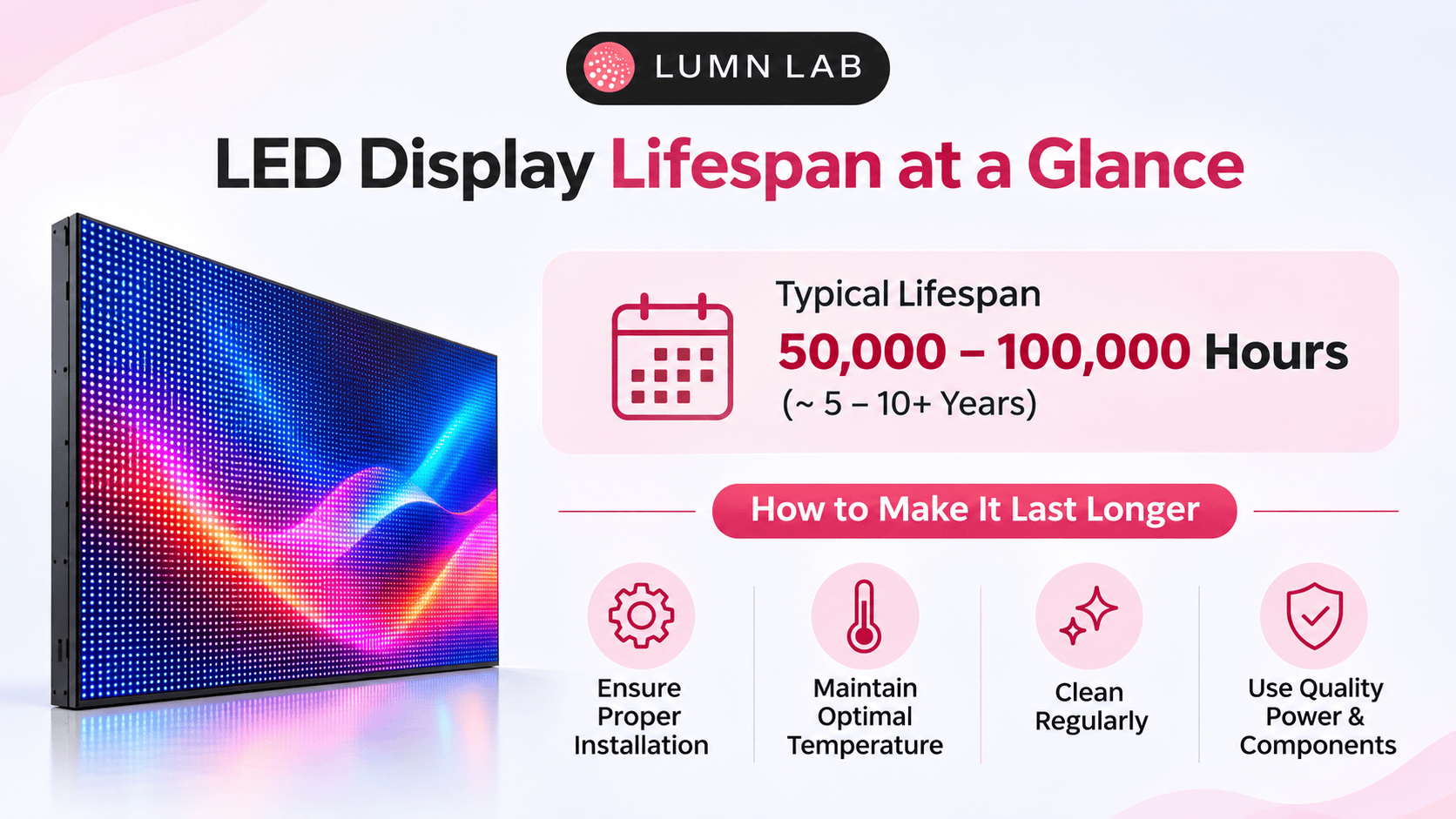
LED display lifespan is usually rated at 50,000 to 100,000 hours. That’s 5 to 11 years if the screen never switches off, and 8 to 15 years in real commercial use. Outdoor screens land lower, around 3 to 8 years, because sun, rain and heat keep working on them.
But that rating isn’t an expiry date. A screen at year six is rarely dead. It’s dimmer, a little patchy, and no longer sells like it used to. If you’re budgeting for a lobby wall in Gurgaon or a storefront screen in Mumbai, the real question is how many good years you get. Here’s what the numbers mean, what cuts them short, and how to stretch them.
What Is the Average Lifespan of an LED Display?
The average LED display is rated for 50,000 to 100,000 hours. How many years that gives you depends on how long it runs each day.
| Daily running time | At 50,000 hours | At 100,000 hours |
| 24 hours | 5.7 years | 11.4 years |
| 16 hours | 8.6 years | 17.1 years |
| 12 hours | 11.4 years | 22.8 years |
Real installations rarely reach the top of that range. Power supplies, heat and dust get there first, which is why 8 to 15 years is the realistic band for a well-kept commercial screen.
LED display lifespan by screen type
| Screen type | Typical lifespan | Why |
| Indoor LED | 6–10 years | Stable temperature, no weather |
| Outdoor LED | 3–8 years | High brightness, sun, rain, heat |
| Transparent and flexible | 5–7 years | Lighter, more delicate construction |
| COB / GOB video walls | 8–10 years | Protective surface resists knocks and moisture |
| LCD (for comparison) | 30,000–60,000 hours (3–5 years) | Backlight wears out sooner |
These are indicative ranges and vary by build quality. For a manufacturer’s take on rated hours, see how LED lifespan ratings are measured.
Choosing between types? Our indoor LED display range and outdoor panels suit different conditions, and that choice is your first lifespan decision.
What Does LED “Lifespan” Actually Mean?
LED lifespan is the time it takes for brightness to fall to 70% (L70) or 50% (L50) of its original level. It is not the time until the screen goes black.
Chip makers reach these figures through standardised testing (IES LM-80 and TM-21) and then extrapolate. Nobody has run a screen for 100,000 hours in a lab, so treat the number as a projection.
Why LED component life is not the same as complete display life
The diode is usually the last thing to give up. Everything around it tends to fail sooner:
• Power supplies: capacitors dry out with heat and are the most common first failure
• Receiving and control cards: sensitive to voltage spikes and moisture
• Fans, cables and connectors: wear out, loosen or corrode
• Cabinet seals and module masks: let in dust and water once they age
A 100,000-hour chip inside a 40,000-hour power supply is a 40,000-hour screen, until someone replaces the supply. That’s why serviceability matters as much as the headline rating.
How LED Displays Age
Brightness fades slowly
Every diode loses a little output each year. You won’t notice month to month, but beside a new module the difference shows.
Colours drift apart
Red, green and blue diodes age at different rates, so a white background slowly picks up a tint. Fine-pitch lobby screens show this first, because people stand close enough to see it.
Dead pixels and module failures
A few dead pixels over the years are normal. A whole module going dark usually points to a power or data fault, not the chips.
What Causes LED Display Failure?
Heat is the biggest cause of early LED failure, followed by brightness set too high, moisture and dust, bad power, and poor installation.
Heat
Heat degrades chips and kills power-supply capacitors. Delhi NCR summers cross 45°C, and a cabinet boxed into a wall with no airflow runs far hotter than the air outside.
Brightness set too high
Running at 100% brightness raises heat and electrical stress. At 60–70%, diodes last noticeably longer. An indoor reception screen set to outdoor-level brightness is a common mistake, and bright white content makes it worse.
Moisture, dust and weather
Coastal humidity in Mumbai, monsoon rain in Bangalore and fine dust around Noida and Gurgaon construction belts all find their way into poorly sealed cabinets. Check the datasheet’s IP rating system values for both the front and rear of the cabinet, since they’re often different.
Power problems
Voltage spikes and weak earthing shorten the life of power supplies and control cards. Surge protection is cheap compared to replacing a card.
Poor installation and ventilation
No service gap behind the screen means no airflow and no easy repairs. Many failures trace back to the install.
How to Extend LED Display Life
To extend LED display life, run brightness at 60–70%, keep the cabinet cool and dry, protect it from power surges, and service it on a schedule.
1. Set brightness for the room. Use an automatic brightness sensor so the screen dims at night and in shaded spaces.
2. Leave breathing room. Keep the ventilation gap the installer specified.
3. Add surge protection and proper earthing. Recheck after any electrical work.
4. Clean on a schedule. Quarterly is fine for most indoor sites; clean more often near construction or traffic.
5. Inspect power supplies and cables yearly. Catch ageing parts early.
6. Keep a few spare modules from the same batch. New batches can differ slightly in colour.
7. Schedule overnight shutdowns for offices and showrooms.
8. Put maintenance on contract. See our guide to LED display AMC and maintenance costs.
Sizing a screen from scratch? Our calculators help you match size, pixel pitch and viewing distance before you buy.
Expert Recommendations: Before You Buy
Most lifespan problems are decided at purchase. Ask these before you sign:
• What’s the rated life, and at what brightness?
• Which L-standard is used? L70 and L50 are not the same number.
• Which brands are the power supply and receiving cards? Can they be swapped easily?
• What does the warranty exclude? Heat, dust and voltage fluctuation are common exclusions.
• Who services the screen in your city? Gurgaon, Noida, Mumbai and Bangalore need local engineers.
• Can you visit a similar installation? Ours includes the HOCCO Ice Cream storefront in Delhi, a P4 display in a 10×10 ft retail setup.
• Does the spec suit the site? AVIXA publishes display performance guidance that helps set brightness expectations.
Buy for the Lifespan You Need, Then Protect It
LED display lifespan is a range, not a promise. The rating describes the chips. How long your screen looks good depends on heat, brightness, power, installation and who services it. Expect 8–15 years indoors and 3–8 outdoors, and run brightness at 60–70% wherever you can.
Lumn Lab has been building and installing LED displays across India since 2015, with 1000+ installations for retail, corporate, hospitality and event clients across Delhi NCR, Mumbai and Bangalore. Share your site details and daily running hours, and we’ll tell you what lifespan to realistically expect and how to protect it.
Planning a screen for a hot, dusty or humid site? Lumn Lab has delivered 1000+ installations since 2015, so we’ve seen how these conditions play out. Talk to our team for a site-specific recommendation.
Frequently Asked Questions
Q1. How long do LED displays last?
Most LED displays last 50,000 to 100,000 hours, which is 5 to 11 years of non-stop use. In real commercial use, a well-maintained screen serves 8 to 15 years.
Q2. What is the average lifespan of an LED display used in outdoor advertising?
Outdoor LED screens typically last 3 to 8 years. Direct sun, rain, dust and high brightness settings shorten that. Well-sealed cabinets, sensible brightness and regular servicing push a screen toward the upper end.
Q3. What factors influence LED display longevity?
Heat, brightness settings, moisture and dust, power quality, installation and ventilation, and component quality. Heat and excessive brightness do the most damage.
Q4. How many years do LEDs last?
LED chips are rated for 50,000 to 100,000 hours, about 5 to 11 years if run 24/7. At 12 hours a day, the same rating works out to roughly 11 to 22 years on paper. Power supplies usually wear out first.
Q5. Does a 100,000-hour rating mean the LED screen stops working?
No. It means brightness has dropped to 70% (L70) or 50% (L50) of its original level. The screen keeps working, only dimmer. Owners usually replace it when brightness or colour consistency becomes a problem.
Q6. Which brand LED is best in India?
No single brand is best for every site. Compare chip and power supply quality, warranty terms, service support in your city, and installations you can visit. Lumn Lab, based in Gurgaon, has delivered 1000+ LED display installations across India since 2015.
Q7. Where can I buy durable LED display panels for retail stores?
Buy from a manufacturer or integrator that handles supply, installation and servicing together. For retail, check pixel pitch for viewing distance, brightness for window glare, and local after-sales support. Lumn Lab operates across Delhi NCR, Mumbai and Bangalore.
Keep Reading