


The best LED display for a retail store is usually an indoor panel at P2.5 to P3 pixel pitch for the shop floor, and a high-brightness P3 to P4 panel for anything facing the street. Pitch and brightness matter more than screen size. Get either wrong and the screen looks washed out or blocky.
A well-chosen LED display for retail store environments pulls people in from the pavement, lets you change offers in minutes, and keeps campaigns consistent across outlets. Lumn Lab has been installing LED displays across India since 2015, with 1000+ installations delivered, including retail storefronts in Delhi NCR. Here is how we think about types, benefits and selection on real retail projects.
What Are the Key Benefits of LED Screens in a Retail Store?
LED screens give a store a bright, changeable sales channel. They attract walk-in traffic, stay readable in daylight, update in minutes, and tile into any size without bezels.
• They stop people at the door. A bright, moving screen beats static signs on the street. Our HOCCO Ice Cream project in Delhi used a 10×10 ft seamless P4 storefront display, specified after an on-site lighting and viewing-distance assessment.
• Offers change without a printer. Sale on Monday, clearance on Friday. Content updates from a laptop, with no flex reprint.
• Daylight stops being a problem. LED panels run far brighter than an indoor TV. Our LED display brightness guide shows how many nits each placement needs.
• No bezels, any shape. Cabinets tile into any size or ratio, without LCD bezel lines.
• One campaign, every outlet. Networked playback pushes one creative to stores in Delhi NCR, Mumbai and Bangalore.
The honest limit: LED costs more than an LCD of similar size, and in a very small shop where shoppers stand within about 1.5 metres, an LCD can be the better buy.
Types of LED Display for Retail Store Environments
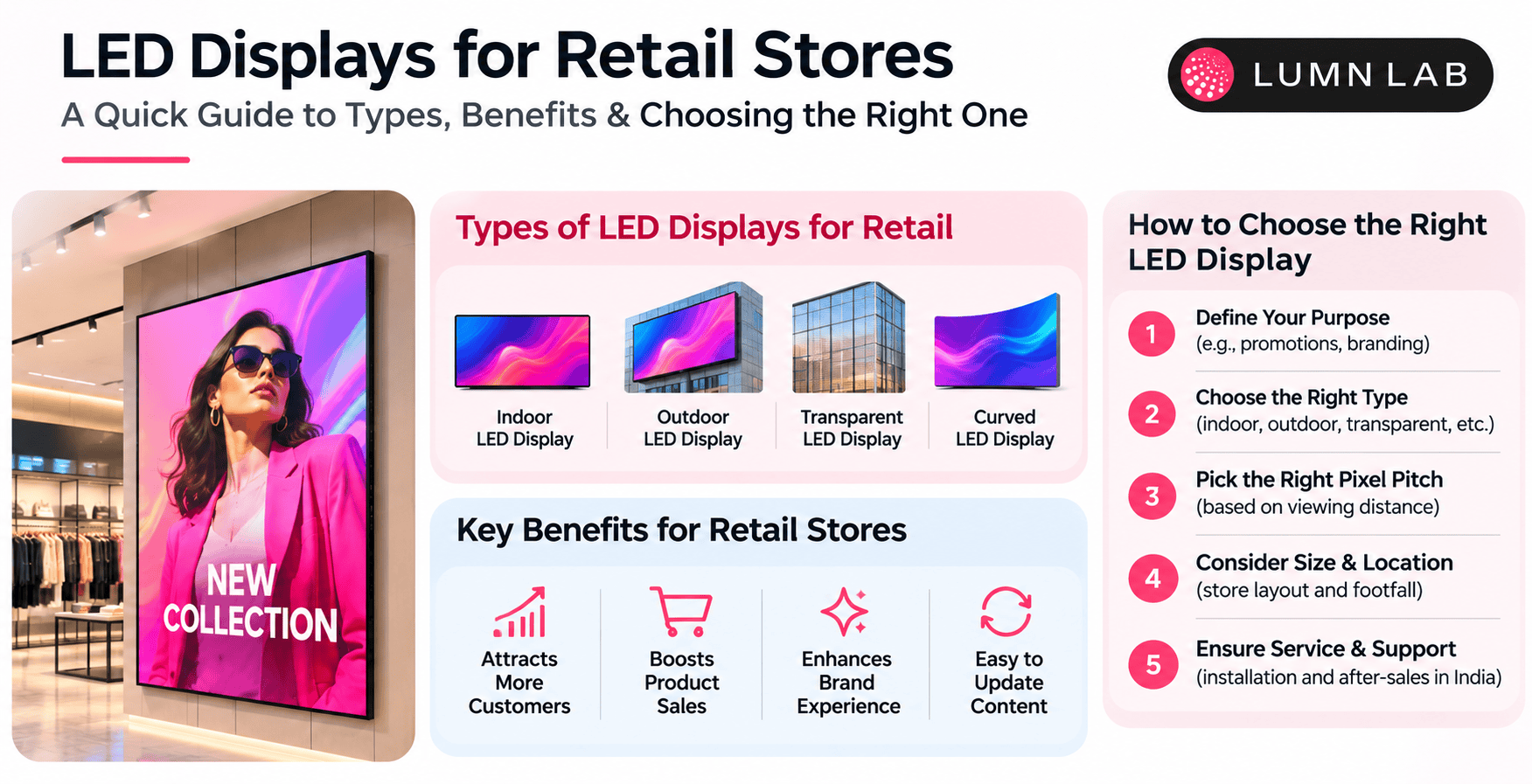
Retail LED displays fall into five types: indoor fixed walls, storefront window displays, transparent LED, outdoor facade screens, and rental or pop-up walls. They differ mainly in pixel pitch and brightness.
| Type | Typical pixel pitch | Best placement | Typical brightness |
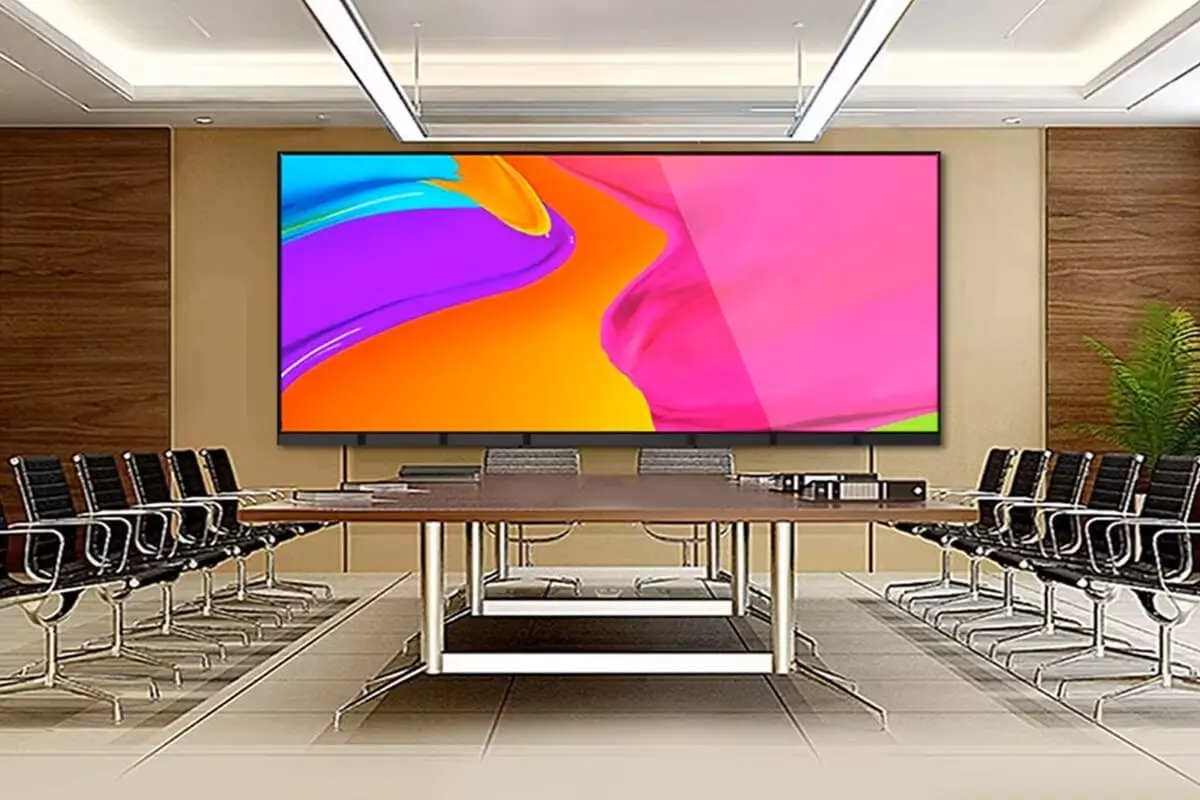
| Indoor fixed wall | P1.5–P3 | Brand zones, billing backdrop, atrium | 600–1,200 nits |
| Storefront / window | P3–P4 | Street-facing glass, mall frontage | 2,500–5,000+ nits |
| Transparent LED | P3.9–P7.8 | Glass facades, showroom windows | Model-dependent |
| Outdoor facade | P4–P10 | Standalone showrooms, high-street frontage | 5,000+ nits |
| Rental / pop-up | P2.6–P3.9 | Launches, mall activations, festive stalls | 800–1,200 nits indoors |
Ranges are typical market values and vary by model.
Most shop floors use indoor LED displays; street-facing shops in Gurgaon, Noida and Delhi need the brighter storefront version. Glass facades suit transparent LED, though dark areas in your content turn see-through. Exposed showrooms need outdoor LED displays, and pop-ups suit rental LED.
LED Video Wall Display for Retail: Why and Where It Works
An LED video wall display for retail is a large screen made by tiling LED cabinets into one seamless display, used as the focal point of a store. The spots that pay off most:
• Entrance wall: the first thing shoppers see.
• Launch or brand zone: product films at full size.
• Mall atrium or escalator-facing wall: for stores opening onto a common area.
A common mistake is stretching 16:9 video onto a wall with a different ratio. Plan content for your wall’s exact pixel dimensions before ordering.
Best LED Display Options for Retail Stores in India
The best option depends on where the screen sits and how far shoppers stand from it. Match the display to the store format:
• Behind the billing counter: shoppers wait there.
• High-street shop in Delhi NCR, Mumbai or Bangalore: high-brightness P3 to P4 storefront panel.
• Mall-based store: indoor P2.5 to P3 behind the glass line, since mall lighting is controlled.
• Flagship or experience store: fine pitch P1.5 to P2 for walls people walk up to.
• Glass-fronted showroom: transparent LED.
Indian conditions matter: Delhi NCR summers, Mumbai humidity and dust stress cabinets and power supplies. Ask any vendor about cooling, surge protection and front-service access, so one failed module does not mean dismantling the wall.
We are based in Gurugram and handle retail projects in Delhi, Noida, Mumbai and Bangalore.
How to Choose an LED Display for Retail Store Use: Pixel Pitch, Brightness and Size
Pick pixel pitch from viewing distance, brightness from ambient light, and size from the wall you actually have.
How do you choose the right pixel pitch?
The minimum comfortable viewing distance in metres roughly equals the pixel pitch in millimetres, so P3 works from about 3 metres. Shoppers on the pavement at 5 to 10 metres are fine with P4. Our pixel pitch guide and the Lumn Lab LED configurator let you test your numbers; the AVIXA display standards resources offer an independent cross-check.
How bright should a retail LED display be?
Indoor shop floors typically run at 600 to 1,200 nits. Window or semi-outdoor panels need roughly 2,500 to 5,000 nits or more, depending on how much sun hits the glass. Brighter is not better indoors; an over-bright screen is uncomfortable to watch.
What should the panel, warranty and IP rating look like?
Screens near ground level get bumped, and COB panels tend to handle that better than standard SMD. Ask for the display’s IP rating, front and rear; IEC’s IP rating guide explains what the digits mean. Get the warranty in writing. Lumn Lab lists a two-year warranty, and our LED display warranty guide covers what is included and what voids it.
Top Companies Offering LED Display Solutions for Retail: How to Shortlist
The right retail LED partner controls its own manufacturing, surveys your site before quoting, and can show retail installations you can visit. Run these checks on every vendor:
• Manufacturer or reseller? Direct makers control quality and spares.
• Site survey before quote: no pitch or brightness advice is reliable without one.
• Documents: ask for BIS and ISO certificates, not just logos.
• References and service: a storefront you can walk past, and a team that can reach your city.
• Written warranty: with exclusions listed.
Lumn Lab is a Gurugram-based LED display manufacturer and installer. Since 2015 we have delivered 1000+ installations, and brands on our client list include Lenskart, Pepperfry and Timex. Our displays are BIS and ISO certified, and our retail LED display solutions page shows how we specify store screens. Hold every vendor, us included, to this checklist.
Expert Recommendations
• Photograph your frontage at noon and at 5 pm. Glare changes and decides the brightness class.
• Stand where shoppers stand. Measure that distance, not the shop depth.
• Build content first. Make a 15-second loop at the wall’s resolution before locking the size.
• Order spare modules from the same batch. Colour matching across batches is never perfect.
Before You Order a Single Panel
Choosing the right LED display for retail store use comes down to three numbers: how far shoppers stand, how much light hits the screen, and how big the wall can be. Get those from a site visit, then check every vendor against the shortlist above.
Lumn Lab has done this since 2015, across 1000+ installations in Delhi NCR, Mumbai, Bangalore and beyond. Share your store photos and dimensions, and our team will recommend a pitch, brightness and size, with a free quote.
| Not sure which type fits your frontage? Send a photo of your frontage and the viewing distance. Talk to Lumn Lab’s team for a recommendation and a free quote. |
Frequently Asked Questions
What is the best LED display for a retail store?
For most stores, a P2.5 to P3 indoor LED panel suits the shop floor, and a high-brightness P3 to P4 panel suits a street-facing window.
What are the benefits of LED screens in a retail store?
LED screens attract foot traffic, stay readable in daylight, update offers in minutes and tile into any size without bezels.
Which pixel pitch is best for a retail LED display?
Use viewing distance as the guide: the minimum distance in metres is roughly the pitch in millimetres. Street-facing screens are usually P3 to P4, and close-viewing walls inside a store use P1.5 to P2.5.
How much does an LED display for a retail store cost in India?
Price depends on screen area, pixel pitch, brightness class and installation complexity. Finer pitch and larger area cost more. The LED configurator gives a starting range; a site survey gives a firm quote.
Can an LED display work in a shop window in direct sunlight?
Yes, with a high-brightness window or semi-outdoor panel, typically 2,500 nits or more. A standard indoor panel looks washed out behind sunlit glass.
When should a store choose LED over LCD?
Choose LED when the screen must be larger than a commercial TV, bright enough for a window, or seamless without bezels. For a small screen viewed from under about 1.5 metres, LCD is often cheaper.
Which companies offer LED display solutions for retail in India?
Several Indian manufacturers and integrators serve retail. Shortlist on in-house manufacturing, a pre-quote site survey, retail references, BIS and ISO documents, and a written warranty. Lumn Lab, based in Gurugram since 2015 with 1000+ installations, is one option.
Keep Reading