


A retail brand in Gurgaon installed an LED display outside its flagship store last summer. Indoors, on the sales floor, it looked sharp. Outdoors, by 1 PM, the screen washed out completely under direct sun — customers couldn’t read a word from the pavement. The panel wasn’t broken. It was rated for the wrong led display brightness.
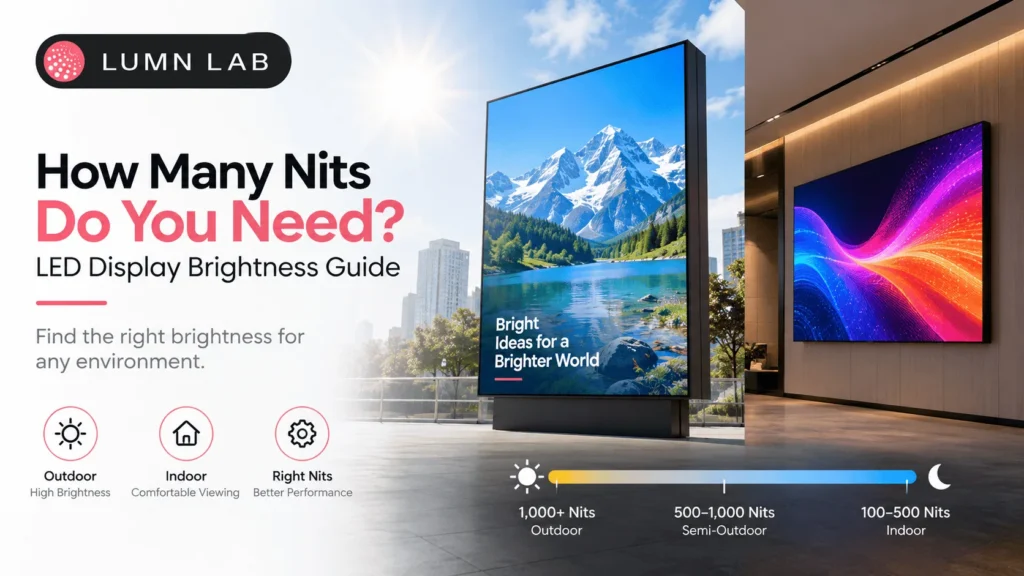
This happens more than it should. Buyers see “high brightness LED display” on a spec sheet and assume it’ll work anywhere. It won’t. LED display brightness is measured in nits, and the number you need changes completely depending on where the screen sits — an office lobby, a semi-shaded entrance, or direct Indian sunlight on a Gurgaon or Noida street. Get the nits wrong and you’ve either overpaid for brightness nobody needs, or bought a screen that disappears the moment the sun comes out.
Here’s how much brightness different environments actually need, how to calibrate outdoor LED display brightness for Indian conditions, and why some screens dim faster than others.
What a Nit Actually Measures (and Why Marketing Numbers Mislead)
A nit equals one candela per square metre — a unit of light output. The higher the nit count, the brighter the display appears in ambient light.
Here’s where buyers get misled: manufacturers often quote peak brightness — the maximum output a panel can hit for a few minutes before heat forces it to throttle down. What matters for a screen running eight or twelve hours a day is sustained brightness — what it delivers hour after hour without overheating. Independent AV standards bodies back this up: AVIXA’s brightness guidelines for commercial displays recommend evaluating sustained output under real ambient light, not a manufacturer’s peak-brightness claim.
A display advertised at “5,000 nits” that can only hold 3,000 nits in real operating conditions isn’t a 5,000-nit display for your purposes. Always ask for sustained, rated brightness — not the marketing peak.
How Much Brightness Does an Indoor LED Display Need?
Indoor LED display brightness depends entirely on ambient light. A dim back-office screen and a sunlit mall entrance need completely different specs — the same logic that separates indoor and outdoor LED display choices in the first place.
| Environment | Recommended Brightness | Typical Use |
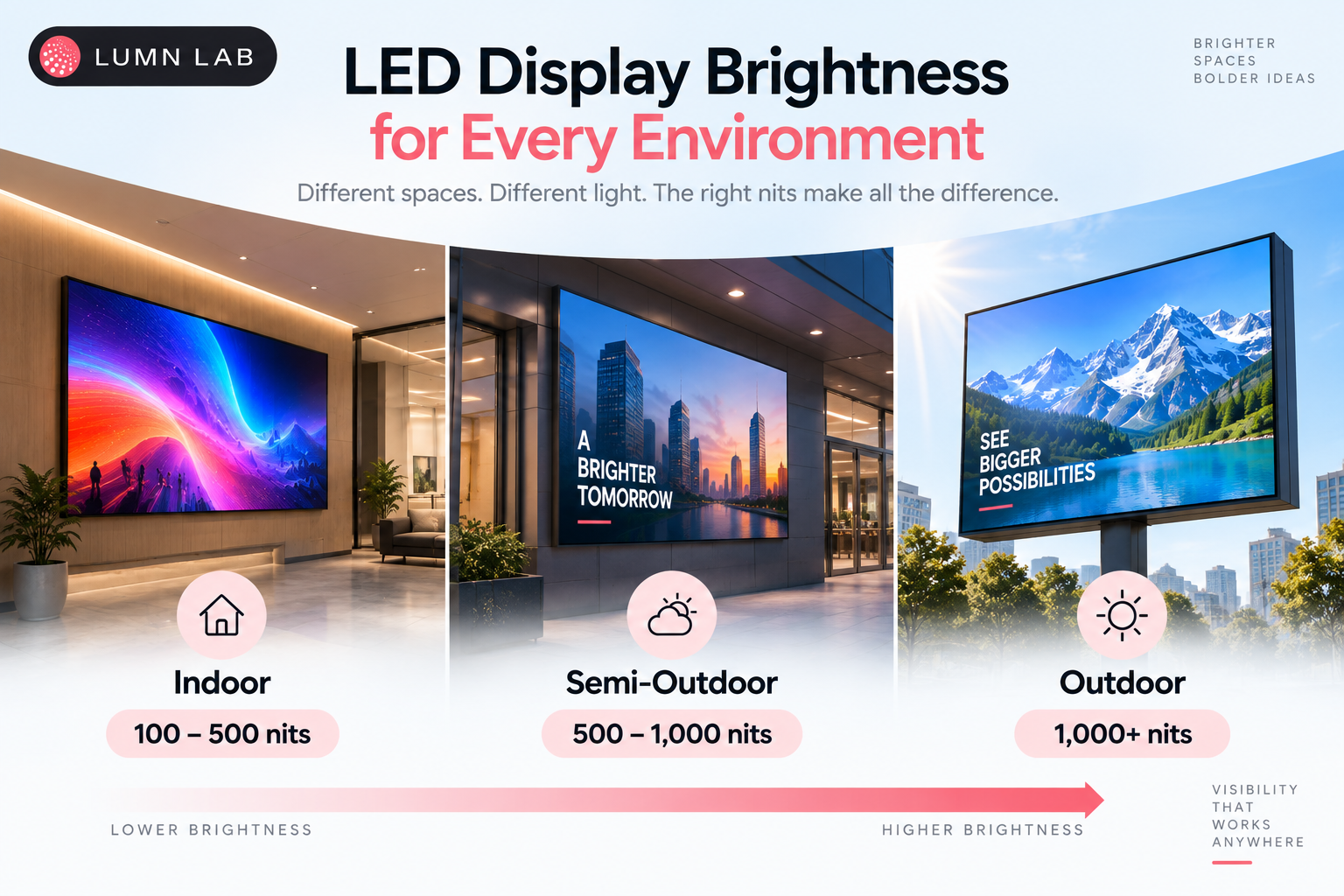
| Low-light indoor | 300–500 nits | Meeting rooms, museums, control rooms |
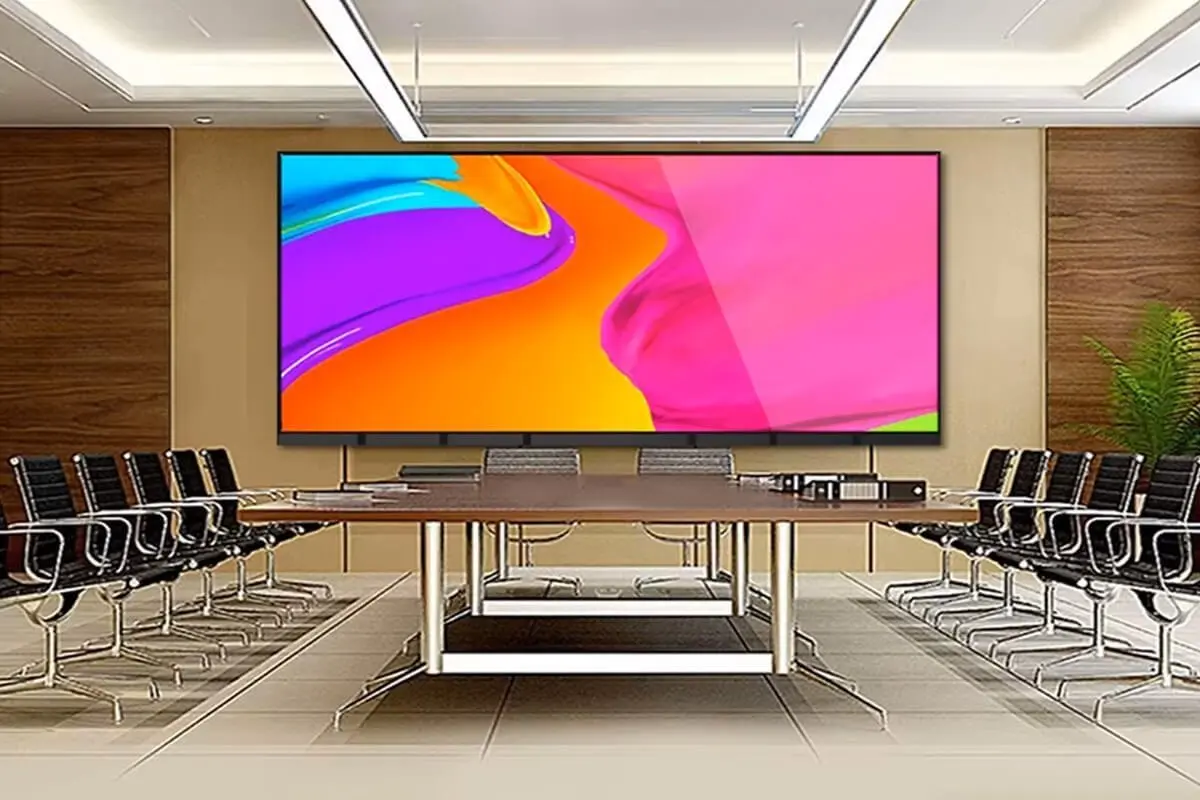
| Standard indoor commercial | 500–800 nits | Corporate lobbies, reception walls, boardrooms |
| Bright indoor / window-facing | 800–1,200 nits | Retail storefronts, mall kiosks, showroom windows |
For indoor advertising, most retail and hospitality installs land between 600 and 1,000 nits — bright enough to hold attention under ceiling lighting, without looking harsh up close. Boardrooms and fine-pitch corporate walls in Bangalore and Delhi NCR offices typically run lower, around 400–600 nits, since viewers sit a few feet away.
If your shop has a glass storefront facing the street, treat it like a semi-outdoor install and size up — daylight through glass behaves closer to outdoor ambient light than indoor lighting.
Outdoor LED Display Brightness: Standard Range for Indian Sunlight
Standard brightness for outdoor LED billboards in India runs 4,000 to 6,000+ nits for full direct-sun visibility. Anything under 4,000 nits struggles to stay legible in Indian summer sun, especially between 11 AM and 3 PM. As AVIXA’s analysis of outdoor display brightness claims points out, many “outdoor-rated” screens on the market are only built for 1,500–2,000 nits — nowhere near enough for direct sun, whatever the marketing implies.
City conditions shift the math slightly:
- Delhi NCR and Gurgaon: Dust and seasonal haze cut ambient contrast, so displays on high-traffic arterial roads often run brighter to compensate.
- Noida: Glass-facade office corridors reflect sunlight onto nearby screens, raising the ambient light a display competes against.
- Mumbai: Humidity and monsoon glare call for displays that hold brightness consistently across changing weather, not just clear days.
- Bangalore: More diffuse cloud cover for parts of the year means outdoor screens can sometimes run at the lower end of the range without losing legibility.
For a shaded or under-canopy install — covered parking, a metro concourse, a display under a deep awning — 2,000 to 4,000 nits is usually enough. Reserve 4,000–6,000+ nits for unobstructed sunlight: highway billboards, building facades, stadiums and large outdoor venue displays.
Automatic Brightness Control: How It Works
Automatic brightness adjustment uses an ambient light sensor (ALS) mounted on or near the panel to read real-time light levels and adjust output accordingly — dimming indoors at night, brightening as the sun moves overhead.
This matters for two reasons:
- Comfort and courtesy: An outdoor-rated display running full brightness after dark isn’t just wasteful — in dense urban areas it can annoy nearby residents or drivers.
- Panel lifespan: Running LEDs at maximum brightness around the clock accelerates lumen depreciation. Automatic dimming during low-ambient hours meaningfully extends panel life.
Most established LED manufacturers, including Lumn Lab, build ALS-based automatic brightness control into outdoor and semi-outdoor panels as standard, not an add-on. When comparing suppliers, ask whether brightness control is sensor-driven and continuous, or a manual day/night toggle set once by the installer — the two behave very differently in practice.
How to Calibrate LED Display Brightness for Outdoor Use
- Measure ambient light at the actual site, not a showroom — a lux reading at the real location, at the brightest time of day, gives the true baseline.
- Set brightness 20–30% above the minimum legible threshold, leaving headroom for brighter days instead of running at the edge.
- Recalibrate seasonally. Indian summer sun and winter haze produce very different ambient light — a display calibrated in December can under-perform by May.
- Check uniformity, not just peak output. A panel can hit its rated nits at the centre and still look patchy at the edges without proper panel-by-panel calibration.
- Review calibration at 12–18 months. Brightness declines naturally with use, so a screen perfectly calibrated at installation may need a bump a year or two in. This pairs with viewing-distance planning — worth checking against Lumn Lab’s pixel pitch calculator if you’re speccing a new install.
Why LED Displays Dim Over Time
LED display brightness drops gradually through lumen depreciation — LEDs produce less light per unit of drive current as they age. A few factors speed it up:
- Overdriving the panel to hit a higher advertised brightness shortens LED lifespan.
- Poor thermal management. Heat is the biggest enemy of LED longevity; panels with weak heat dissipation dim faster, especially outdoors.
- Dust and grime buildup, common on unshaded outdoor screens in Delhi NCR and Gurgaon, physically blocks light output — a cleaning issue, not a component failure.
- Inconsistent driver ICs across a panel cause uneven dimming, where some sections darken faster than others.
If a display flickers between dim and bright rather than dimming evenly, that’s usually a different problem — a failing driver IC, a loose connection, or a power supply fault — not standard lumen depreciation. That calls for a repair, not a brightness adjustment.
Conclusion
LED display brightness isn’t a single number to chase — it’s a spec that has to match where the screen actually lives. An indoor lobby needs a fraction of the nits an outdoor billboard on a Gurgaon highway needs, and a screen calibrated for December haze can fall short by peak summer. Get the environment right first, then size the nits to it — not the other way around.
Lumn Lab has been designing and installing LED displays across indoor, outdoor, and rental categories since 2015, with 1,000+ installations across Delhi NCR, Noida, Gurgaon, Mumbai, and Bangalore.
If you’re planning a display and aren’t sure what brightness your space actually needs, get in touch with Lumn Lab’s team for a site-specific brightness and pixel pitch recommendation before you order.
Frequently Asked Questions
Q. What is a good display brightness for different LED screens?
It depends on the environment. Low-light indoor spaces need 300–500 nits, standard indoor commercial spaces need 500–800 nits, and bright window-facing indoor spaces need 800–1,200 nits. Full outdoor sunlight needs 4,000–6,000+ nits.
Q. Is 1,000 nits brightness good?
For indoor use, yes — 1,000 nits comfortably handles bright indoor spaces like sunlit showrooms or mall entrances. For direct outdoor sunlight, 1,000 nits is far too low; the display will wash out by mid-morning.
Q. Is 1,000 nits twice as bright as 500 nits?
Numerically, yes — nits is a linear scale of light output, so 1,000 nits produces twice the light output of 500 nits. Human eyes perceive brightness non-linearly, so the difference feels noticeable but not always exactly “double.”
Q. What are standard brightness levels for outdoor LED billboards?
Outdoor LED billboards in India typically run 4,000 to 6,000+ nits for direct-sunlight legibility. Shaded or under-canopy screens can perform well at 2,000–4,000 nits.
Q. How do I adjust LED display brightness for outdoor use in India?
Measure ambient light at the install site, set brightness with headroom above the minimum legible threshold, and recalibrate seasonally — Indian summer sun and winter haze create very different baselines.
Q. What causes an LED display to dim over time?
Natural lumen depreciation as LEDs age, sped up by overdriving the panel, poor heat dissipation, and dust buildup on unshaded outdoor screens. Uneven flickering, rather than gradual dimming, usually points to a driver IC or connection fault instead.
Q. Which companies offer LED displays with automatic brightness adjustment?
Most established LED manufacturers, including Lumn Lab, build ambient-light-sensor-based automatic brightness control into their outdoor and semi-outdoor panel ranges as standard, not an optional extra.
Keep Reading