

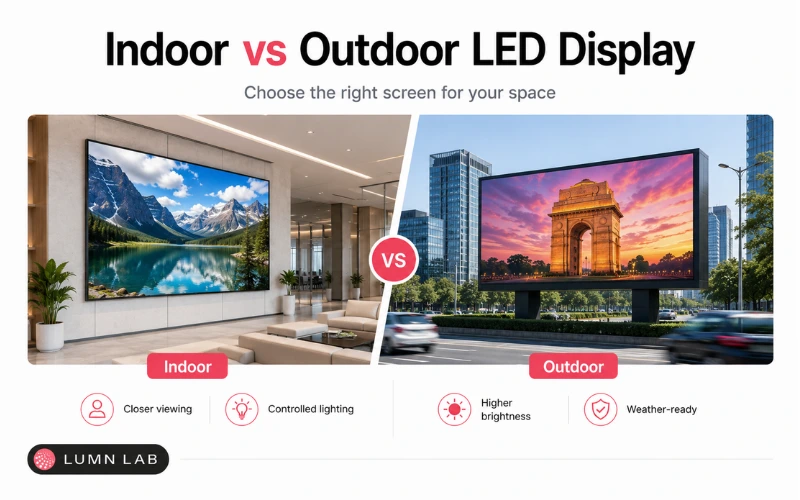

Most buyers make one of these two mistakes: either they buy an indoor screen for an outdoor wall, or an outdoor-grade display for a conference room. Both will impact the proficiency of the LED display.
This guide is for anyone planning to buy an LED display for a corporate lobby in Bangalore, a highway billboard in Mumbai, a retail store in a Delhi NCR mall, or an event stage in Hyderabad. By the end, you will know exactly which type you need and why.
What is an Indoor LED Display?
An indoor LED display is built for controlled environments – offices, retail stores, hotel lobbies, auditoriums, shopping malls. The small LED diodes in them are packed tightly together, which produces sharp, high-definition images that hold up at close viewing distances of 2 to 15 metres.
Brightness typically runs between 600 and 2,000 nits. That is more than enough for a well-lit interior without causing eye strain.
What is an Outdoor LED Display?
An outdoor LED display is built to take punishment – direct sunlight, monsoon rain, coastal humidity, road dust, temperature swings. Every design decision, from the diodes to the cabinet construction, is made keeping these factors in mind.
Brightness goes from 5,000 to 10,000 nits. That is what it takes to stay visible under peak afternoon sunlight in Chennai or Pune. Anything less and your screen just disappears in daylight.
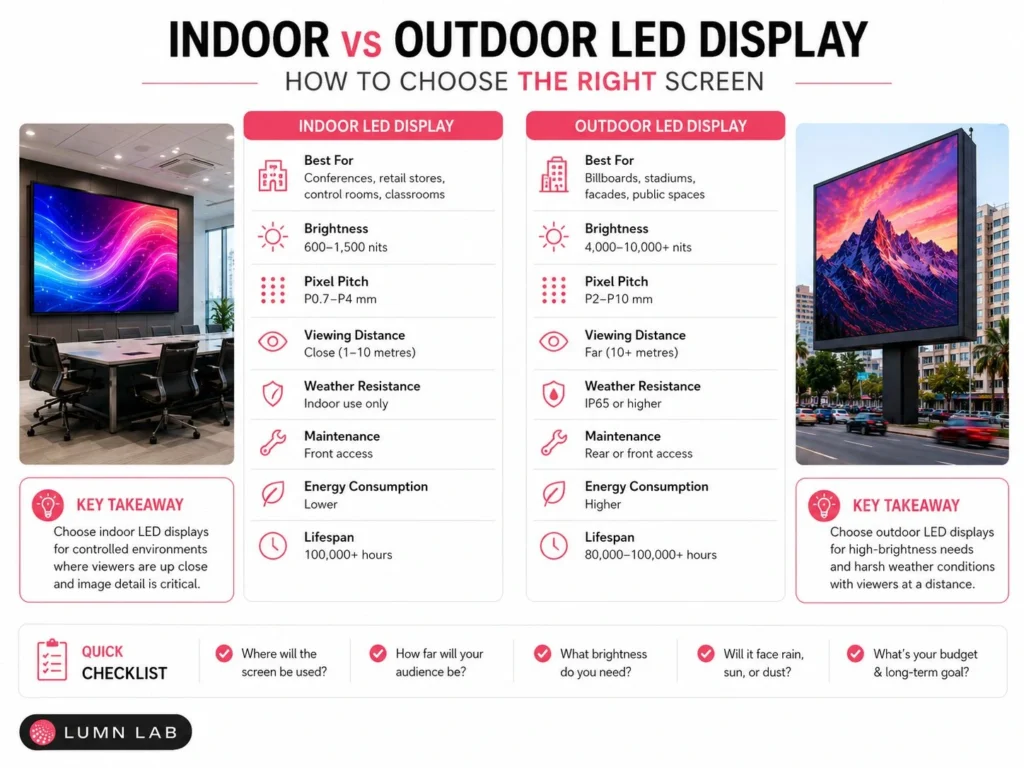
Indoor vs Outdoor LED Display: Key Differences at a Glance
| Feature | Indoor LED Display | Outdoor LED Display |
| Brightness | 600-2,000 nits | 5,000-10,000 nits |
| Pixel Pitch | P0.9 – P4 (fine to standard) | P4 – P16 (standard to wide) |
| IP Rating | IP30-IP43 | IP65-IP68 |
| Viewing Distance | 2-15 metres | 10-200+ metres |
| Cabinet Material | Lightweight aluminium alloy | Heavy-duty steel or aluminium |
| Power Consumption | Lower | Higher |
| Weatherproofing | Not required | Fully weatherproof |
| Typical Applications | Offices, retail, studios, hotels | Billboards, stadiums, highways |
| Approximate Cost (India) | ₹8,000–₹20,000 per sq ft | ₹12,000–₹30,000 per sq ft |
Brightness and Visibility
Brightness is the single most important factor when choosing between indoor and outdoor displays.
Indoors, ambient light is predictable. An 800-1,200 nit display looks vivid and comfortable in a typical office or retail space. Pushing higher wastes energy and gains nothing.
Outdoors, direct sunlight hits 100,000 lux. A screen that looks stunning at 1,000 nits in your boardroom becomes completely washed out under midday sun. Outdoor displays need a minimum of 5,000 nits and premium billboard installations often run at 7,000-10,000 nits to stay readable throughout the day.
Quick rule: If any part of your display faces direct sunlight or sits in an outdoor environment, get an outdoor-rated screen. No exceptions.
Pixel Pitch Explained
Pixel pitch is the distance in millimetres between the centres of two adjacent LED pixels. Smaller pitch = more pixels per square metre which means sharper image and closer minimum viewing distance.
Here is how it maps in practice:
P1.2 – P2.5 (Fine Pitch): Control rooms, broadcast studios, corporate boardrooms. Viewers stand 1.5–3 metres away.
P3 – P4 (Indoor Standard): Retail stores, hotel lobbies, auditoriums, conference halls.
P5 – P8 (Outdoor Close-Range): Building-mounted displays, transit stations, stadium perimeters.
P10 – P16 (Outdoor Long-Range): Roadside billboards, highway advertising, large sports venues.
Getting this wrong is one of the most common procurement mistakes. A P10 screen in a conference room looks pixelated from normal seated distances. A P2 screen on a highway billboard is expensive waste – no one standing 50 metres away can see the difference.
Match the pitch to the viewing distance, not to the brochure.
Weatherproofing and IP Ratings
IP (Ingress Protection) ratings tell you how well a display is sealed against dust and water. It is expressed in two digits: the first covers dust protection (0-6), the second covers water protection (0-9).
IP30-IP43: Standard indoor. Fine for controlled interiors, not suitable outside.
IP55: Semi-outdoor – covered walkways, open atriums, partially sheltered transit areas.
IP65: Fully dustproof and protected against water jets. Minimum standard for any outdoor installation.
IP67-IP68: Submersion-rated. Coastal sites, flood-prone areas, extreme conditions.
For India’s coastal cities like Mumbai or Chennai where salt air and humidity are real factors, IP66 or higher is worth the investment.
Structural and Installation Requirements
Indoor cabinets weigh 8-18 kg per square metre. Wall-mounting and hanging installations are straightforward in most commercial interiors.
Outdoor cabinets run 25-50 kg per square metre and need engineered support structures built to handle wind loads. In India, outdoor installations in cities like Delhi NCR and Hyderabad must comply with local municipal hoarding regulations and IS:875 Part 3 wind load norms.
For any large outdoor installation: get a civil and structural engineering review before fabricating the support structure. It is not optional.
Power Consumption and Operating Costs
Indoor displays: 100–300 watts per square metre at full brightness.
Outdoor displays: 400–800 watts per square metre.
Intelligent brightness control – automatically adjusting output based on ambient light – cuts outdoor power consumption by 30–50% at night. Across a multi-year installation lifecycle, that adds up to a significant electricity bill reduction.
Total cost of ownership matters more than purchase price. An energy-efficient panel with intelligent brightness control and a five-year warranty will cost less over its operating life than a cheaper unit with no after-sales support.
Industry Use Cases
Corporate Offices
Fine-pitch video walls at P1.5–P2.5 have largely replaced projectors and LCD panels in boardrooms, reception lobbies, and command centres across Bangalore, Pune, and Delhi NCR. Seamless, no bezels, far sharper than anything a projector produces in a lit room.
Retail Stores
P3–P4 indoor displays for window displays, in-store product showcases, and promotional signage. High brightness and vivid colour reproduction – measurable impact on customer dwell time and conversions.
Educational Institutions
Universities and schools are deploying indoor LED video walls in auditoriums and seminar halls. In lit environments, large-format LED simply outperforms projectors.
Events and Entertainment
Rental LED panels at P2.9–P3.9 are the industry standard for concerts, product launches, weddings, and exhibitions. Lightweight die-cast aluminium cabinets assemble and disassemble quickly – practical for touring events across multiple cities.
Hospitality
Hotels use indoor displays in lobbies, ballrooms, and restaurants for brand storytelling and event information. Outdoor LED is increasingly used on facades for visibility and wayfinding.
Outdoor Advertising
Roadside billboards, building-wrap screens, and retail facades – all require IP65, high brightness, and robust structures. Mumbai and Hyderabad have seen rapid growth in programmatic outdoor LED advertising over the past three years.
How to Choose the Right LED Display for Your Project
Four questions to consider before you approach any supplier:
1. Where is the screen going? Indoor and protected, or outdoor and exposed
2. What is the minimum viewing distance? That determines the pixel pitch you need.
3. What are the ambient light conditions? Bright sunlit spaces – indoors or outdoors need higher brightness.
4. What is the installation surface and structure? Heavy outdoor cabinets need engineered mounting. Confirm load ratings before ordering.
If you are unsure about any of these, a site assessment from a qualified LED specialist answers all four in a single visit.
Expert Recommendations
After 1,000+ installations across India since 2015 – fine-pitch boardroom video walls in corporate parks to large-format outdoor billboards on national highways – here is what we have learned:
- Never compromise on IP rating for outdoor installations: A non-IP65 screen exposed to Indian monsoon conditions will fail within one or two rain seasons. We have seen it.
- Match pixel pitch to your actual viewing distance, not your budget: Overspending on resolution no one can perceive at your distance is a common, avoidable mistake.
- Ask for brightness in nits, with a documented spec sheet: “Bright” and “ultra bright” are marketing descriptions, not specifications.
- Watch the boundary zones: Covered parking entrances, open atriums, and partially shaded facades are neither fully indoor nor outdoor. They often need IP55-rated screens running at 3,000–4,000 nits.
- Factor in total cost of ownership: A more efficient screen with intelligent brightness control and solid after-sales support costs less over five years than a cheaper panel that draws more power and leaves you without service.
All Lumn Lab displays are certified under BIS, ISO, IP65, CE, FCC, and RoHS standards.
Conclusion
If you are still unsure which display fits your project, a free site assessment from the Lumn Lab team will give you a clear answer.
Indoor or outdoor is not a quality question — it is an environment question. Indoor displays optimise for resolution and visual comfort at close range. Outdoor displays optimise for brightness, durability, and weather resistance at distance.
Get those two fundamentals right and everything else — pixel pitch, IP rating, cabinet spec, structure — follows logically from there.
Contact Lumn Lab for expert advice, a site assessment, and a project quote.
Frequently Asked Questions
Q1. What is the main difference between indoor and outdoor LED displays?
Brightness, pixel pitch, and weatherproofing. Outdoor displays run at 5,000–10,000 nits with IP65 ratings to handle sun, rain, and dust. Indoor displays run at 600–2,000 nits with finer pixel pitch for close-range viewing.
Q2. Which pixel pitch is best for an indoor LED video wall?
For boardrooms viewed from 2–4 metres: P1.5 to P2. For retail and lobby displays viewed from 4–8 metres: P2.5 to P4 — solid results at a lower cost.
Q3. Can an outdoor LED display be used indoors?
Technically yes. In practice, no. Outdoor screens are heavier, consume more power, and produce brightness levels that cause eye discomfort in enclosed spaces. Use the right display for the environment.
Q4. What IP rating is required for outdoor LED in India?
IP65 is the minimum for any outdoor installation. For coastal cities like Chennai or Mumbai where salt air and humidity are constant factors, IP66 or higher is worth it.
Q5. How much does an outdoor LED display cost in India?
Typically ₹12,000–₹30,000 per square foot depending on pixel pitch, cabinet quality, and installation complexity. For an accurate quote, share your size and location requirements.
Q6. What is the lifespan of an LED display?
Quality LED displays are rated for 100,000+ hours — over 11 years of continuous operation, or 27+ years at 10 hours per day.
Q7. Do outdoor LED displays work in heavy rain?
Yes. IP65-rated displays are fully protected against rain and water jets. Lumn Lab’s outdoor range is tested to perform through India’s monsoon season.
Q8. What is fine pitch LED and where is it used?
Pixel pitch of P0.9 to P2.5 used where viewers stand close to the screen — corporate boardrooms, broadcast studios, control rooms, and premium retail displays where image sharpness at short distances matters.
Q9. How long does installation take?
Small indoor installations up to 20 sq ft: one to two days. Medium video walls: two to four days. Large outdoor installations: five to ten days including structural work and final calibration.
Q10. Can LED displays be customised to non-standard sizes?
Yes. Custom sizes in any dimension — from compact 2×1 ft panels to 100+ sq ft video walls — including curved, cylindrical, and transparent configurations for architectural installations.
Keep Reading