
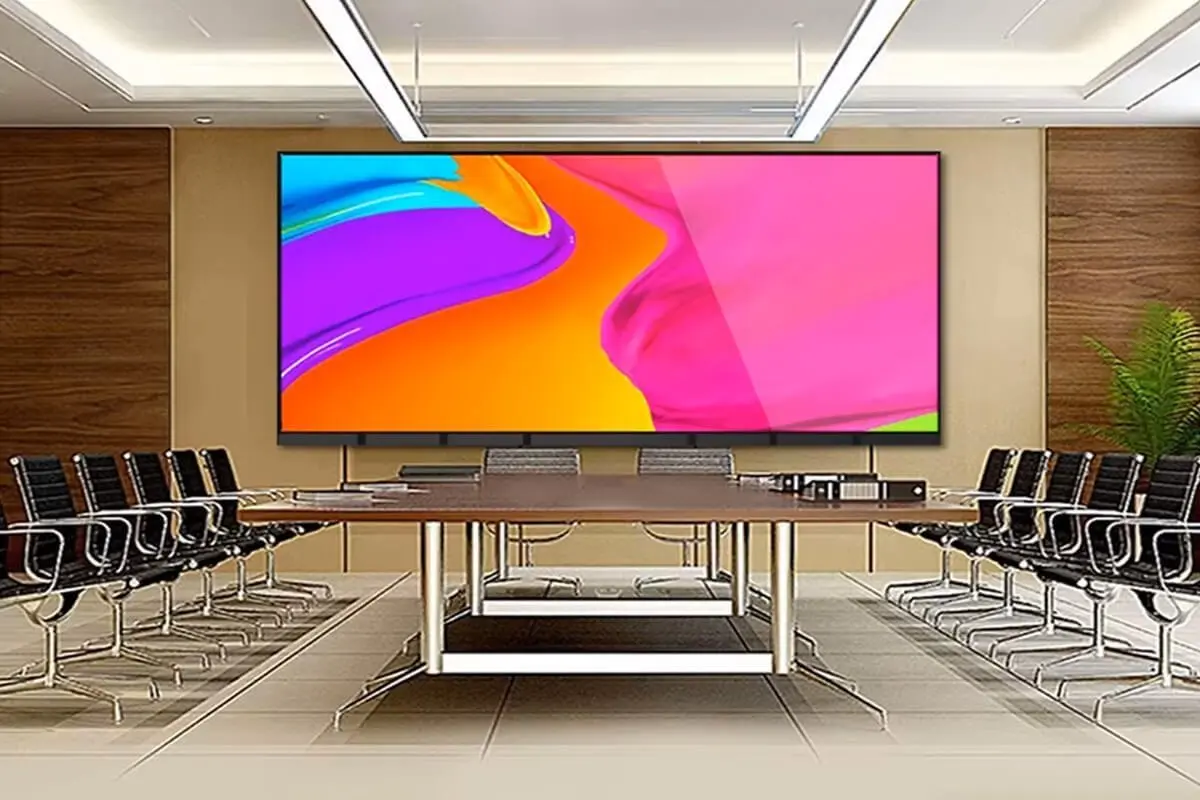

A standard LED panel is built for a standard wall. Most walls are not standard. The moment your installation involves a curved reception desk, a column-heavy lobby, a ceiling mount with a strict weight limit, or a creative shape for a brand activation, off-the-shelf cabinets stop being an option and a custom LED screen becomes the only way to make the display actually fit the space.
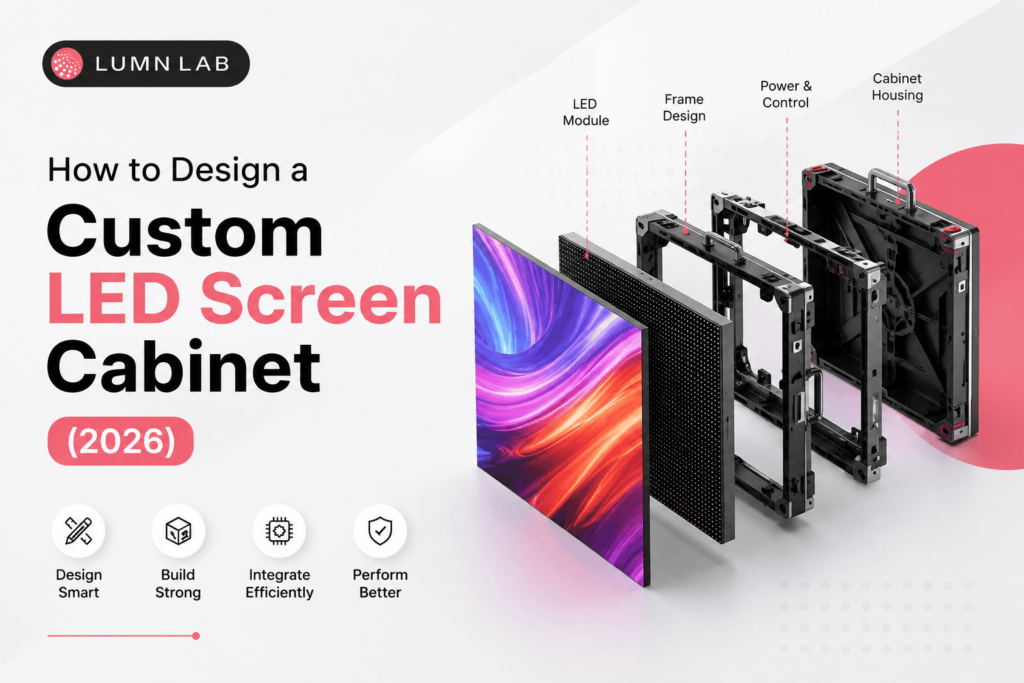
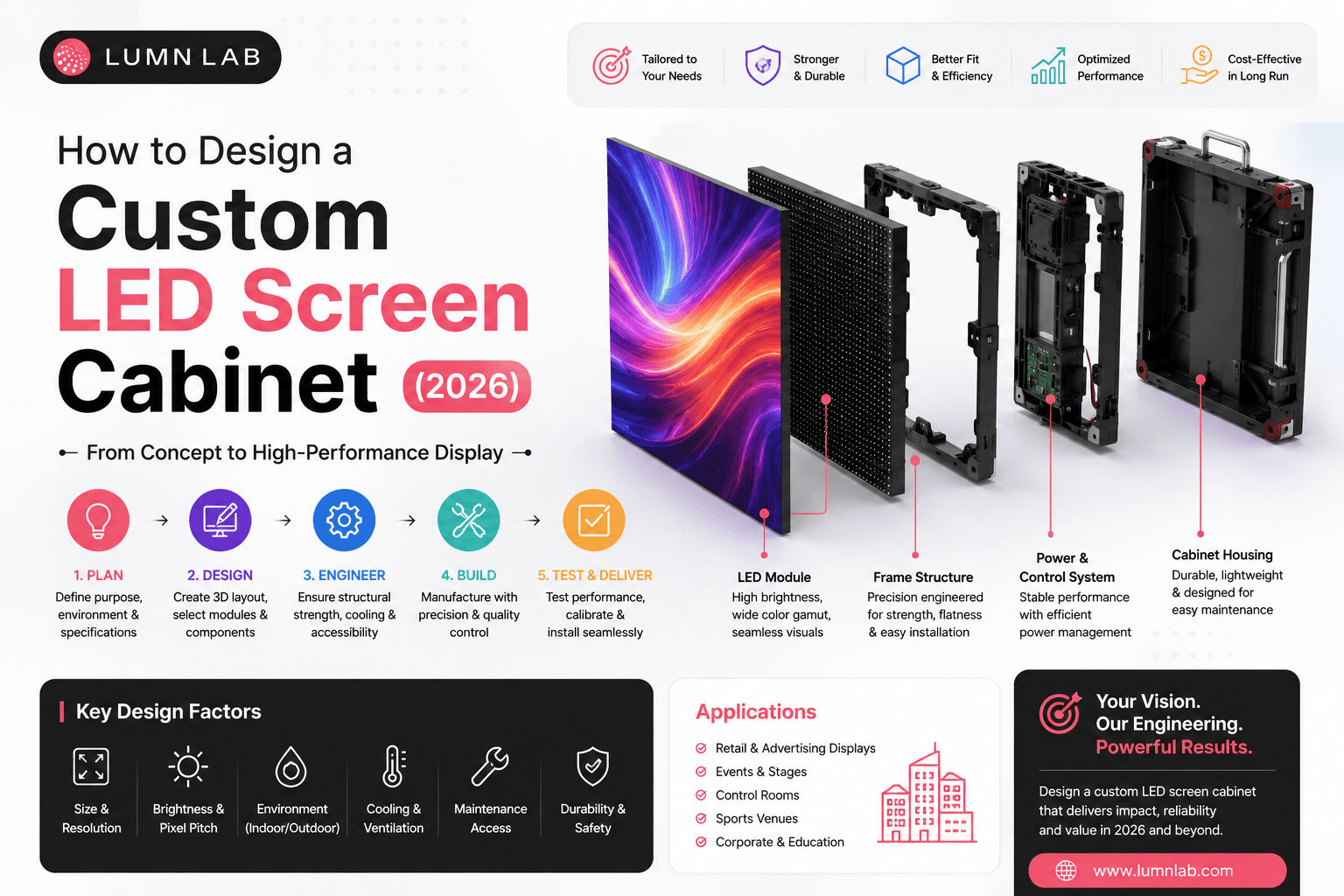
A custom LED screen cabinet is the structural housing — built to a specific size, shape, weight, and service requirement — that holds the LED modules, power supplies, and control hardware in place. Get the cabinet design wrong and you inherit problems no amount of pixel pitch tuning can fix: sagging panels, blocked servicing, or a screen that simply does not fit the wall it was built for. This guide breaks down how custom LED cabinets are designed, what actually drives their cost, and where to go from a rough idea to a buildable spec.
What Is a Custom LED Screen Cabinet?
A custom LED screen cabinet is a purpose-built enclosure engineered to a project’s exact dimensions, shape, and mounting conditions, rather than assembled from stock catalog sizes. Standard cabinets typically ship in fixed sizes such as 500mm x 500mm or 500mm x 1000mm. A custom cabinet breaks from that grid — it might be curved, circular, non-rectangular, or simply sized to fill an architectural opening that a standard module grid cannot cleanly tile.
Why Businesses Choose Custom Over Standard Panels
Custom fabrication adds cost and lead time, so it is worth understanding exactly when it earns its place over a standard panel:
• Irregular wall dimensions — columns, angled walls, or openings that don’t divide evenly into standard module sizes.
• Weight and structural limits — ceiling-hung or false-wall installations often need lighter cabinet materials than a standard floor-mounted wall.
• Creative or brand-driven shapes — circular displays, curved video walls, or logo-shaped screens for retail and event activations.
• Specific service access — some sites only allow front access for maintenance, which changes the cabinet design entirely.
• Outdoor or semi-outdoor exposure — custom weatherproofing and IP-rated housings that a generic indoor cabinet can’t offer.
Key Design Factors That Shape a Custom LED Cabinet
Before fabrication starts, a handful of decisions determine how the cabinet is built:
• Material — die-cast aluminum, sheet steel, or iron, each with different weight, durability, and cost profiles.
• Cabinet size and module compatibility — how the custom shape integrates with standard LED module sizes to control cost.
• Pixel pitch — the module density the cabinet needs to house; see our pixel pitch guide for how this connects to viewing distance.
• Service access — front-service cabinets allow maintenance without dismantling the structure behind the screen; rear-service cabinets need open access space behind the wall.
• IP rating — outdoor and semi-outdoor cabinets need sealed housings (typically IP65 on the front, IP54 or higher on the rear) to handle dust and moisture.
• Weight per square meter — directly affects what mounting structure or truss the installation site needs to support.
• Curve and creative-shape capability — some cabinet designs support gentle bends for curved walls; sharper geometric shapes usually require fully custom molds.
Material Comparison: Die-Cast Aluminum vs Steel vs Iron Cabinets
| Material | Typical Weight | Durability & Precision | Best Fit |
| Die-cast aluminum | Lightest of the three | High dimensional precision, good heat dissipation | Rental, curved, and ceiling-mounted installations |
| Sheet steel | Moderate | Strong and rigid, less precise than die-cast | Fixed indoor installations on solid walls |
| Iron | Heaviest | Very rigid, lowest cost per cabinet | Budget-conscious, permanent, floor-supported installs |
Also Read: LED Screen for Events: Types, Sizes, Costs & Setup Guide
What Drives the Cost of a Custom LED Screen Cabinet?
Custom fabrication cost is shaped by more than just screen size. The factors that move the price most are:
• Material choice — die-cast aluminum costs more per cabinet than iron but reduces structural and mounting costs downstream.
• Shape complexity — a straight custom size is far cheaper to produce than a curved or circular cabinet, which often needs custom molds.
• Pixel pitch — finer pitch means more LEDs and driver components per cabinet, which raises material cost independent of cabinet shape.
• IP rating — weatherproofing for outdoor use adds sealing, gasket, and coating costs that indoor cabinets don’t need.
• Service access type — front-service cabinets involve more complex mechanical design than rear-service, which typically costs less.
• Order volume — custom tooling costs are largely fixed, so they get distributed across more cabinets on larger orders, lowering the per-unit price.
Because these variables interact, two custom projects of the same screen size can land at very different price points. The fastest way to get a realistic number for your specific project is to run your size, pitch, and location through the LED Configurator on Lumn Lab’s calculator hub before requesting a formal quote.
Common Custom Cabinet Use Cases Across Industries
• Retail — curved corner displays and shaped storefront screens built to match a brand’s architecture.
• Corporate — lobby and reception walls custom-fit to non-standard wall dimensions or column layouts.
• Events and rental — lightweight die-cast aluminum cabinets designed for fast rigging and de-rigging on stage backdrops.
• Broadcast and control rooms — flat, fine-pitch custom cabinets sized to fit exact rack and viewing-distance requirements.
• Outdoor facades — weatherproof, creative-shape cabinets for building wraps, signage, and architectural lighting integration.
Where This Comes Up Across India
Custom cabinet requirements tend to follow the type of project as much as the city, but a few patterns show up consistently:
• Delhi corporate offices often need custom lobby walls sized around existing architectural columns.
• Gurgaon reception and boardroom projects frequently call for curved or shaped displays to match interior design.
• Mumbai event and stage backdrops lean on lightweight rental cabinets built for quick assembly and creative shapes.
• Bangalore tech campuses commonly request custom branding walls that fit irregular open-office layouts.
• Noida exhibition and retail spaces often need large-format custom sizing to fill specific booth or storefront dimensions.
Custom vs Standard LED Cabinets: Which Should You Choose?
| Criteria | Standard Cabinet | Custom Cabinet |
| Lead time | Shorter — built from stock sizes | Longer — includes design and tooling time |
| Cost per unit | Lower, especially at scale | Higher, driven by shape and material |
| Design flexibility | Limited to catalog sizes | Built to exact wall, shape, and weight needs |
| Best for | Standard walls, quick turnarounds | Irregular spaces, brand-driven shapes, weight limits |
Common Mistakes When Specifying a Custom LED Cabinet
• Not confirming the site’s structural load capacity before choosing cabinet material and weight.
• Deciding on service access after fabrication has started, rather than at the design stage.
• Underestimating lead time — custom tooling and mold work takes longer than ordering standard cabinets.
• Choosing pixel pitch without checking it against actual viewing distance — a mismatch here undermines even a well-built custom cabinet.
Conclusion
A custom LED screen cabinet exists to solve one problem: making the display fit the space, not the other way around. The material, shape, service access, and pixel pitch decisions made at the design stage determine whether that screen performs well for years or turns into a maintenance headache within months.
Lumn Lab has been designing and manufacturing LED displays in India since 2015, including custom cabinets for retail, corporate, event, and outdoor installations. Got a wall, column, or shape a standard panel won’t fit? Share your project dimensions with our team, or run a first estimate through the LED Configurator, and we’ll help you spec a cabinet built for your actual space.
Frequently Asked Questions
Q. What is a custom LED screen cabinet?
A custom LED screen cabinet is a purpose-built enclosure for LED modules, power supplies, and control hardware, engineered to a project’s specific size, shape, weight, and service-access needs rather than assembled from standard catalog sizes.
Q. How much does a custom LED display cost in India?
Cost varies by material, shape complexity, pixel pitch, IP rating, and order volume, so there is no single fixed price. Use Lumn Lab’s LED Configurator to get an estimate based on your specific project details.
Q. What materials are used for LED cabinets?
The three most common materials are die-cast aluminum, sheet steel, and iron. Die-cast aluminum is the lightest and most precise, steel offers a balance of rigidity and cost, and iron is the heaviest but most budget-friendly option.
Q. Can LED screens be made in curved or circular shapes?
Yes. Some cabinet designs support gentle curves for walls, while circular or sharply geometric shapes typically require fully custom molds and a longer production timeline.
Q. How long does it take to manufacture a custom LED cabinet?
Custom cabinets take longer than standard ones because they include design finalization and, for curved or shaped cabinets, tooling and mold production before manufacturing begins. Exact timelines depend on shape complexity and order size.
Q. What’s the difference between front and rear service cabinets?
Front-service cabinets allow maintenance and module replacement from the front of the screen, without needing access behind the wall. Rear-service cabinets require open space behind the installation for technicians to access components.
Q. Is a custom LED cabinet more expensive than a standard one?
Generally yes, since custom cabinets involve design work and, often, dedicated tooling. The gap narrows on larger orders, where fixed tooling costs are spread across more units.
Q. What pixel pitch should I choose for a custom LED display?
Pixel pitch should be chosen based on how close your audience will stand to the screen, not the cabinet shape itself. See Lumn Lab’s pixel pitch guide and calculator to match pitch to your actual viewing distance.
Keep Reading