


A higher IP rating sounds safer, so buyers often assume IP67 must be better than IP65 and IP65 must always beat IP44. That is not how the system works.
An IP rating tells you how well an electrical enclosure protects against solid particles and water under defined test conditions. For an LED display, that matters because a screen in a hotel lobby faces a very different environment from a roadside billboard in Mumbai during monsoon season.
The practical question is not “What is the highest IP rating?” It is “What level of protection does this installation actually need?” Choosing too little protection risks moisture, dust ingress and failures. Choosing far more than the site needs can add cost without improving the viewing experience.
This guide explains the ratings that matter for commercial LED displays in India and how to specify them properly.
What Are IP Ratings and What Do IP Ratings Mean?
An IP rating is a standardized way of describing how well an enclosure protects electrical equipment from solid objects, dust and water.
IP ratings for electrical equipment are defined by IEC 60529, the international standard covering degrees of protection provided by enclosures. India also recognizes IS/IEC 60529:2001, which BIS lists as the standard for the IP Code.
That makes IP ratings more useful than vague terms such as “weather resistant” or “waterproof.”
An IP code normally looks like this:
IP65
- 6 = level of protection against solids and dust
- 5 = level of protection against water
So when people ask what IP ratings mean, the easiest answer is: read the two numbers separately.
How IP Ratings Work
The first digit runs from 0 to 6. The second runs from 0 to 9, with “X” sometimes used when a protection level has not been specified or tested. IEC 60529 provides the classification system used for these ratings.
For LED display buyers, these are the numbers worth remembering:
| Rating element | Meaning |
| First digit 4 | Protected against solid objects larger than 1 mm |
| First digit 5 | Dust protected |
| First digit 6 | Dust-tight |
| Second digit 4 | Protection against splashing water |
| Second digit 5 | Protection against water jets |
| Second digit 6 | Protection against powerful water jets |
| Second digit 7 | Protection during temporary immersion under defined conditions |
| Second digit 8 | Protection during immersion under conditions specified by the manufacturer |
People sometimes search “how many IP ratings are there?” There is no short numbered list from IP1 to IP10. The IP Code combines solid-protection and water-protection levels, which is why you see combinations such as IP44, IP55, IP65, IP66 and IP67.
For commercial LED projects, you do not need all IP ratings explained. You mainly need to understand the combinations relevant to your installation environment.
IP Waterproof Ratings Explained: Is “Waterproof” the Right Word?
Not quite.
If you are asking what are IP waterproof ratings or what IP ratings are waterproof, it is more accurate to think in terms of water ingress protection.
IP65, for example, does not mean a cabinet can be submerged indefinitely. It means the enclosure is designed to withstand the water-jet test associated with the “5” rating.
Likewise, IP66 deals with more powerful water jets, while IP67 addresses temporary immersion.
This distinction matters because the water ratings above IPX6 are not simply a staircase where every higher number automatically includes every lower test. An IP67 enclosure is tested for immersion, but that does not automatically prove that it has passed the IPX6 powerful water-jet test.
That is why IP68 is not automatically the “best” rating for an outdoor LED billboard. The correct test needs to match the actual exposure.
LED IP Ratings: Which Rating Fits Which Environment?
Here is the practical comparison most LED buyers actually need.
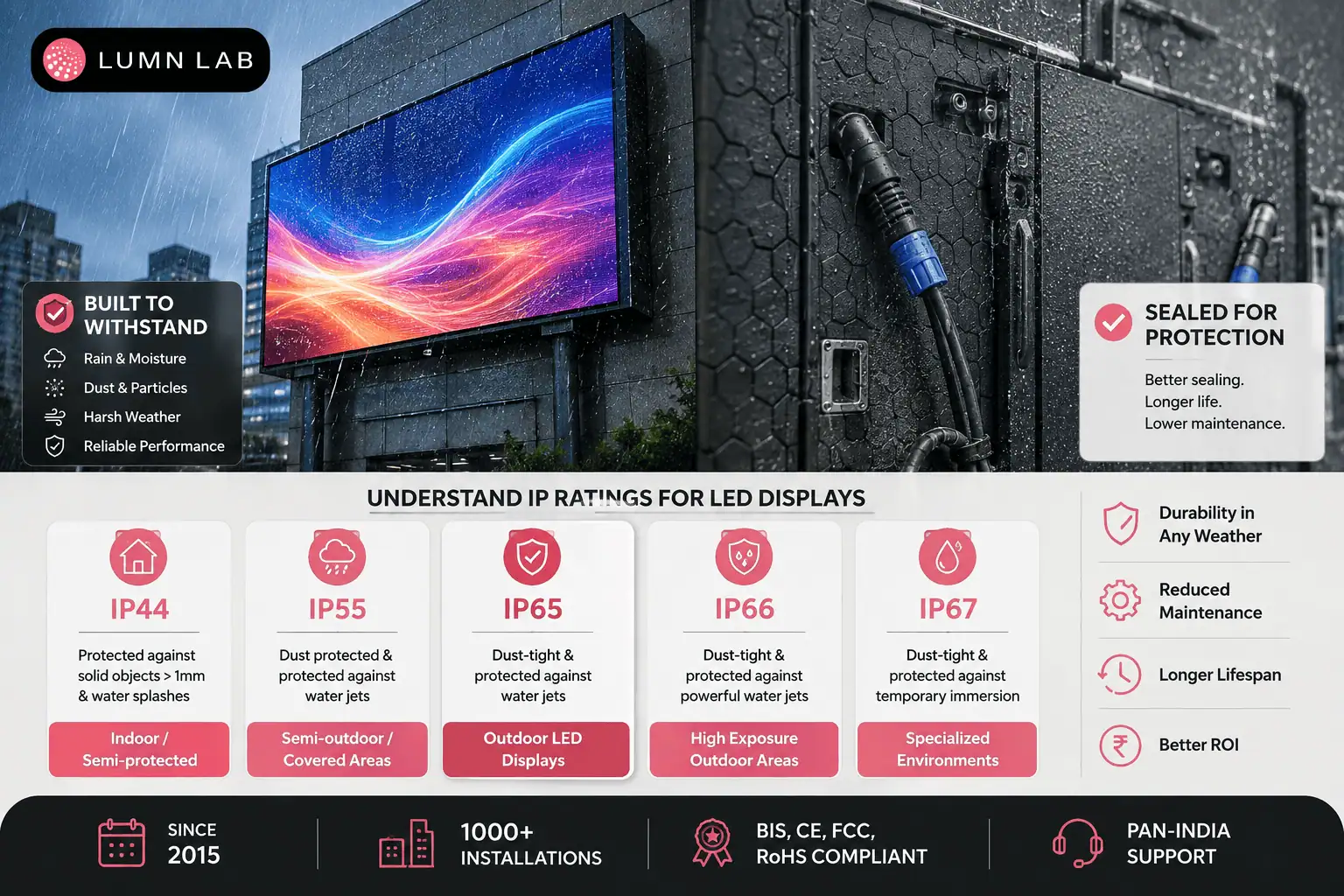
| IP Rating | Dust Protection | Water Protection | Typical LED Display Use |
| IP44 | Objects over 1 mm | Water splashes | Protected indoor or semi-covered areas |
| IP55 | Dust protected | Water jets | Semi-outdoor locations and protected façades |
| IP65 | Dust-tight | Water jets | Outdoor LED displays, billboards, façades |
| IP66 | Dust-tight | Powerful water jets | Highly exposed outdoor installations |
| IP67 | Dust-tight | Temporary immersion | Specialized environments, not usually necessary for fixed LED screens |
| IP68 | Dust-tight | Extended immersion under manufacturer-defined conditions | Rarely required for normal commercial LED displays |
IP44: Fine Indoors, Weak for Exposed Outdoor Installations
IP44 protects against splashing water, but it is not the rating we would choose for a permanently exposed outdoor LED screen.
A digital display inside a covered entrance, sheltered retail zone or protected architectural space may work with this level of protection depending on site conditions.
For a screen directly exposed to India’s rain and road dust, look higher.
IP55: Useful in the Grey Area Between Indoor and Outdoor
Some sites are neither fully indoor nor fully outdoor.
Think of an open-air mall entrance, covered parking facility, semi-covered stadium concourse or a display mounted beneath a deep canopy.
IP55 can make sense here because it adds dust protection and resistance to water jets without specifying a fully dust-tight enclosure.
IP65: The Practical Starting Point for Outdoor LED Displays
For most fixed commercial outdoor LED installations, IP65 is the rating buyers should start evaluating.
The first “6” means the enclosure is dust-tight. The “5” covers water jets.
That combination makes IP65 well suited to applications such as:
- building facade displays
- retail exterior screens
- outdoor digital signage
- roadside digital billboards
- transportation hubs
- stadium displays
- outdoor event screens
Lumn Lab’s current outdoor display range is publicly specified at IP65/IP66, with applications including façades, outdoor advertising, transport hubs, billboards and stadiums.
IP66: Worth It When Exposure Gets Harsher
IP66 increases water protection from standard water jets to powerful water jets.
That makes it useful for exposed installations where wind-driven rain, open facades or demanding cleaning conditions create more risk.
For example, a fully exposed building screen in Mumbai may justify IP66 more readily than an LED screen sitting beneath a deep canopy in Gurgaon.
IP67 and IP68: Higher Number Does Not Always Mean Better Fit
IP67 and IP68 are mainly associated with immersion protection.
That sounds impressive, but a billboard in Noida is not supposed to sit underwater.
If the actual problem is heavy rain, dust and wind exposure, IP65 or IP66 is normally more relevant than paying for an enclosure designed around immersion testing.
Planning an outdoor LED installation? Share the location, screen size and exposure conditions with Lumn Lab before locking the specification. The right IP rating should come from the site, not from whichever number looks highest on a quotation.
What IP Rating Do You Need for Different LED Display Applications?
The environment should make the decision.
| Application | Practical Starting Point | What Matters Most |
| Corporate boardroom in Bangalore | Indoor-rated enclosure | Dust, ventilation and thermal management |
| Retail screen inside a Delhi NCR mall | Indoor/IP4X where required | Controlled environment |
| Covered storefront in Gurgaon | IP44 to IP55 depending on exposure | Wind-blown dust and occasional moisture |
| Outdoor façade in Mumbai | IP65, consider IP66 for high exposure | Rain, humidity and dust |
| Roadside billboard near Noida | IP65/IP66 | Rain, dust and continuous outdoor exposure |
| Outdoor event LED wall | IP65 on exposed surfaces | Rain, connectors, cabinet seals and temporary rigging |
These are starting points, not substitutes for a site inspection.
A display facing the road can experience completely different conditions from one mounted 10 metres away beneath a canopy.
What Buyers Get Wrong About IP Ratings
The highest number is not automatically the best specification
IP68 sounds better than IP65 on paper. For a commercial outdoor LED screen, the relevant exposure matters more than the headline number.
The cabinet is only one part of the system
Ask about:
- cabinet joints
- power connectors
- signal connectors
- cable glands
- ventilation points
- module seals
- rear access doors
- power supplies
A beautifully rated front face does not help much if water enters through an incorrectly sealed cable connection.
Front and rear protection may differ
This is especially important on outdoor LED displays.
Ask your supplier whether the quoted IP rating applies to the complete cabinet and all exposed sides, rather than assuming the same protection exists everywhere.
Installation quality still matters
An IP65 cabinet installed with damaged seals, poorly routed cables or incorrect drainage can still develop problems.
The enclosure specification and the installation method have to work together.
Do not accept an IP number without supporting documentation
An IP rating is a technical classification, not a marketing adjective.
IEC recognizes different forms of conformity assessment, including supplier declarations and third-party assessment. A manufacturer can declare conformity, so buyers should ask what testing supports the stated rating and request relevant reports where project risk warrants it.
Expert Recommendations
After more than a decade in LED display solutions, a few rules make IP selection much easier.
1. For permanently exposed outdoor LED, start the conversation at IP65.
Do not specify an indoor-grade cabinet simply because the site has an awning.
2. Consider IP66 for harsher exposure.
Coastal humidity, fully open facades, wind-driven rain and difficult service conditions may justify the extra protection.
3. Do not use IP67 or IP68 simply because the number is higher.
Immersion resistance is not normally the main requirement for a billboard, façade or stadium screen.
4. Ask what part of the display was tested.
Front module protection alone is not the same as protection across the entire installed cabinet system.
5. Match IP rating with brightness, structure and thermal design.
Weather resistance alone does not make an outdoor display suitable. The screen must also handle sunlight, heat, mounting loads and service access.
Lumn Lab has been serving the LED display market since 2015 and reports 1000+ successful installations across India and beyond.
That experience matters because choosing LED specifications is rarely about one number. It is about how the entire display behaves once it is installed in the real environment.
Conclusion
The right IP rating is not the highest number you can afford. It is the rating that matches the environment your LED display will face every day.
For indoor displays, extensive weather protection may add little value. For outdoor billboards, façades, stadium screens and exposed digital signage in India, IP65 is a strong practical starting point, with IP66 worth considering for harsher locations.
And remember: IP rating is only one part of an outdoor LED specification. Cabinet sealing, brightness, structural engineering, thermal management, connectors and installation quality all matter.
If you are planning an LED video wall in Bangalore, a retail screen in Delhi NCR, a façade display in Mumbai, or an outdoor installation in Gurgaon or Noida, Lumn Lab can assess the site and recommend the right display specification before you commit to hardware.
With 1000+ installations and experience dating back to 2015, the team can help you choose an LED solution based on actual operating conditions rather than specifications that simply look impressive on paper.
Frequently Asked Questions
1. What are IP ratings and what do they mean?
IP ratings describe how well an electrical enclosure protects against solids and water. The first digit covers solids and dust. The second digit covers water ingress.
2. How many IP ratings are there?
There is no simple fixed list of IP1, IP2 and so on. IEC 60529 combines solid-protection levels with water-protection levels to create ratings such as IP44, IP55, IP65 and IP66.
3. Is IP65 or IP44 better for an LED display?
For outdoor LED displays, IP65 provides significantly stronger protection because it is dust-tight and protects against water jets. IP44 is more suitable for protected environments exposed only to splashing water.
4. Is IP44 OK for heavy rain?
IP44 is not the preferred specification for an LED display directly exposed to heavy rain. For permanently exposed outdoor screens, IP65 or IP66 is usually the more appropriate choice.
5. Can IP65 handle heavy rain? Is IP65 enough for heavy rain?
IP65 is commonly used for outdoor LED displays because it protects against dust and water jets. Correct cabinet sealing, connectors, drainage and installation remain essential in heavy monsoon conditions.
6. Which is better, IP65 or IP66?
IP66 provides stronger water-jet protection than IP65. Choose IP66 for more exposed or demanding locations; IP65 is sufficient for many standard outdoor LED installations.
7. Is IP67 better than IP65?
Not automatically. IP67 adds temporary immersion protection, while IP65 specifically addresses water jets. An outdoor LED screen should be selected according to its actual exposure rather than the highest number.
8. Are IP ratings self certified?
They can be supported by a manufacturer’s own conformity testing or by third-party testing, depending on the product and compliance route. For commercial procurement, ask your supplier for the test basis or third-party report instead of relying only on a brochure claim.
Keep Reading