


Walk down any high street in Gurugram or through a mall in Mumbai right now, and count how many printed posters you actually notice versus how many bright, moving screens catch your eye first. That’s the shift happening in commercial spaces across India — static signage is losing the attention war, and businesses know it. The tricky part isn’t deciding to switch to an LED screen for commercial use. It’s figuring out which one.
Get the pixel pitch wrong and your screen looks fuzzy up close. Get the brightness wrong on an outdoor unit and it washes out in afternoon sun. Buy on price alone and you end up replacing panels within two years. This guide walks through what actually matters — the specs, the real costs, and where LED displays earn their keep — so you’re not learning these lessons the expensive way.
What Is a Commercial LED Screen?
It’s a display built from clusters of LEDs, designed for business environments rather than your living room. The difference from a regular TV or LCD panel comes down to three things: commercial units run for 12-18 hours a day without complaint, they’re built to be modular (so you can scale a wall from 6 panels to 60), and they’re rated for the actual lighting conditions they’ll face — whether that’s a dim corridor or direct outdoor sun.
Why Businesses Are Making the Switch
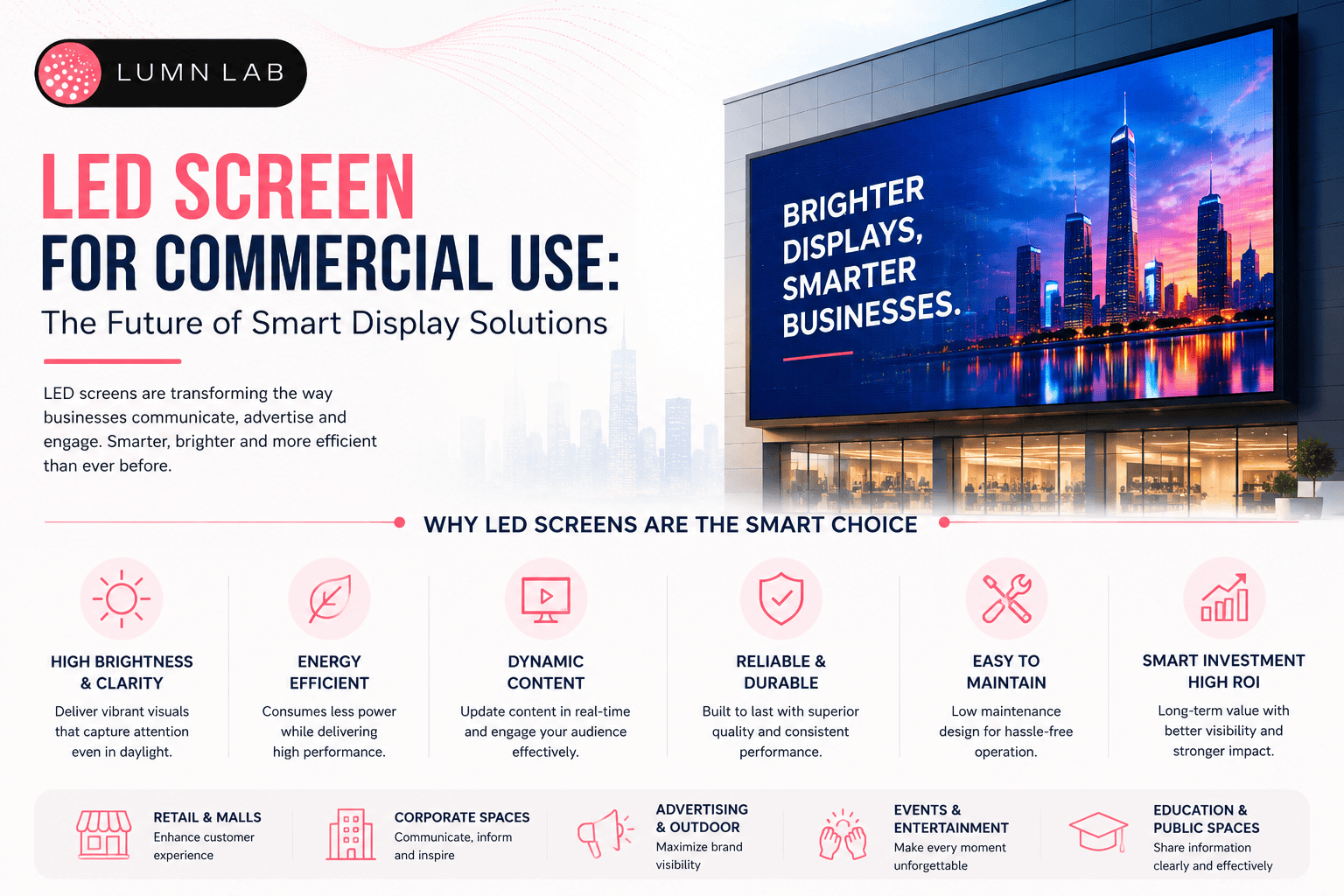
Attention is the one thing every business is competing for, and a static poster just can’t hold it the way motion and color do. A few reasons this shift keeps accelerating:
- They get noticed — high-contrast, moving visuals pull the eye faster than print, even outdoors in daylight
- Content changes in minutes, not weeks — no reprinting, no lamination, no waiting on a vendor
- The math works out over time — no recurring print costs once the hardware’s paid for
- You can actually track performance — most setups run on a CMS that logs play schedules, so you know what ran when
- It signals something about the business — a sharp, modern display tells customers you’ve invested in the experience, not just the product
Retail studies have repeatedly found that dynamic digital signage pulls noticeably higher recall than static posters — and that gap has only grown as screen resolution and pixel density have improved.
Types of Commercial LED Screens
Not every screen does the same job. This is usually the first real fork in the road:
| Type | Best For | Key Trait |
| Indoor LED Display | Retail stores, lobbies, showrooms, malls | Finer pixel pitch, sharp up close |
| Outdoor LED Display | Billboards, building facades, highway signage | Weatherproof, high brightness (nits) |
| Rental LED Screen | Events, weddings, concerts, exhibitions | Lightweight panels, fast setup and teardown |
| LED Video Wall | Corporate offices, control rooms, auditoriums | Seamless multi-panel large format |
| Transparent LED Display | Storefront windows, glass facades | See-through mesh, doesn’t block natural light |
Indoor vs. Outdoor: What’s Actually Different?
The honest answer: ambient light and viewing distance decide this, not preference.
Indoor screens use a finer pixel pitch — typically P1.2 to P2.5 — because people stand close to them, and they don’t need to fight sunlight. Outdoor screens need to push 5,000 to 8,000 nits just to stay readable at noon, plus IP65-rated weatherproofing to survive monsoon season without a single dead module.
Businesses that buy on price alone often mix this up — they install an indoor-spec panel outdoors and wonder why it’s unreadable by 2pm. It’s one of the costliest mistakes in this category, and it’s completely avoidable with the right spec conversation upfront.
Also Read: Indoor LED Display for Advertising: A Smart Choice for Modern Businesses
Where These Screens Actually Earn Their Keep
Some real applications, not hypotheticals:
- Retail: In-store promotional screens and window-facing displays that convert foot traffic into walk-ins — increasingly common along retail corridors in Delhi and Bengaluru
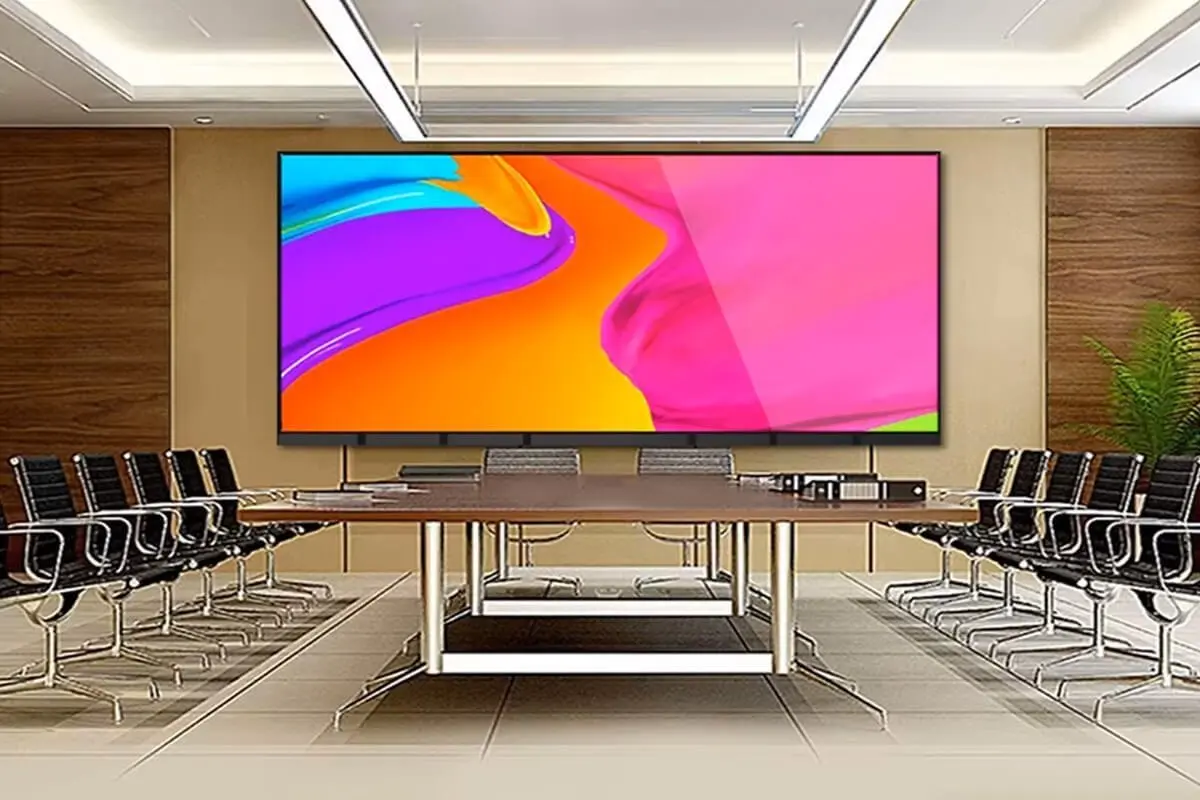
- Corporate offices: Boardroom video walls and lobby displays for branding and presentations, standard now in business parks across Gurugram and Noida
- Hospitality: Lobby screens and digital menu boards that cut printing costs and let staff update pricing instantly
- Events: Rental LED stages and backdrops for weddings, launches, and concerts — a fixture at event venues across Mumbai
- Transportation: Wayfinding and schedule boards in metro stations and airports
- Sports venues: Perimeter LED and scoreboard displays that double as sellable sponsorship space
- Government and education: Public information displays and digital notice boards for campuses and civic buildings
Here’s a pattern worth noting: when a mall swaps its static directory board for an indoor LED wall, it’s not just modernizing wayfinding — it’s creating ad inventory it can now sell to tenant brands. The screen pays for itself twice.
What to Check Before You Buy
Screen size is the easy decision. These are the ones that actually determine whether it performs:
- Pixel pitch — smaller pitch means sharper detail up close; larger pitch is fine when viewers are further away
- Brightness (nits) — indoor spaces generally need 800-1,500 nits; outdoor needs 5,000+
- Viewing distance and angle — this decides your pixel pitch, not the other way around
- Refresh rate — matters most if the screen will ever appear on camera or in photos; low refresh rates flicker on video
- IP rating — non-negotiable for anything exposed to dust or rain
- Content management system — how easily you can schedule and update content remotely
- Maintenance access — front-serviceable panels are far easier to service on a wall-mounted install than rear-access ones
What Actually Drives the Price
There’s no single number that works across the board here, and honestly, anyone quoting one flat rate without knowing your specs is guessing. What moves the price:
- Finer pixel pitch costs more per square foot than a coarser one — you’re paying for density
- Outdoor-rated, weatherproof panels cost more than indoor panels of the same size
- Curved installs, custom shapes, and transparent displays carry a premium over a standard flat wall
- Don’t forget the ongoing costs — CMS software, occasional servicing, power draw — these add up over the screen’s life and matter more than the upfront number
What We’ve Learned Since 2015
We’ve been designing, manufacturing, and installing LED displays for businesses across India since 2015 — retail storefronts, corporate video walls, event stages, all of it. One thing holds up across nearly every project: businesses that bring their display partner in during space planning, not after the walls are already up, end up with cleaner sightlines, simpler cabling, and no expensive retrofits.
The other lesson took longer to learn — brightness and pixel pitch on a spec sheet don’t tell the whole story. We’ve seen a panel that looked perfect on paper underperform because the site had unexpected glare or an odd viewing angle nobody accounted for. That’s why we push for an on-site visit before finalizing specs, even when a client is confident they already know what they need.
Planning an installation in Delhi NCR, Mumbai, or Bengaluru? Talk to Lumn Lab’s display specialists about a site visit before you finalize specs.
Conclusion
An LED screen for commercial use is a long-term call, not a quick purchase. The right choice comes down to your space, your audience, and your lighting — not the lowest quote you can find.
A few things worth remembering:
- Match pixel pitch and brightness to your actual viewing distance and lighting, not a generic recommendation
- Indoor and outdoor panels are built for different jobs — don’t treat them as interchangeable
- Price the total cost of ownership, not just the screen itself
- Bring your display partner in early, while the space is still being planned
Since 2015, Lumn Lab has helped businesses across Delhi, Noida, Gurugram, Mumbai, and Bengaluru design and install LED screens that actually hold up in their real environment, not just on a spec sheet. If you’re weighing options for your space, reach out to Lumn Lab for a consultation and site assessment before you commit to anything.
Not sure which LED display fits your space?
Our team has installed screens across retail stores, corporate offices, and event venues since 2015. Send us your space details and we’ll tell you straight — pixel pitch, brightness, that works.
Frequently Asked Questions
Q1. What is the best LED screen for commercial use?
It depends on where it’s going. Indoor spaces do well with a finer pixel pitch (P1.2-P2.5) for close viewing, while outdoor locations need high-brightness, weatherproof panels rated for direct sunlight and moisture.
Q2. How much does a commercial LED display cost in India?
It comes down to pixel pitch, screen size, brightness rating, and installation complexity. Finer pixel pitch and outdoor-rated panels cost more than standard indoor displays. A site-specific quote is the only accurate way to price it.
Q3. Why does pixel pitch matter so much?
It determines how sharp the image looks at a given viewing distance. A smaller pitch gives you crisp detail up close; a larger pitch works fine for something viewed from far away, like a billboard.
Q4. How long do commercial LED screens actually last?
With proper maintenance, commercial-grade panels commonly run for tens of thousands of hours before brightness starts to noticeably drop — a much longer runway than print or LCD signage.
Q5. When does it make sense to move from static signage to an LED display?
When static signage stops driving engagement, when your content needs frequent updates, or when you want visible, measurable branding in a high-footfall spot.
Q6. What kind of maintenance do these screens need?
Routine cleaning, checking for dead pixels or module faults, making sure ventilation is adequate, and confirming the CMS is running correctly. Whether panels are front- or rear-serviceable affects how easy this is.
Q7. Can LED screens be customized for unusual spaces, like curved walls or windows?
Yes — curved installations, custom shapes, and transparent panels for storefront windows are all standard now, not just flat walls.
Keep Reading