


A fine pitch LED display is built for places where people view the screen from a short distance and still expect sharp, premium visuals.
That is where many standard LED screens fail. The text looks soft. The edges look pixelated. The image feels large, but not clear.
For boardrooms, control rooms, retail stores, experience centres, hotels, auditoriums and corporate offices, clarity matters as much as size. A screen is not just there to look big. It needs to make presentations readable, product visuals richer, dashboards clearer and brand experiences more polished.
This guide explains what a fine pitch LED display is, how pixel pitch works, where it is used, and how to choose the right one for your space.
What Is a Fine Pitch LED Display?
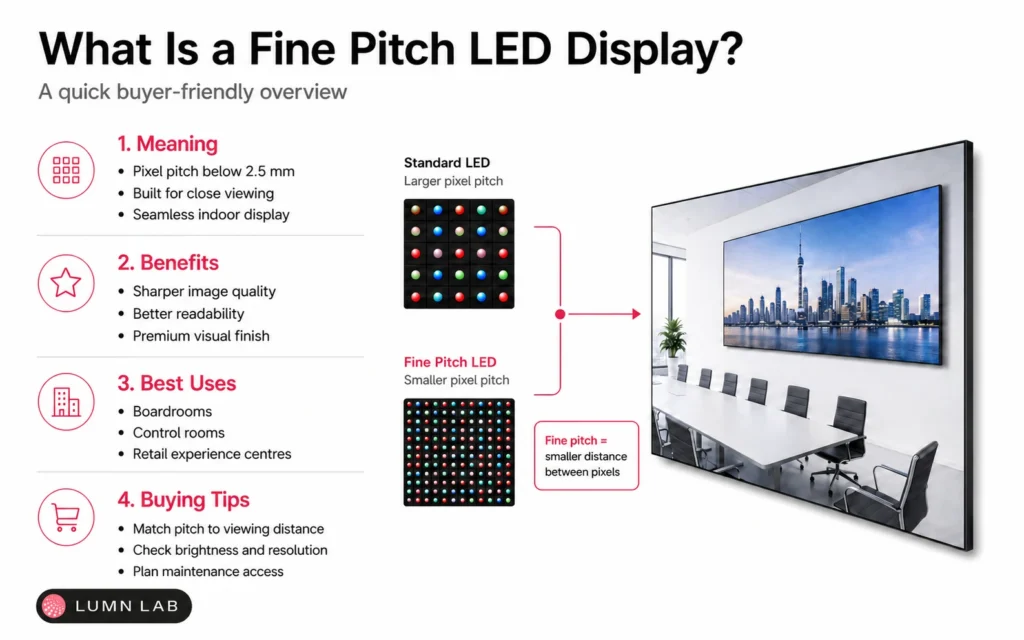
A fine pitch LED display is an LED screen with a very small distance between pixels.
This distance is called pixel pitch. It is measured in millimetres. For example, P1.2 means the distance between two LED pixels is 1.2 mm. P1.5 means the distance is 1.5 mm.
The smaller the pixel pitch, the more pixels fit into the same screen area. More pixels means better image detail.
Fine pitch LED displays are usually used for indoor or close-viewing environments where people sit or stand near the screen. Common examples include:
- Corporate boardrooms
- Control rooms
- Retail showrooms
- Experience centres
- Auditoriums
- Broadcast studios
- Hotel lobbies
- Educational institutions
- Command centres
In simple terms, if people are going to view the screen from 1 to 5 metres away, fine pitch LED is usually the better choice.
Why Pixel Pitch Matters So Much
Pixel pitch decides how clear your LED display will look from a certain distance.
A large outdoor billboard can use a bigger pixel pitch because people view it from far away. But the same pixel pitch inside a boardroom will look pixelated because people are sitting much closer.
Here is an easy way to understand it:
| Pixel Pitch | Best For | Approx. Viewing Distance |
| P0.9 to P1.2 | Premium boardrooms, studios, command centres | Very close viewing |
| P1.5 to P1.8 | Corporate spaces, retail, experience centres | Close viewing |
| P2.0 to P2.5 | Auditoriums, indoor events, large rooms | Medium viewing |
| P3 and above | Larger indoor or outdoor displays | Longer viewing distance |
The mistake many buyers make is choosing an LED display only by screen size.
Size is important, but pixel pitch decides whether the screen will actually look sharp.
A 12 ft wide screen with the wrong pitch can look worse than a smaller screen with the right pitch.
How Does a Fine Pitch LED Display Work?
A fine pitch LED display uses thousands or even millions of tiny LED pixels placed close together on modular panels.
These panels are joined to create one seamless video wall. Unlike LCD video walls, LED panels do not have thick borders or bezels between screens. That gives you one continuous display surface.
A good fine pitch LED display should offer:
- Sharp text readability
- Smooth image quality
- Uniform brightness
- Consistent colour output
- High refresh rate
- Wide viewing angle
- Seamless panel alignment
- Reliable performance for long operating hours
For corporate and commercial spaces, this matters because the screen is often used daily. It may show presentations, dashboards, videos, live feeds, brand films or product visuals. The display cannot look uneven, dull or patchy.
That is why site survey, pitch selection, calibration and installation quality are just as important as the LED panel itself.
Fine Pitch LED Display vs Standard LED Display
A fine pitch LED display is not always needed. It depends on the use case.
If the audience is far from the screen, a standard LED display may work well. But if the audience is close, fine pitch gives a much better experience.
| Feature | Fine Pitch LED Display | Standard LED Display |
| Pixel pitch | Smaller, usually below P2.5 | Larger, usually P3 and above |
| Viewing distance | Close viewing | Medium to long viewing |
| Image clarity | Very high | Good from distance |
| Best use | Boardrooms, control rooms, retail interiors | Events, large halls, outdoor signage |
| Cost | Higher | Lower |
| Visual feel | Premium and detailed | Large-format visibility |
For example, a P1.5 LED display can work beautifully inside a boardroom where people are seated close to the screen. But for an outdoor billboard on a main road, a larger pitch may be more practical and cost-efficient.
The right choice is not always the most expensive screen. The right choice is the screen that matches the viewing distance, content type and business goal
Where Are Fine Pitch LED Displays Used?
Fine pitch LED displays are used wherever visual detail matters.
Boardrooms and Corporate Offices
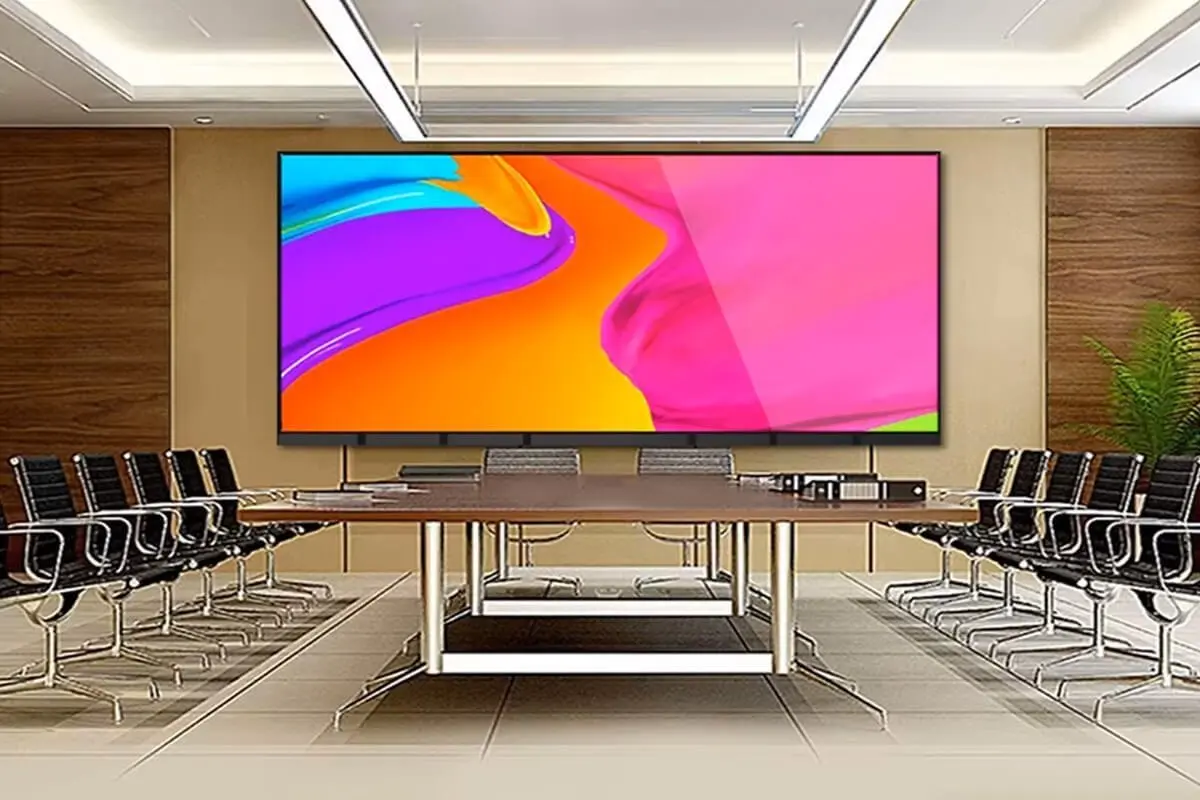
In boardrooms, small text, charts, video calls and presentations must be readable from every seat. A fine pitch LED video wall gives a cleaner and more premium alternative to projectors or multiple LCD panels.
Control Rooms and Command Centres
Control rooms need live dashboards, camera feeds, maps and operational data to stay visible 24/7. Fine pitch LED displays help teams monitor details without visual gaps.
Retail Stores and Experience Centres
Retail brands use fine pitch LED screens to create a stronger in-store experience. Product videos, campaign visuals and brand films look sharper and more immersive.
Hotels and Hospitality Spaces
Hotels use LED video walls in lobbies, banquet areas, ballrooms and premium event spaces. A fine pitch display can act as a digital backdrop, information wall or luxury visual feature.
Education and Auditoriums
Educational institutions use indoor LED video walls for lectures, presentations, hybrid sessions and events. The screen needs to be large, bright and readable from different seating positions.
Events and Broadcast Studios
Fine pitch LED walls are widely used for studio backdrops, stage visuals, product launches and high-end indoor events where cameras capture the screen closely.
Lumn Lab works with LED display requirements across India, including Delhi NCR, Mumbai, Bangalore, Hyderabad, Chennai and Pune, helping brands choose displays based on space, distance and usage.
How to Choose the Right Fine Pitch LED Display
Before buying a fine pitch LED display, do not start with the screen size alone.
Start with these questions:
1. What is the closest viewing distance?
If people will stand or sit very close, you need a smaller pixel pitch. For boardrooms and premium interiors, P1.2, P1.5 or P1.8 may be suitable depending on screen size and budget.
2. What content will run on the screen?
A screen used for Excel sheets, dashboards or presentations needs higher clarity than a screen used only for brand videos.
3. How bright is the space?
A hotel lobby, retail showroom or corporate reception may need higher brightness than a closed meeting room.
4. How many hours will it run daily?
For control rooms and commercial spaces, the display should be built for long operating hours with stable performance.
5. Who will manage the content?
A good LED display setup should include easy content control, training and after-sales support.
6. What is the installation environment?
Wall strength, ventilation, power supply, maintenance access and cable routing all affect the final installation.
A professional LED partner should check these before recommending a product.
Fine Pitch LED Display Price in India
The price of a fine pitch LED display in India depends on several factors:
- Pixel pitch
- Screen size
- Indoor or outdoor requirement
- Brightness level
- Refresh rate
- Cabinet type
- Controller and processor
- Installation complexity
- Content management system
- Warranty and service support
Fine pitch LED displays usually cost more than standard LED screens because they have a higher pixel density. More pixels means more components, better processing and more precise calibration.
But the higher cost makes sense when the screen is viewed from close range. In a boardroom, luxury retail store or control room, poor clarity can make the whole setup feel compromised.
A good way to decide is simple:
If people are close to the screen and the content has fine details, invest in fine pitch.
Why Choose Lumn Lab for Fine Pitch LED Displays?
Lumn Lab has been serving clients since 2015 and has delivered 1000+ LED display installations across India.
That experience matters because a fine pitch LED project is not just about supplying panels. It requires correct pitch selection, site planning, installation, calibration and long-term support.
Lumn Lab provides LED display solutions for corporate spaces, retail stores, hotels, educational institutions, events, public spaces and commercial environments.
For businesses that need certified and reliable LED display systems, Lumn Lab also works with quality-focused LED solutions such as BIS, ISO and IP-rated options where applicable to the project.
When you work with an experienced LED display company, you reduce common problems such as:
- Wrong pixel pitch selection
- Poor viewing experience
- Uneven brightness
- Visible panel gaps
- Content resolution mismatch
- Weak after-sales support
- Installation delays
For businesses in Delhi NCR, Mumbai, Bangalore, Hyderabad, Chennai, Pune and other Indian cities, Lumn Lab can help plan, supply and install the right fine pitch LED display for the space.
Conclusion
A fine pitch LED display is the right choice when your audience is close to the screen and visual clarity cannot be compromised.
It gives you sharper text, cleaner visuals, seamless video wall performance and a more premium experience than standard LED screens, projectors or LCD walls in many indoor applications.
The key is to choose the right pixel pitch for your viewing distance and content type.
Lumn Lab has been helping Indian businesses build LED display solutions since 2015, with 1000+ installations across sectors. Whether you need a boardroom LED wall, retail display, hotel lobby screen, control room video wall or indoor event display, Lumn Lab can help you choose and install the right fine pitch LED display.
Talk to Lumn Lab today to get a fine pitch LED display recommendation for your space.
Planning a boardroom, showroom, control room or indoor video wall?
Speak to Lumn Lab for a display recommendation based on your space, viewing distance and budget.
Frequently Asked Questions
What is a fine pitch LED display?
A fine pitch LED display is an LED screen with a small pixel pitch, usually used for close-viewing spaces. It offers sharper visuals, better text clarity and a more premium viewing experience than standard LED displays.
Is fine pitch LED better than an LCD video wall?
For seamless large-format visuals, fine pitch LED is usually better because it has no visible bezels between panels. It also offers better brightness, flexible sizing and a more premium look.
Where are fine pitch LED displays used?
They are used in boardrooms, control rooms, retail stores, hotels, auditoriums, experience centres, educational institutions, command centres and broadcast studios.
How much does a fine pitch LED display cost in India?
The cost depends on pixel pitch, screen size, brightness, installation needs and control system. Fine pitch LED displays are generally more expensive than standard LED screens because they use more pixels per square foot.
Can a fine pitch LED display be customized?
Yes. Fine pitch LED displays are modular, so they can be customized by size, shape and layout depending on the wall, room and content requirement.
How long does a fine pitch LED display last?
A good-quality LED display can last for many years with proper installation, ventilation and maintenance. Lifespan depends on usage hours, product quality and service support.
Who should buy a fine pitch LED display?
Businesses that need sharp close-viewing visuals should consider fine pitch LED. This includes corporate offices, retailers, hotels, event companies, institutions and control room operators.
Keep Reading