

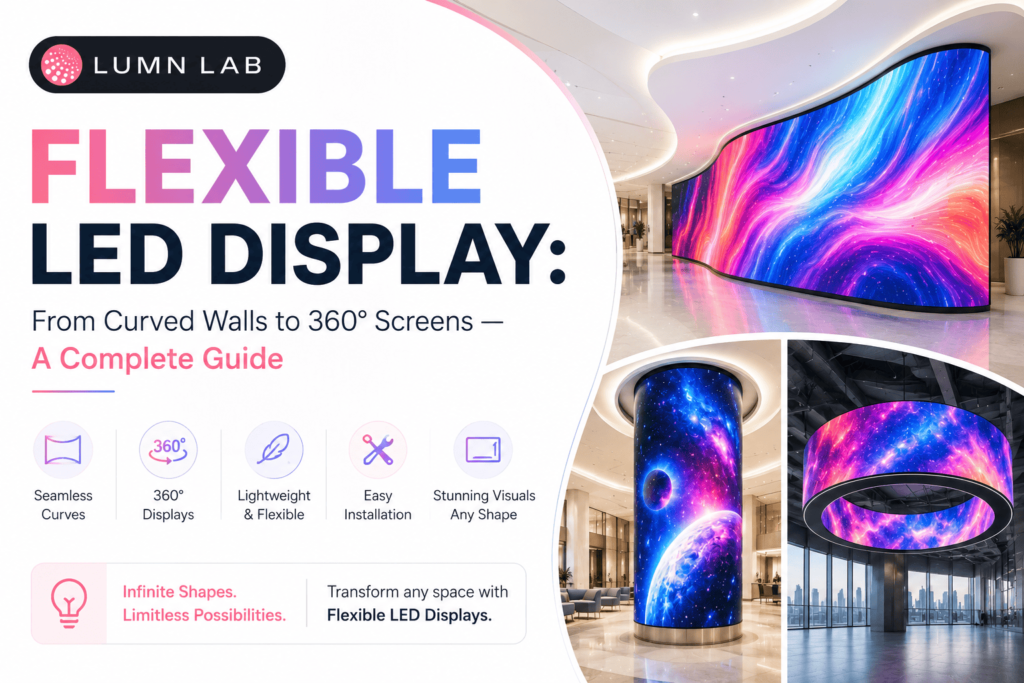

Flat rectangular screens are running out of room to impress. Now flexible led display is coming into picture. Walk into a flagship store in Delhi or an exhibition hall in Mumbai and the pixels aren’t confined to a rectangle anymore — they wrap around pillars, curve across domed ceilings, and fold into shapes a rigid panel simply can’t hold.
A flexible LED display is a bendable LED screen built on a soft PCB and flexible silicone or PU coating instead of a rigid metal cabinet, so it can curve, roll, or fold around columns, arches, and irregular surfaces. It’s the reason a growing number of retail brands, event organisers, and architects across India are moving away from flat video walls for anything with a curve, corner, or story to tell.
This guide covers the different types of flexible LED screens, what actually drives flexible LED display price in India, how durable these screens really are, and how to choose one for your next store, stage, or home theatre — whether you’re in Delhi, Gurgaon, Noida, Mumbai, or Bangalore.
What Is a Flexible LED Display?
A flexible LED display is an LED video screen made of thin, bendable modules — usually a flexible PCB with silicone-coated LED strips — that can curve to a set radius, roll up like a mat, or fold flat for transport. Unlike a traditional rigid LED cabinet, which is built on a fixed aluminium frame, a flexible module can be shaped on-site to follow curved walls, cylindrical columns, domes, or 360° structures.
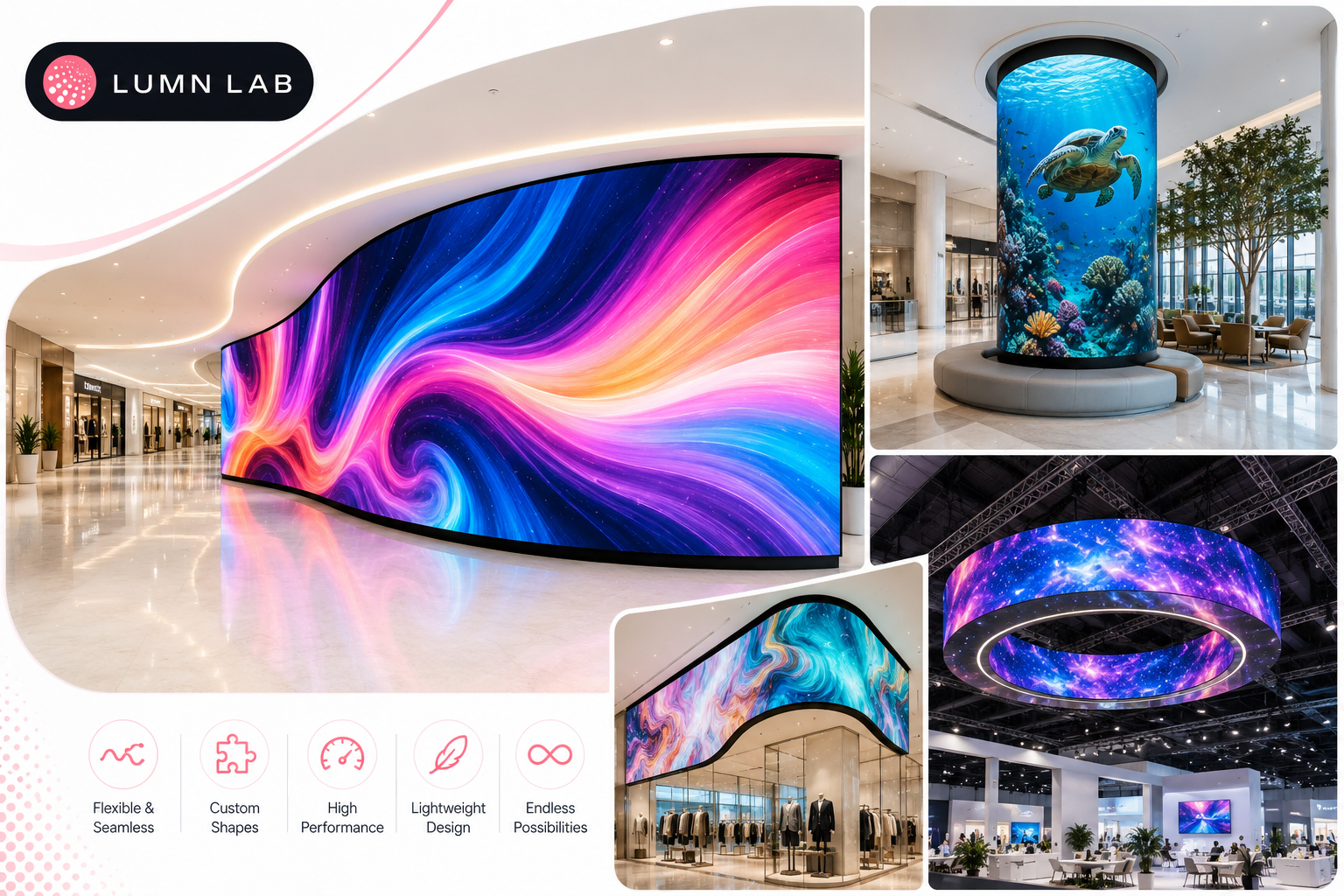
Because the module itself bends, it opens up display formats that were never possible with standard flat panels: wraparound store windows, spiral staircases, rounded reception counters, and immersive 360° stage backdrops.
Types of Flexible LED Screens
Flexible LED display isn’t one product — it’s a category. Here are the formats you’ll come across when sourcing one:
• Rolling / rollable LED display — mounted on a flexible mat that rolls up for storage or transport; common for touring events and rental stages.
• Foldable display screen — modules that fold along hinge points, useful for portable setups and pop-up activations.
• Curved / bendable LED wall — fixed-install panels curved to a specific radius for columns, arches, and domed ceilings.
• 360° LED screen — flexible panels wrapped fully around a structure (a pillar, cylinder, or stage truss) for all-angle viewing.
• Ultra-thin flexible LED screen — lightweight, low-profile modules designed for tight spaces, ceilings, and lightweight rigging.
• Flexible LED screen for glass — semi-transparent or mesh-style flexible modules mounted on glass facades and storefronts, popular for retail windows in malls.
Most indoor flexible LED display products used for retail and corporate interiors fall in the P2.5 to P4 pixel pitch range, while outdoor-facing curved installations tend to run coarser for viewing-distance and brightness reasons — the right pitch depends on how close your audience actually stands.
Key Features to Look for in a Rollable LED Screen
Not every flexible panel on the market is built the same way. Before you choose a rolling or foldable LED display, check for:
• Minimum bend radius — how tight a curve the module can safely hold without damaging the LEDs.
• IP rating — indoor flexible LED display panels typically need less protection than anything installed near glass facades or semi-outdoor areas.
• Weight per panel — lighter modules matter for rigging on trusses, ceilings, and temporary stage structures.
• Refresh rate and brightness — a high refresh rate matters if the screen will be filmed for broadcast or social content; brightness should match ambient light at the install location.
• Programmable control system — a genuinely programmable flexible LED screen should support standard control software so content updates don’t require a technician visit.
• Panel-to-panel seam quality — curved and 360° installs show seams more than flat walls do; ask for close-up sample footage before ordering.
Flexible LED Display Price in India: What Drives the Cost
There’s no single flexible LED screen price in India — cost depends on pixel pitch, screen size, curve complexity, control system, and whether it’s a purchase or a rental. As a rough guide, expect these factors to move the number:
| Factor | Impact on Price | Notes |
| Pixel pitch | Finer pitch = higher cost | P2.5–P3 typically costs more per sq. ft than P4–P6 |
| Curve / bend complexity | Tighter radius = higher cost | Custom-radius curves need factory-shaped modules |
| Panel type | Rental vs. fixed install | Rollable/rental panels are priced differently from permanent curved walls |
| Control system | Adds to total cost | Programmable, sync-capable controllers cost more than basic ones |
| Installation complexity | Site-dependent | 360° and ceiling-mounted installs need specialised rigging |
Because pricing is project-specific, we’d rather give you an accurate quote based on your actual space and use case than a generic number that doesn’t hold up on-site. Get a custom flexible LED display price quote from Lumn Lab and we’ll walk you through the real cost for your project.
Flexible LED Display vs. Traditional Rigid LED Display
The right choice depends on your surface, not just your budget. Here’s how the two compare:
| Aspect | Flexible LED Display | Traditional Rigid LED Display |
| Installation surface | Curved, cylindrical, domed, 360° structures | Flat walls only |
| Portability | Rolls or folds for transport | Rigid cabinets, harder to transport |
| Weight | Generally lighter per panel | Heavier aluminium cabinets |
| Best use case | Retail windows, curved stages, architectural features | Standard indoor/outdoor video walls, control rooms |
| Maintenance access | Front or rear, depending on model | Usually front or rear service, well standardised |
If your wall is flat, a rigid LED display is usually the more cost-effective option. If the surface curves, wraps, or needs to travel between events, flexible is the only real option — which is also the answer to the common question of which type of display is better: it comes down to the shape of the surface, not one format being universally superior.
Also Read: Fine Pitch LED Display: Meaning, Benefits, Uses and Buying Guide
How Durable Are Flexible LED Screens?
Flexible LED screens are built to be bent and rolled, so the modules use a silicone or rubberised coating designed to flex without cracking — well within their rated bend radius, they hold up to repeated rolling and unrolling across many event cycles. Durability comes down to three things: staying within the panel’s rated bend radius, matching the IP rating to the install environment, and using a reputable manufacturer’s driver ICs and connectors, since seams and connectors are typically the first failure point on a curved install, not the LEDs themselves.
Where Flexible LED Displays Are Used
Flexible and curved LED screens have moved well beyond novelty installs. Common applications include:
• Retail — wraparound storefront windows and curved brand walls in malls across Delhi, Gurgaon, and Mumbai.
• Events and stages — 360° concert backdrops, rollable rental screens for touring productions.
• Corporate interiors — curved reception walls, cylindrical lobby columns, and boardroom feature walls.
• Hospitality — hotel lobby domes and curved bar backdrops.
• Home theatres — a flexible LED display for home is increasingly used for curved home-cinema walls where a flat panel would break the room’s design line.
• Architecture and facades — flexible LED screen for glass applications on building exteriors and atriums, often semi-transparent for daylight visibility.
Flexible LED Display Manufacturers and Rental Services in India
If you’re comparing flexible LED display manufacturers in India, the practical checklist is the same wherever you’re based — Delhi, Noida, Gurgaon, Mumbai, or Bangalore: ask for a live sample bend demonstration, confirm the actual bend radius (not just the marketing spec), check what warranty covers the flexible module versus the control system, and confirm turnaround time for custom-curved orders.
For rental — a common need for events in Mumbai and exhibitions in Delhi-NCR — ask specifically whether the rollable panels being quoted are rental-grade (built for repeated setup/teardown) or repurposed fixed-install stock, since the two aren’t built to the same duty cycle.
Lumn Lab has been designing and installing LED display solutions since 2015, working across indoor, outdoor, rental, and now flexible and curved formats for clients across India. If you’re planning a curved wall, a 360° stage screen, or a flexible display for your storefront in Delhi, Gurgaon, Noida, Mumbai, or Bangalore, talk to our team about your surface and use case — we’ll recommend the right panel type and pixel pitch instead of a one-size-fits-all quote.
How to Choose the Right Flexible LED Display for Your Project
Work through these questions before requesting quotes:
• What’s the surface — a fixed curved wall, a temporary stage, or a 360° structure?
• How close will viewers stand? This decides the pixel pitch.
• Is it a one-time event or a permanent install? This decides rollable vs. fixed-curve panels.
• Is the location indoor, semi-outdoor, or near glass? This decides the IP rating.
• Do you need centralised content control across multiple screens or locations?
For broader industry standards and education on display technology, organisations like the Digital Signage Federation are a useful reference point when comparing vendors.
Conclusion
A flexible LED display isn’t a replacement for standard video walls — it’s the answer for every surface a flat panel can’t cover: curved columns, 360° stages, wraparound storefronts, and glass facades. Getting it right comes down to matching the panel type, bend radius, and pixel pitch to your actual space, not picking the cheapest quote on a spec sheet.
Lumn Lab has designed and installed LED display solutions across India since 2015, from standard indoor and outdoor screens to curved and flexible formats for retail, events, and corporate spaces.
If you’re planning a flexible LED display for a store, stage, or building in Delhi, Gurgaon, Noida, Mumbai, or Bangalore, get in touch with our team for a project-specific quote and panel recommendation.
Frequently Asked Questions
Q. Where can I find suppliers of bendable LED displays in Delhi?
Look for manufacturers with an in-house factory and a track record of curved installs, not just resellers — ask to see a live bend demo before ordering. Lumn Lab supplies and installs bendable LED displays for clients in Delhi and across the NCR.
Q. How much does a custom curved LED video wall cost?
Cost depends on pixel pitch, the curve’s bend radius, panel size, and control system — there’s no fixed number that applies across projects. Request a quote based on your actual wall dimensions and curve for an accurate figure.
Q. Which companies offer rental services for flexible LED panels in Mumbai?
Several LED display companies serve the Mumbai events market with rental-grade rollable panels; confirm the panels are rated for repeated setup and teardown, not repurposed fixed-install stock, before booking.
Q. What are the different types of flexible LED screens available?
The main types are rolling/rollable displays, foldable screens, curved or bendable walls, 360° wraparound screens, ultra-thin panels, and flexible mesh screens designed for glass facades.
Q. What are the key features to look for in a rollable LED screen?
Check the minimum bend radius, IP rating, panel weight, refresh rate, brightness, and whether the control system is genuinely programmable for easy content updates.
Q. How much does a flexible LED screen cost?
Flexible LED screen price in India varies by pixel pitch, curve complexity, and whether it’s a rental or permanent install — get a project-specific quote rather than relying on a generic per-square-foot figure.
Q. How durable are flexible LED screens?
Flexible LED screens are built with silicone-coated modules designed for repeated bending within their rated radius. Durability depends on staying within that bend radius, matching the IP rating to the environment, and the quality of the panel’s seams and connectors.
Q. Which type of display is better — flexible or traditional rigid LED?
Neither is universally better — it depends on the surface. Flat walls suit rigid LED displays; curved, cylindrical, or 360° surfaces need a flexible LED display.
Keep Reading