

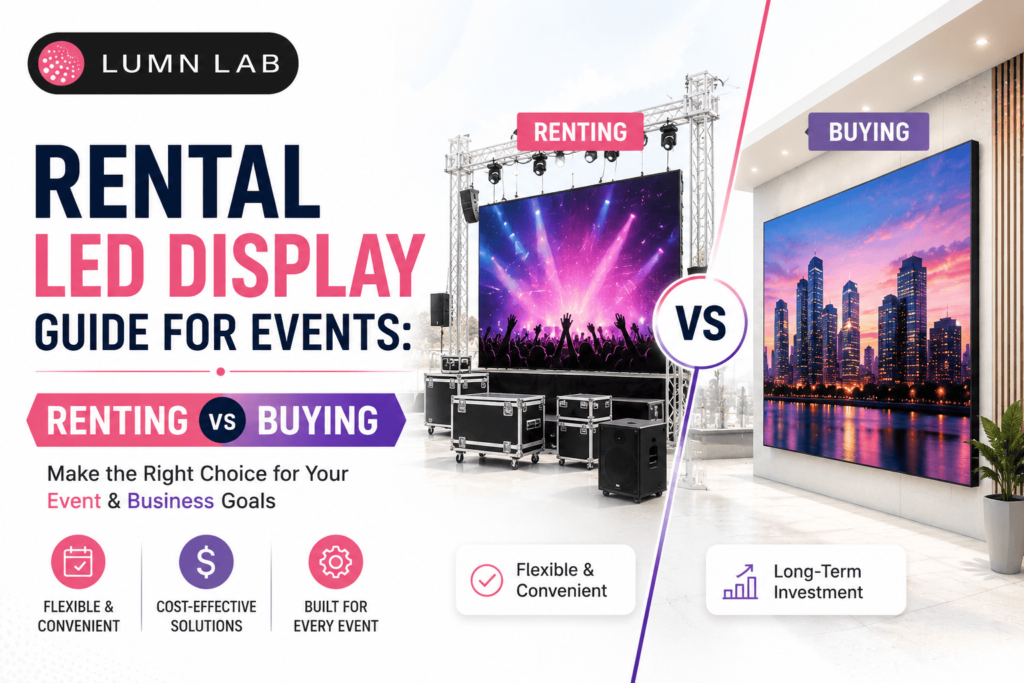

Every event company runs into this question eventually: rent the LED wall, or buy one and stop paying a rental fee every time. A rental LED display is built for exactly this dilemma — lightweight panels that assemble on-site, run for the length of your show, and get packed up and shipped to the next venue.
For a wedding backdrop or a single product launch, renting almost always wins on cost. For an event company running fifteen shows a year, the math flips. This guide breaks down what a rental LED display actually is, what it costs in India right now, and how to decide which side of that line you’re on.
What Is a Rental LED Display?
A rental LED display is a modular LED video wall built specifically to be assembled, used, and disassembled repeatedly — not installed once and left in place. The panels use die-cast aluminium cabinets, usually 500x500mm or 500x1000mm, that weigh around 6-9kg each and lock together with quick-release clamps instead of screws. That’s the entire difference between a rental panel and a fixed-installation panel: rental hardware is designed around fast rigging and repeated transport, fixed hardware is designed around staying bolted to one wall for a decade.
Most rental LED display screens in India run on P2.6 to P4.81 pixel pitch, which gives sharp images at typical stage and audience viewing distances without pushing costs into fine-pitch territory.
Renting vs Buying: Which Makes Sense for Your Event
This is really a frequency question dressed up as a technology question. If you need a screen once, twice, maybe three times a year, ownership rarely pays off — you’re carrying storage, maintenance, calibration, and depreciation costs on an asset that sits idle 350 days a year.
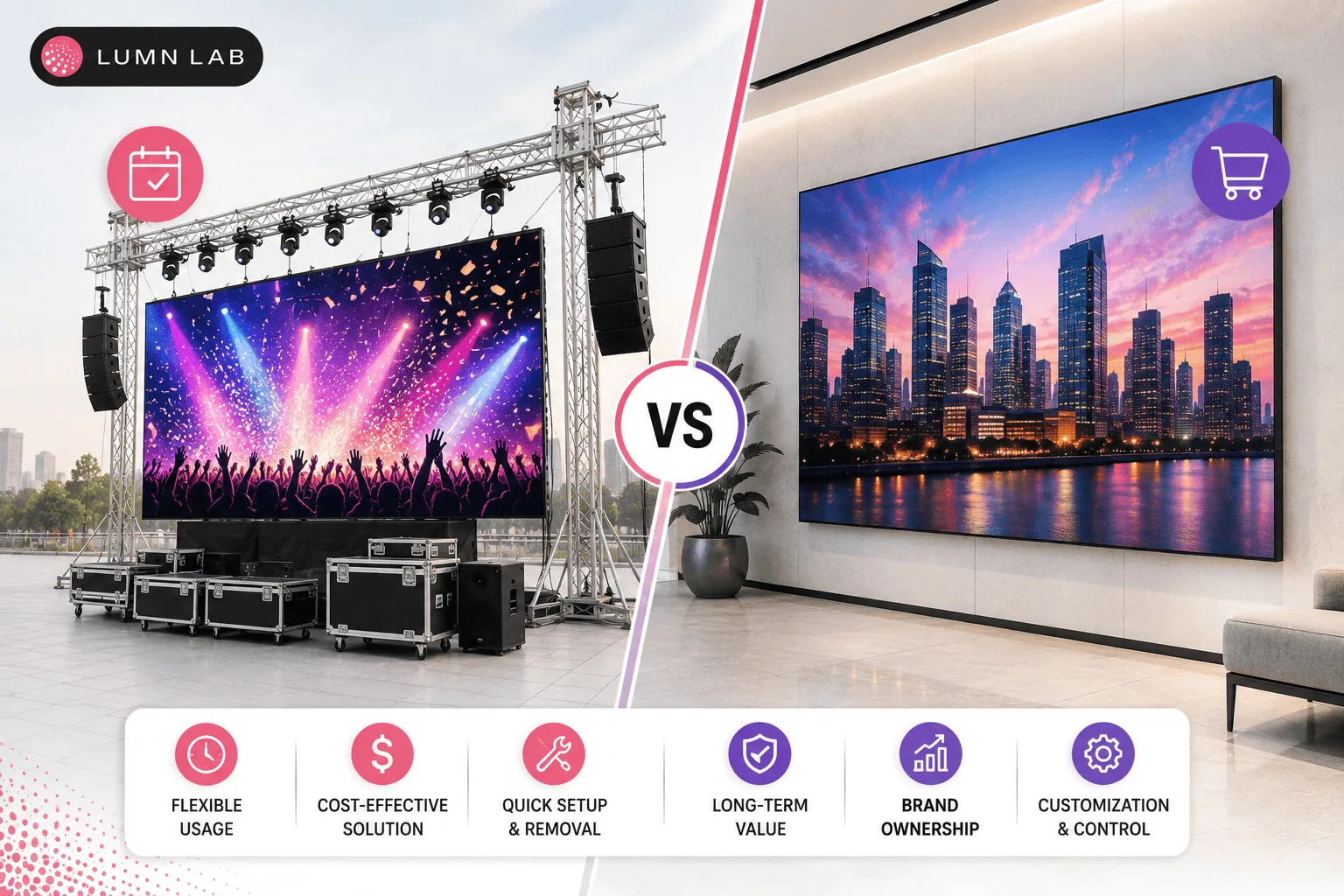
| Factor | Renting an LED Display | Buying an LED Display |
| Upfront cost | Low — daily or event-based rate | High — full panel + structure cost |
| Best for | One-off events, touring shows, seasonal campaigns | Fixed venues, recurring in-house events, brand offices |
| Maintenance | Handled by the rental vendor | Your responsibility (AMC recommended) |
| Storage | None needed | Requires climate-controlled storage between uses |
| Technology refresh | Always current gear | Panel ages with you; upgrade means a new purchase |
| Setup & breakdown | Vendor’s crew | Your team or a separate service contract |
If you’re an event company or a brand running six or more activations a year at similar screen sizes, owning a rental-grade inventory can lower your per-event cost within 18-24 months. Everyone else — corporates doing an annual townhall, couples planning a wedding, colleges hosting an annual fest — comes out ahead renting.
Rental LED Display Price in India
Rental LED display pricing in India typically runs ₹20 to ₹80 per sq.ft per day for the panels themselves, depending on pixel pitch and indoor vs outdoor grading. That number is just the panel rate — it usually doesn’t include transportation, rigging structure, power distribution, or an on-site operator, so a “full event quote” always runs higher than the bare per-sq.ft figure.
A few things that move the price:
- Pixel pitch — P2.6 and P2.9 cost more per sq.ft than P3.91 or P4.81 because there are more LEDs packed into the same area.
- Indoor vs outdoor — outdoor rental panels need higher brightness and weatherproofing, which adds to the day rate.
- Duration — multi-day bookings usually get a better daily rate than single-day hires.
- Rigging complexity — a ground-stacked backdrop is cheaper to rig than a flown, curved video wall.
- Location — availability and transport costs shift the quote between a Delhi NCR event and one in a smaller city.
If you want a working budget figure before contacting a vendor, multiply your planned screen area by the per-sq.ft rate for your pixel pitch, then add a rigging and logistics buffer of roughly 25-40% for a realistic total.
Also Read: Flexible LED Display: From Curved Walls to 360° Screens — A Complete Guide
P2.6, P2.9, P3.91 and P4.81 — Which Rental Panel Do You Need?
These four pixel pitches cover almost every event scenario in India:
- P2.6 — closest viewing distances, boardroom-style product reveals, front-row content that needs to hold up on camera.
- P2.9 — the most common indoor stage pitch; good balance of clarity and cost for concerts, corporate stages, and product launches.
- P3.91 — the industry default for general event rental, indoor or outdoor, when the audience sits more than 3-4 metres back.
- P4.81 — outdoor-leaning, larger screens, wider crowds, where cost-per-sq.ft matters more than the last bit of sharpness.
For outdoor rental jobs, look for panels rated IP65 or better on the front side — that’s what keeps the screen running through India’s monsoon and dust conditions without a mid-event failure. Checking India Meteorological Department’s monsoon forecasts ahead of an outdoor booking helps confirm whether the added weatherproofing cost is justified.
Where Rental LED Displays Get Used
- Concerts, weddings, and stage backdrops
- Product launches and press conferences
- Exhibitions and trade show booths (including LED poster and standee formats for smaller footprints)
- Corporate townhalls and annual functions
- Sports and broadcast events across various cities like Delhi NCR, Mumbai, Bangalore, Gurgaon, Noida, etc.
Event companies default to rental LED over LCD or projection for one simple reason: it’s modular. A 10×10 backdrop today can become a 20×8 stage wall next weekend, using the same panels, without buying new hardware.
How to Set Up a Rental LED Display Screen
- Site survey — confirm power availability, rigging points, and ground/flown mounting before the panels arrive.
- Structure build — ground stack or truss rigging goes up first, sized to the exact screen dimensions.
- Panel assembly — cabinets lock together row by row, starting from a corner, cables and data lines run as you go.
- Calibration — brightness and colour matching across every panel, done on-site before content goes live.
- Content test — run your actual show file end-to-end, checking sync, brightness in ambient light, and viewing angles from the back row.
- Standby support — a technician stays on-site through the event for anything that needs a quick fix.
- Breakdown — reverse of assembly, panels packed into flight cases for the next job.
Choosing a Rental LED Display Manufacturer
Not every vendor selling rental LED display screens actually manufactures them — a lot of the market resells factory stock. That distinction matters when a panel fails mid-event: a manufacturer or a factory-backed supplier can usually get a replacement module same-day, while a pure reseller has to wait on their own supplier chain.
Ask any rental LED display manufacturer you’re evaluating three things directly: how fast can they swap a failed panel during a live event, do they carry spares on every job, and can they show you a past installation of comparable scale. Vendors carrying BIS certification standards for their panels are worth prioritising when comparing quotes.
Expert Recommendations
- Always get the all-in quote, not just the panel rate. Rigging, transport, and operator charges can add 25-40% to the base panel price — ask for the full number upfront to avoid surprises.
- Match pixel pitch to viewing distance, not budget. A P2.9 screen wasted on a crowd standing 15 metres back is money spent on resolution nobody sees.
- Confirm IP65 rating for anything outdoor. India’s monsoon and dust conditions will find the weak point in an underrated panel faster than any indoor event would.
- Book rigging and power requirements before the panel booking. Screen availability rarely blocks an event — a last-minute truss or power shortfall does.
- Ask about spare panel coverage. A vendor carrying 5-10% spare cabinets on-site is the difference between a five-minute swap and a dark screen during your show.
Conclusion
Whether you rent or buy an LED display for your event comes down to how often you need one. Renting wins for weddings, one-off launches, and touring shows — no storage, no maintenance, no depreciation. Buying only pays off once you’re running events often enough to offset the upfront cost. Either way, the panel spec — pixel pitch, IP rating, and rigging plan — matters more to how the screen actually performs on the day than whether you own it or rented it for the weekend.
Lumn Lab has delivered 1,000+ LED display installations across India since 2015, including rental deployments for concerts, exhibitions, and corporate events in Delhi NCR, Mumbai, Bangalore, Gurgaon, and Noida.
If you’re planning an event and weighing a rental LED display against buying, get in touch with Lumn Lab for a same-day quote and panel recommendation.
Frequently Asked Questions
Q. What is a rental LED display?
A rental LED display is a modular LED video wall built with lightweight, quick-assembly cabinets designed to be set up, used for an event, and disassembled for transport to the next venue — unlike fixed-installation panels, which stay bolted in one location.
Q. How much does it cost to rent an LED screen in India?
Rental LED display prices in India typically run ₹20 to ₹80 per sq.ft per day for the panels alone. A full event quote — including transport, rigging, power, and an operator — usually runs higher than that base rate, so always ask for an all-inclusive number.
Q. What is the price of a 10×10 ft LED wall for a rental event?
A 10×10 ft (100 sq.ft) rental wall at a mid-range P3.91 rate of roughly ₹40-50 per sq.ft per day works out to about ₹4,000-5,000 per day for panels, before rigging, transport, and operator charges are added.
Q. What is the price of an 8×12 ft LED wall-mounted screen in India?
An 8×12 ft screen is more common as a fixed installation than a rental setup — for a permanent wall-mounted display of this size, pricing depends heavily on pixel pitch and site work, so a site-specific quote is the only reliable way to get an accurate number.
Q. Can a rental LED display be repaired if a panel fails during an event?
Yes. Rental panels are modular by design, so a single faulty cabinet or module can usually be swapped out in minutes without taking the whole screen down — which is why working with a vendor who carries on-site spares matters.
Q. How long do rental LED display panels last?
Well-maintained rental LED panels typically run 80,000-100,000 hours of LED lifespan, though the cabinets themselves see more physical wear from repeated assembly and transport than fixed installations do, so panel condition should be checked before every major booking.
Q. Should I rent or buy an LED display for my event?
Rent if you need a screen for one-off events, touring shows, or fewer than roughly six bookings a year. Buying starts making financial sense once you’re running frequent, similarly-sized events and can offset storage and maintenance costs against the rental fees you’d otherwise pay repeatedly.
Q. How do I set up a rental LED display screen?
Setup follows a fixed sequence: site survey, structure build (ground stack or truss), panel assembly, on-site calibration, a full content test, and a technician on standby through the event — followed by breakdown and repacking once the show ends.
Keep Reading