

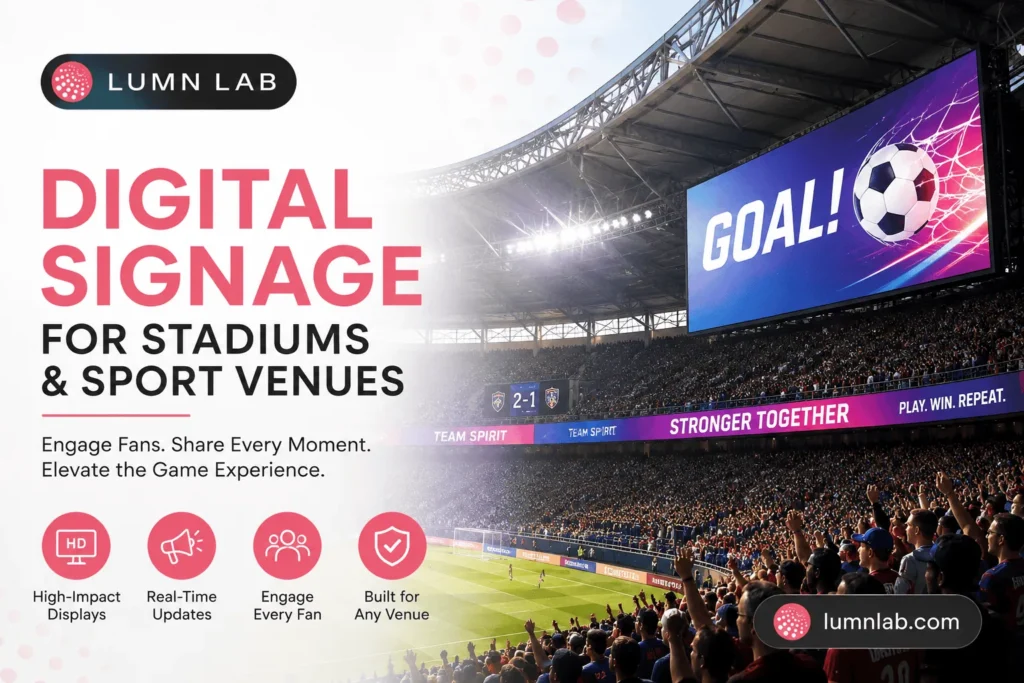

Walk into a stadium on match day and the first thing that pulls your eye usually isn’t the pitch — it’s the wraparound wall of light running replays, stats, and sponsor messages in sync with the crowd. That’s digital signage for sports venues, and it’s stopped being optional equipment.
For stadium owners, event companies, and sports federations across India, the real question isn’t whether to install LED displays — it’s which specification actually survives a full outdoor season without the picture degrading. This guide covers where these displays go inside a venue, what they deliver, and where a cheap install starts to fail.
What Is Digital Signage in Sports Stadiums?
Digital signage in sports stadiums refers to LED display systems — perimeter boards, giant video walls, scoreboards, and concourse screens — installed to deliver live match content, sponsor advertising, fan engagement visuals, and safety information across a venue. Unlike static banners, these displays update in real time and are engineered for extended outdoor exposure, high ambient-light brightness, and continuous operation through hours of live play.
Why Stadiums Are Investing in LED Display Technology
At-home viewers now get instant replays, multiple camera angles, and on-screen stats as standard. For a stadium to hold its own against that experience, it has to offer something a television broadcast can’t: a stadium-only visual layer built into the venue itself. LED displays give organisers that layer — real-time score overlays, crowd energy graphics, and sponsor activations that only make sense live, in the building.
There’s also a commercial reason. A perimeter LED board can rotate several sponsors through the same physical space during one match, instead of locking one advertiser into a static hoarding for an entire season. That turns a fixed asset into flexible, trackable inventory — which is why LED signage now shows up in venues of every size, from top-tier stadiums in Mumbai and Delhi NCR down to university and state-level sports complexes across India.
Key Applications of LED Displays in Sports Stadiums
Stadium LED signage isn’t a single product — it’s a set of display types, each solving a different problem inside the venue.
Perimeter LED Displays for Broadcast & Sponsorship
Perimeter boards ringing the field are the most broadcast-visible signage in the stadium. Content is programmed to rotate on schedule, so sponsor messages get guaranteed airtime both for the live crowd and for the television and streaming audience watching from home.
Giant Video Walls & Scoreboards
Large-format video walls anchor the fan experience — showing the live score, player stats, instant replays, and crowd cam moments. These need higher brightness and finer pixel pitch than perimeter boards, since fans view them from a wide range of distances across the stands.
Fan Engagement & Interactive Displays
Concourse-level screens, photo walls, and interactive kiosks give fans something to do before kickoff and during breaks — contests, social media walls, and promotional content that fills the halftime lull instead of leaving fans staring at their phones.
Wayfinding & Concourse Signage
Large crowds need fast, clear direction. Digital wayfinding screens showing gate numbers, seating blocks, and queue status reduce congestion at entry points and washrooms far more effectively than printed signage.
VIP Lounges & Hospitality Boxes
Premium suites typically use smaller-format indoor LED panels for match feeds, menus, and branded content — prioritising picture quality and finer pixel pitch over the brightness needed outdoors.
Emergency Communication & Crowd Safety
Beyond entertainment, stadium LED signage doubles as a safety tool. Evacuation instructions, weather alerts, and crowd-control messaging can be pushed to every screen in the venue instantly — a capability static signage simply cannot offer.
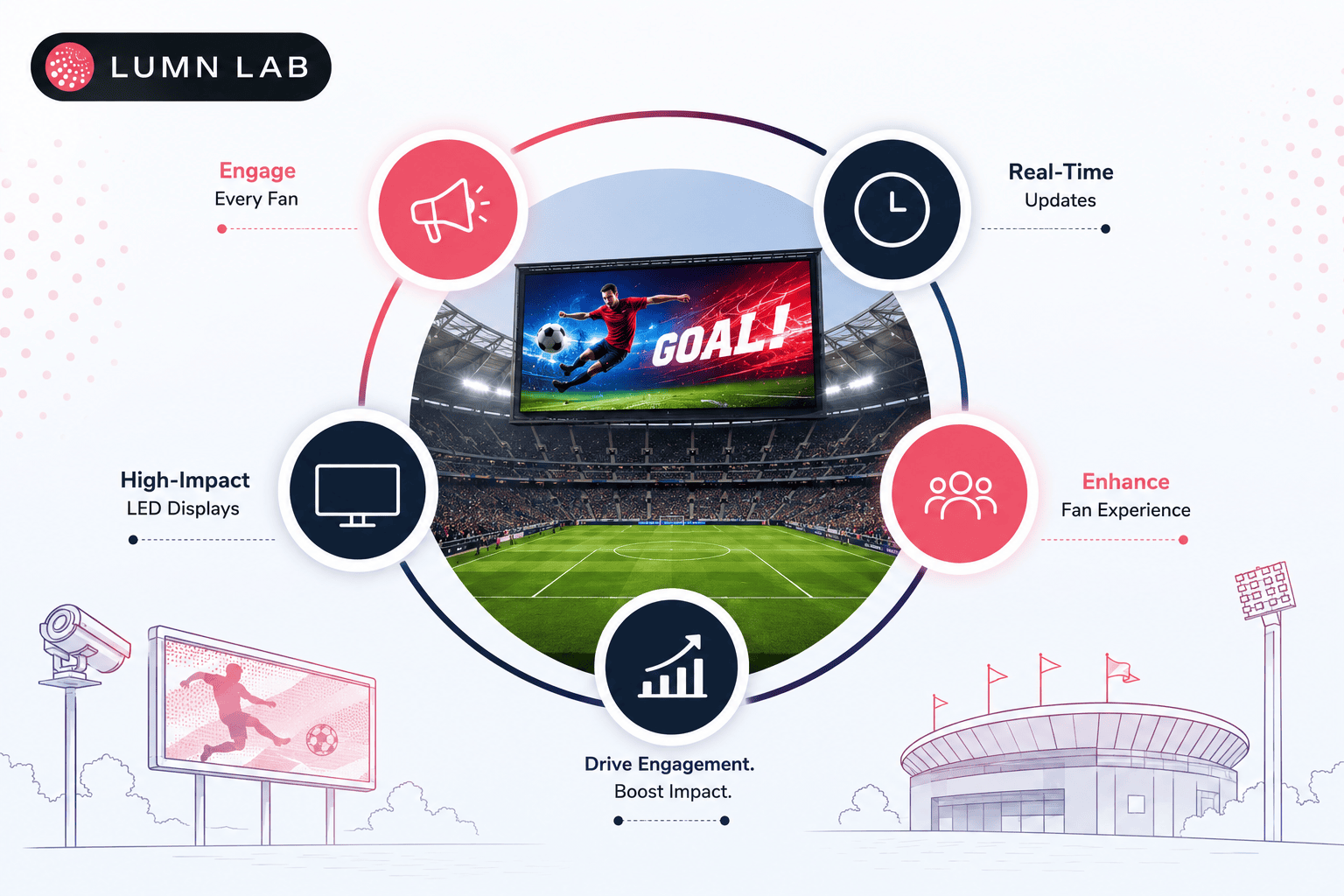
Benefits of LED Digital Signage for Stadiums and Sports Venues
Enhanced Fan Experience
Real-time replays, stats overlays, and in-stadium graphics keep energy high and give fans a reason to stay engaged between plays.
Increased Sponsorship Revenue
Rotational LED inventory lets venues sell the same screen space to multiple sponsors, increasing revenue per square metre compared with static hoardings.
Real-Time Information Delivery
Scores, weather updates, and safety alerts reach the entire venue simultaneously, with no lag between what’s happening on the field and what fans see on screen.
Energy Efficiency and Durability
Modern LED panels draw less power than older display technologies and are built for continuous operation. Outdoor-rated panels handle India’s heat, humidity, and monsoon conditions — though brightness does taper gradually over years of outdoor use, which is why panel quality and cooling design matter more than the number on a spec sheet.
Brand Visibility for Event Organizers
A well-lit, professionally run signage system signals a well-run venue. That matters when a stadium is pitching for tournaments, concerts, or corporate events outside its regular sports calendar — organisers notice the details.
Factors to Consider When Choosing a Stadium LED Display
Pixel Pitch and Viewing Distance
Pixel pitch determines image clarity at a given distance. Perimeter boards viewed from a distance can use a wider pixel pitch, while video walls closer to seating need a finer pitch for crisp, readable content.
Brightness and Weather Resistance
Outdoor stadium displays need high nit brightness to stay visible in direct daylight, along with an IP65 rating to withstand dust, rain, and humidity — a non-negotiable for open-air venues across Indian cities like Bangalore, Mumbai, and Noida.
Refresh Rate for Broadcast Quality
Displays that will appear on television or live-stream broadcasts need a high refresh rate to avoid flickering or banding on camera — a detail that’s easy to overlook until match footage reveals the problem.
Installation and Structural Support
Large-format stadium displays carry real structural load. Mounting design, ventilation, and cable routing all need to be engineered around the venue’s architecture, not retrofitted after the fact.
Certifications and Compliance
For institutional and government sports projects in particular, working with a manufacturer holding BIS and ISO certifications, alongside IP65-rated panels, simplifies compliance and gives procurement teams a documented quality standard to point to.
Also Read: LED Screen for Commercial Use: The Future of Smart Display Solutions
Digital Signage vs. Traditional Stadium Signage
The comparison below outlines where LED digital signage pulls ahead of static, print-based stadium signage.
| Factor | LED Digital Signage | Traditional Static Signage |
| Content updates | Real-time, remotely programmable | Requires manual reprinting/replacement |
| Sponsorship inventory | Multiple sponsors rotate on one screen | One sponsor per physical space |
| Weather durability | IP65-rated panels built for outdoor use | Prone to fading, tearing, weather damage |
| Fan engagement | Live stats, replays, interactive content | Static image only |
| Safety communication | Instant venue-wide alerts | Not possible in real time |
| Long-term cost | Higher upfront, lower cost per impression over time | Lower upfront, recurring reprint costs |
Conclusion
Digital signage for stadiums and sport venues isn’t just entertainment infrastructure anymore — it drives sponsorship revenue, keeps fans engaged, and doubles as a safety communication system when it matters most. Getting it right comes down to matching pixel pitch, brightness, and structural planning to the actual venue, not picking whatever tops a generic spec sheet.
Lumn Lab has delivered 1000+ LED display installations since 2015, including stadium, arena, and large-format outdoor projects across India, backed by BIS, ISO, and IP65-certified panels.
If you’re planning a stadium or arena LED display project in Delhi NCR, Mumbai, Bangalore, Noida, or anywhere else in India, get in touch with Lumn Lab for a site-specific consultation and quote.
Get an LED Display Built for Your Venue
From perimeter boards to full-scale video walls, Lumn Lab designs stadium LED displays backed by BIS, ISO, and IP65-certified panels — engineered to hold up under continuous outdoor use across Indian weather conditions.
Frequently Asked Questions
Q. What is digital signage for stadiums and sports venues?
It’s the use of LED display systems — perimeter boards, video walls, scoreboards, and concourse screens — to deliver live match content, advertising, and safety information throughout a venue in real time.
Q. How much does an LED display for a stadium cost in India?
Cost depends on pixel pitch, screen size, brightness rating, and installation complexity. Perimeter boards and video walls are priced per square metre; venues should request a site-specific quote based on viewing distance and budget.
Q. What pixel pitch is best for stadium LED screens?
Perimeter boards viewed from a distance typically use a wider pixel pitch (P10–P16), while video walls closer to seating areas use a finer pitch (P4–P8) for sharper detail.
Q. Are stadium LED displays weatherproof?
Outdoor-rated stadium displays should carry an IP65 rating or higher, protecting the panels from dust, rain, and humidity across seasonal conditions.
Q. How long do stadium LED displays last?
With proper installation and maintenance, quality outdoor LED panels typically operate for many years of continuous use; actual lifespan depends on panel quality, brightness settings, and environmental exposure.
Q. Can one LED perimeter board run multiple sponsors during a match?
Yes. Perimeter LED boards can be programmed to rotate multiple sponsor messages on a set schedule, giving each advertiser guaranteed screen time within the same physical display.
Q. How is a stadium LED display different from a standard advertising LED screen?
Stadium displays require higher brightness for daylight visibility, broadcast-safe refresh rates, and weatherproofing, along with structural mounting designed for large-format outdoor installation — requirements a standard indoor advertising screen doesn’t need to meet.
Q. Do stadium LED screens need special certification in India?
For institutional and government projects especially, BIS and ISO certification along with an IP65 rating are commonly required or preferred as part of procurement and quality compliance.
Q. How is stadium LED signage powered and maintained during live events?
Stadium displays typically run on dedicated power circuits with backup provisions, and are maintained through scheduled panel checks, cleaning, and firmware updates between events to prevent downtime on match day.
Q. Which Indian cities have the most stadium LED display installations?
Metro sports hubs including Delhi NCR, Mumbai, and Bangalore have the highest concentration of large-format stadium and arena LED installations, though demand is growing steadily in Tier-2 sports infrastructure as well.
Keep Reading