


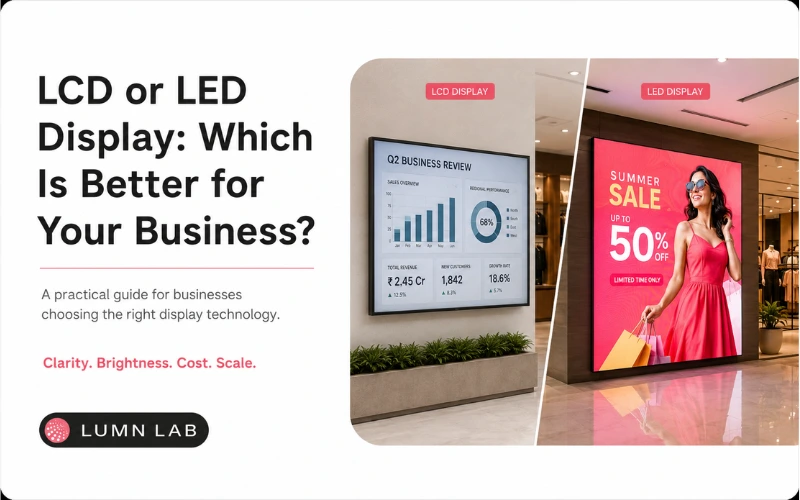

Most people ask the wrong question first. They ask, “Which is better, LCD or LED display?”
The better question is this: where will the screen be used, how large does it need to be, and how far away will people stand from it?
A 55-inch screen inside a meeting room has very different needs from a 12-foot LED wall in a showroom. A hotel lobby display is not the same as an outdoor billboard in Mumbai traffic. And an event screen that has to travel every week is a different product altogether.
So the answer is not “LCD is always better” or “LED is always better.”
The honest answer: LCD works well for smaller, close-viewing screens. LED is usually the better choice when you need size, brightness, visibility and commercial impact.
Let’s make the comparison simple.
What Is an LCD Display?
An LCD display is a flat-panel screen that uses liquid crystals and a backlight to show images.
You already see LCD screens everywhere. Office monitors, televisions, classroom screens, restaurant menu boards, information kiosks and reception displays often use LCD technology.
LCD is practical when the screen size is limited and the viewer is close to the display.
Good examples include:
- Office cabins
- Small meeting rooms
- Billing counters
- Menu boards
- Self-service kiosks
- Classroom smart screens
- Reception information displays
For these use cases, LCD can be enough. It is easy to buy, familiar to use and usually cheaper upfront.
But LCD starts showing its limits when the screen needs to become very large, very bright or completely seamless.
What Is an LED Display?
An LED display uses light-emitting diodes to create visuals directly.
In commercial spaces, when people say “LED display,” they usually mean a direct-view LED screen. These displays are made with LED modules or cabinets that join together to form a large screen.
That is why LED displays are used in places where a normal screen is not enough.
You will see them in:
- Retail showrooms
- Corporate lobbies
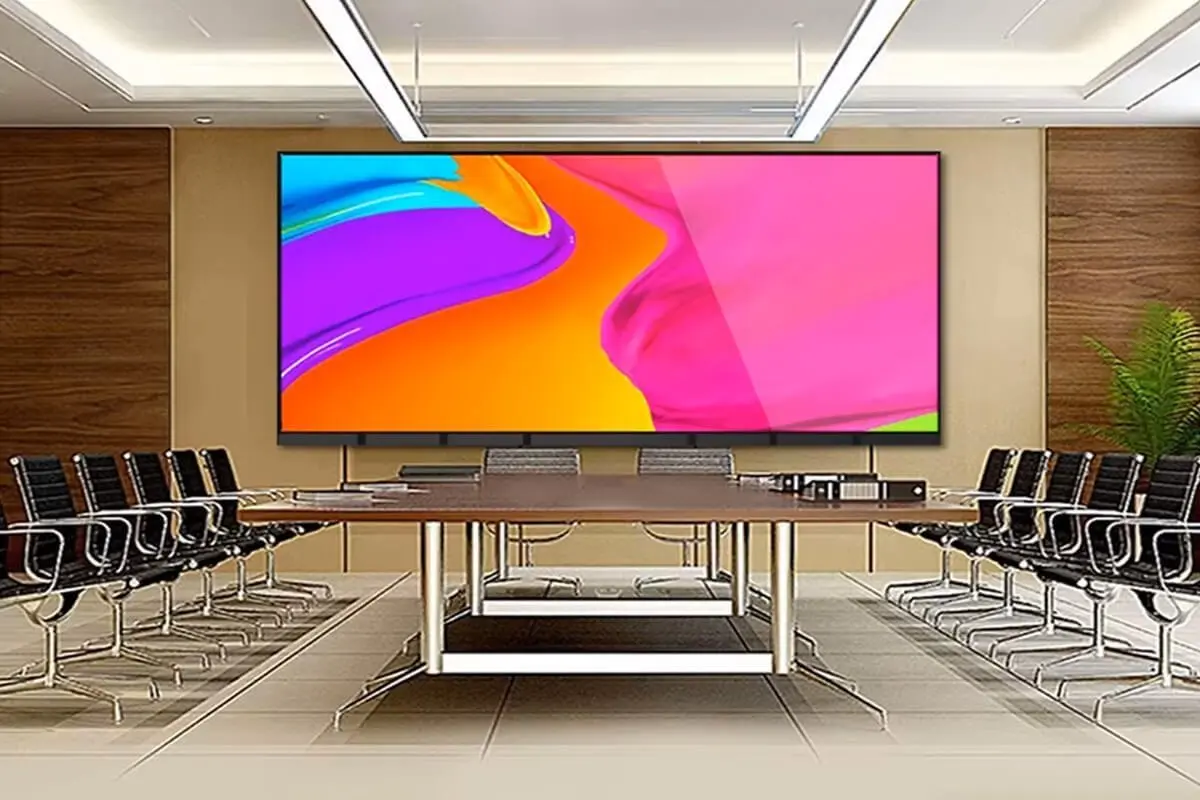
- Boardrooms
- Auditoriums
- Event stages
- Hotels
- Shopping malls
- Airports
- Outdoor advertising
- Experience centres
- Command centres
The biggest advantage of LED is flexibility.
You are not locked into one fixed screen size. You can build a small indoor wall, a large outdoor screen, a curved installation, a rental stage backdrop or a fine-pitch boardroom display depending on the space.
LCD or LED Display: The Main Difference
The main difference is how the image is produced.
LCD uses a liquid crystal panel with a backlight behind it. LED displays use individual LED pixels that emit light directly.
That one difference changes everything: brightness, size, viewing distance, maintenance and the final look.
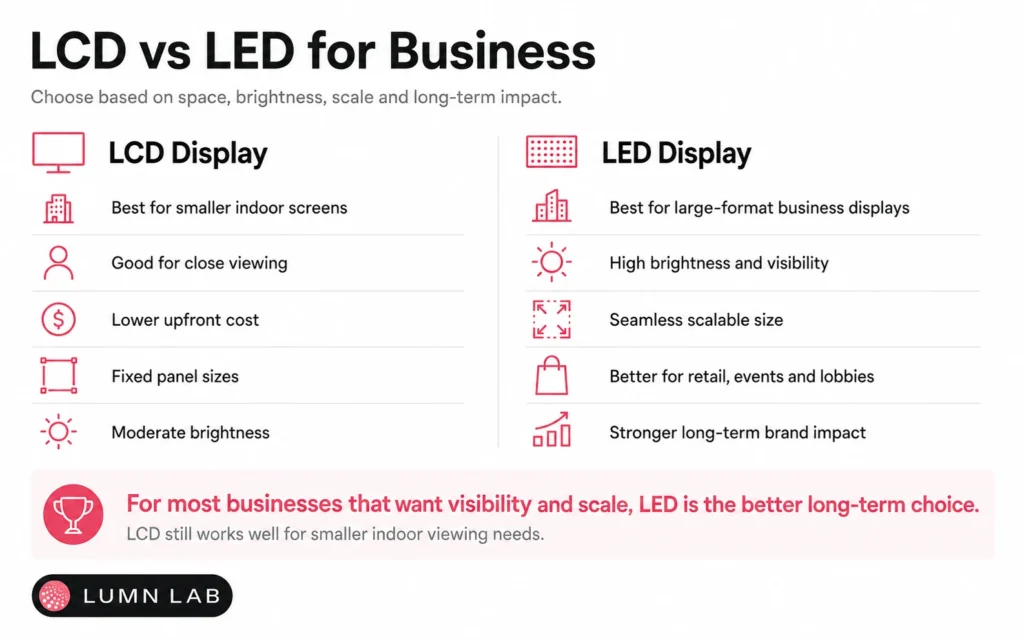
| Factor | LCD Display | LED Display |
| Best for | Small and medium screens | Large commercial screens |
| Screen size | Fixed panel sizes | Custom and scalable |
| Brightness | Good indoors | Strong indoors and outdoors |
| Viewing distance | Best for close viewing | Works for close, mid and long distance |
| Large video wall look | Bezels may be visible | Seamless or near-seamless |
| Outdoor use | Limited | Strong option with weather-rated products |
| Maintenance | Usually panel-based | Modular service and replacement |
| Best examples | Monitors, kiosks, menu boards | Video walls, events, retail, outdoor signage |
Which Is Better for Business Use?
For most commercial projects, LED display is the better long-term choice.
Not because LCD is bad. LCD is useful. But it is not built for every business environment.
If you need one screen in a small meeting room, LCD may do the job. If you need a display that becomes part of the space, LED usually makes more sense.
Think of it this way:
A cafe menu board can work on LCD.
A jewellery showroom that wants premium visuals should use LED.
A small classroom may be fine with LCD.
A university auditorium needs LED because people sitting at the back also need to see clearly.
A hotel reception desk may use LCD.
A hotel lobby, ballroom or banquet space will usually look better with LED.
The choice depends on the role of the screen. Is it just showing information, or is it creating attention, trust and experience?
Why LED Displays Work Better in Commercial Spaces
LED displays are not just bigger screens. They solve problems that LCD screens struggle with.
1. LED Is Easier to See in Bright Spaces
Brightness is one of the biggest reasons businesses choose LED.
Retail stores, malls, airports, hotel lobbies and outdoor locations usually have strong ambient light. A screen that looks bright in a dark room may look dull in a sunlit space.
LED displays are designed for better visibility. Outdoor LED displays, especially, are built with much higher brightness levels so the content remains visible during the day.
This matters in cities like Delhi NCR, Mumbai, Bangalore, Hyderabad, Chennai and Pune, where brands often compete for attention in busy retail streets, malls, commercial hubs and event venues.
2. LED Looks Better at Large Sizes
LCD video walls can show lines between panels. These lines are called bezels.
In some places, that may not matter. But in a premium showroom, boardroom, hotel lobby or brand experience centre, those lines can make the setup look less polished.
LED displays are modular, but the final surface can look seamless or near-seamless. That makes a huge difference when the screen is part of the interior design.
A large display should feel like one screen, not a group of screens joined together.
3. LED Can Be Built Around the Space
LCD screens come in fixed sizes. LED displays can be planned around the site.
That means you can design the display based on:
- Wall size
- Viewing distance
- Ceiling height
- Lighting condition
- Content format
- Audience size
- Installation structure
This is useful for architects, interior designers, retail teams and corporate decision-makers. The display does not have to look like an afterthought. It can be planned as part of the space.
4. LED Is Better for Outdoor Use
Outdoor displays need more than a bright screen.
They need weather protection, proper cabinet design, heat handling, secure installation and easy maintenance access.
That is where outdoor LED displays have a clear advantage. Depending on the product, they can come with IP-rated protection for dust and water resistance, which is important for Indian weather conditions.
For outdoor projects, do not choose only by price. Check brightness, pixel pitch, IP rating, cabinet quality, service access and installation structure.
A cheap outdoor screen can become expensive very quickly if it fails in rain, heat or dust.
5. LED Is the Better Choice for Events
Event companies usually prefer LED because it is modular and portable.
Rental LED displays can be assembled, dismantled, moved and reused across different venues. That makes them useful for:
- Corporate events
- Product launches
- Exhibitions
- Concerts
- Weddings
- Conferences
- Stage backdrops
- Award nights
LCD screens are not ideal for this kind of work. They are harder to scale, more fragile in repeated movement and less flexible for stage design.
When Should You Choose an LCD Display?
Choose LCD when the display is small, indoor and viewed from a short distance.
LCD is a sensible option for:
- Small office rooms
- Individual monitors
- Counter displays
- Restaurant menus
- Kiosks
- Reception information screens
- Classroom screens
If your display requirement is simple and under the large-format range, LCD may be enough.
But once the screen becomes a major part of the customer experience, brand presentation or public communication, LED deserves serious consideration.
When Should You Choose an LED Display?
Choose LED when the screen needs to be large, bright, seamless or visually impressive.
LED is a better fit for:
- Retail stores and showrooms
- Shopping malls
- Corporate boardrooms
- Office lobbies
- Hotels and banquet halls
- Colleges and universities
- Auditoriums
- Command centres
- Broadcast studios
- Event stages
- Outdoor advertising
- Religious and public venues
For example, a corporate office in Bangalore may need a fine-pitch LED wall for presentations. A retail brand in Mumbai may use LED for storefront visibility. A hotel in Delhi NCR may need an LED backdrop for its ballroom. An event company in Hyderabad may need rental LED panels. A showroom in Chennai or Pune may use LED to make product visuals feel larger than life.
Different cities. Different spaces. Same principle.
If the screen has to attract, inform and impress, LED usually does the job better.
Pixel Pitch Matters More Than Most People Think
Screen size is not the only thing that matters in an LED display.
Pixel pitch is just as important.
Pixel pitch is the distance between two LED pixels. Smaller pixel pitch gives sharper visuals for close viewing. Larger pixel pitch works when people are watching from farther away.
This is where many businesses make mistakes.
They either overpay for a pixel pitch they do not need, or they save money on the wrong specification and end up with a screen that looks pixelated.
Simple examples:
- Boardrooms need fine-pitch LED because people sit close.
- Retail stores need a balance between clarity and budget.
- Outdoor billboards can use larger pixel pitch because viewers are farther away.
- Event screens depend on stage size and audience distance.
- Auditoriums need planning based on the first row and last row.
This is one reason working with an LED specialist matters. The right recommendation can save money and improve the final result.
LCD vs LED Display by Industry
| Industry | Better Choice | Why |
| Retail | LED | Better visibility, premium feel and stronger product storytelling |
| Corporate | LED for large rooms, LCD for small rooms | Depends on room size and presentation needs |
| Events | LED | Modular, portable and stage-friendly |
| Education | LCD for classrooms, LED for auditoriums | Depends on audience size |
| Hotels | LED | Better for lobbies, ballrooms and guest experience |
| Architecture | LED | Can be customized for walls, curves and facades |
| Outdoor advertising | LED | Higher brightness and weather-ready options |
| Kiosks | LCD | Cost-effective for close interaction |
Is LED More Expensive Than LCD?
Yes, LED displays usually cost more upfront than LCD screens.
But the cheaper option is not always the better business decision.
LCD makes sense when the display is small and functional. LED makes sense when the display affects brand visibility, customer experience or audience engagement.
LED can offer better value when:
- The screen is large
- The location has high footfall
- The display runs for long hours
- The content needs to look premium
- Outdoor visibility matters
- The screen has to support events or campaigns
- The business wants a long-term visual asset
For a simple screen, LCD may be cheaper. For a showroom, auditorium, hotel, event venue or outdoor branding space, LED is often the stronger investment.
Why Work With an LED Display Specialist?
A commercial LED display is not just a screen.
It includes screen size, pixel pitch, brightness, cabinet type, mounting, viewing distance, content format, power planning, ventilation and maintenance access.
Miss one of these, and the display may not perform the way you expected.
Lumn Lab has been working in LED display solutions since 2015 and has delivered 1000+ installations across India. The company works across indoor LED displays, outdoor LED screens, rental LED solutions, fine-pitch displays, transparent LED displays and specialized visual installations.
The brand also works with product specifications and certifications such as BIS, ISO and IP-rated protection where applicable, depending on the display category and installation environment.
If you are planning a display for an office, showroom, hotel, campus, retail space or event venue, do not finalize only by screen size. Get the viewing distance, brightness and pixel pitch checked first.
That one step can prevent a costly mistake.
Conclusion
When comparing LCD or LED display options, the right answer depends on the space.
Choose LCD when you need a smaller screen for close viewing, simple information display or budget-friendly indoor use.
Choose LED when you need scale, brightness, seamless visuals and stronger commercial impact.
For most business display projects in India, especially across Delhi NCR, Mumbai, Bangalore, Hyderabad, Chennai and Pune, LED displays offer better flexibility, visibility and long-term value.
Lumn Lab helps businesses choose the right LED display based on site conditions, audience distance, lighting, content and installation needs. With 1000+ installations since 2015, the team brings practical experience to projects where the display cannot afford to look average.
If you are planning a new display, start with the space. Lumn Lab can help you choose the right LED screen, pixel pitch and installation approach before you invest.
Planning an LED display for your space?
Get expert guidance on screen size, pixel pitch, viewing distance, installation, and budget before you invest.
Frequently Asked Questions
1. Which is better, LCD or LED display?
LED display is better for large commercial screens, outdoor visibility, events and premium spaces. LCD is better for small indoor screens, kiosks, monitors and close-viewing use.
2. Is LED display more expensive than LCD?
Yes. LED displays usually cost more upfront than LCD screens, but they can offer better value for large-format, outdoor and high-impact commercial applications.
3. What is the main difference between LCD and LED display?
LCD uses a liquid crystal panel with a backlight. Direct-view LED displays use LED pixels that emit light directly, making them brighter, scalable and better for large screens.
4. Is LED better than LCD for outdoor advertising?
Yes. LED is better for outdoor advertising because it offers higher brightness, larger screen sizes and weather-rated options for outdoor conditions.
5. Can LCD be used for a video wall?
Yes, LCD can be used for a video wall. But LCD video walls usually have visible bezels between panels. LED video walls look more seamless.
6. Which display is best for retail stores?
LED displays are better for premium retail stores and showrooms because they attract attention and make product visuals look more impressive. LCD can work for small counter or menu screens.
7. Which display is better for corporate boardrooms?
Fine-pitch LED displays are better for large boardrooms and executive presentation rooms. LCD screens can work well in smaller meeting rooms.
8. What is pixel pitch in LED displays?
Pixel pitch is the distance between two LED pixels. Smaller pixel pitch gives sharper visuals for close viewing. Larger pixel pitch is suitable for long-distance viewing.
9. Which lasts longer, LCD or LED display?
Both can last for years with proper use. Commercial LED displays are often designed for long operating hours, modular servicing and large-scale installations.
10. How do I choose between LCD and LED display?
Choose based on screen size, viewing distance, brightness, location, budget and content type. For large, outdoor or premium spaces, LED is usually the better choice.
Keep Reading