

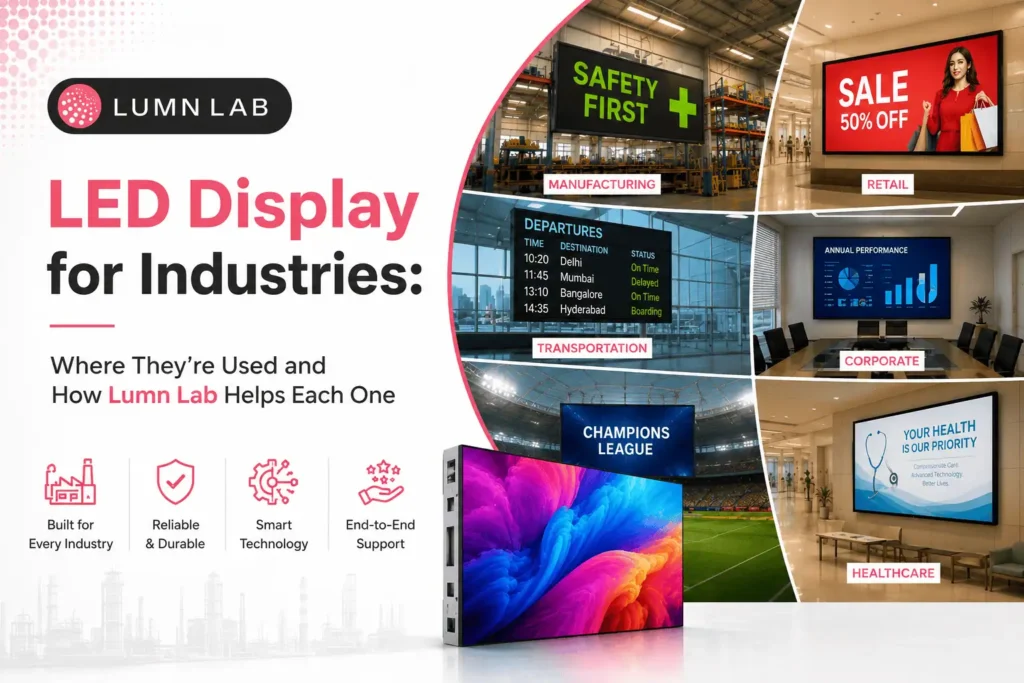

Walk into an airport, a stadium, a mall, or a boardroom today, and there’s a good chance an LED display is doing some of the talking. What started as a niche technology for stadium scoreboards has quietly become standard infrastructure across almost every sector. The reason is simple: LED display for industries solves a problem that static signage, projectors, and LCD panels can’t — visibility at scale, in daylight, at any distance, without losing image quality.
But not every industry needs the same screen. A retail store needs something different from a cricket stadium, and a hospital lobby needs something different from a highway billboard. This guide breaks down how LED displays are actually used across major industries in India, what specifications matter for each, and how Lumn Lab — an LED display manufacturer and installer working across India since 2015 — approaches each one differently.
What Is an LED Display Used for in Industry Settings?
An industrial or commercial LED display is a modular screen built from LED panels or tiles that combine to create one large, seamless visual surface. Unlike a TV or projector, it’s built for continuous, high-brightness operation — indoors or outdoors — and can be manufactured in almost any size or shape.
Businesses use LED displays for three broad purposes:
- Information — wayfinding, queue management, flight or train schedules, pricing boards
- Advertising — product promotion, branding, digital out-of-home (DOOH) campaigns
- Experience — immersive backdrops for events, sports, entertainment, and corporate spaces
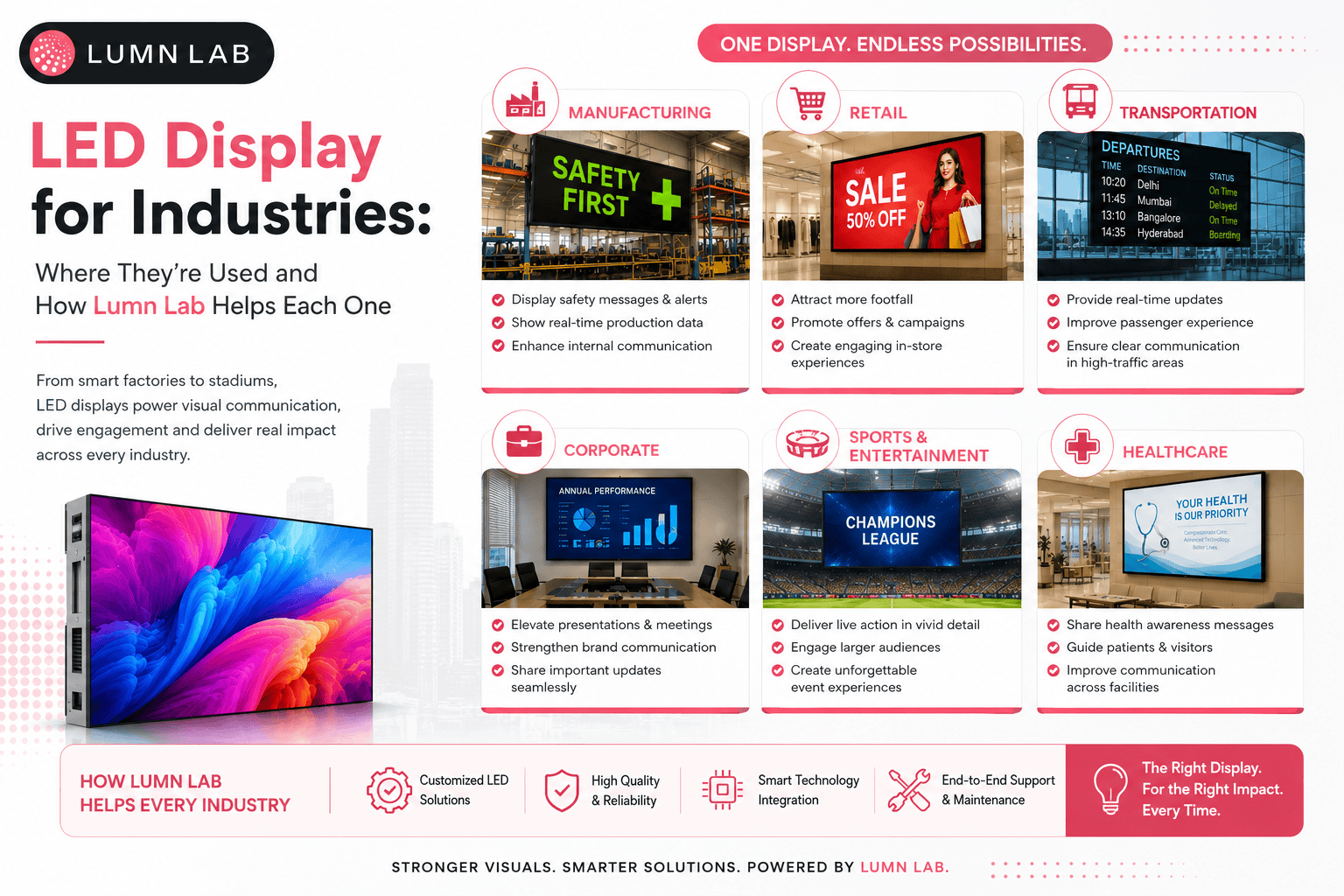
LED Display Applications Across Industries
1. Retail
Retail was one of the earliest adopters of commercial LED signage, and it remains one of the largest use cases today.
- Storefront LED displays pull in footfall with bright, animated promotions visible even in direct sunlight.
- In-store video walls support product launches, seasonal campaigns, and brand storytelling near checkout counters.
- Digital price and offer boards replace printed posters that need manual updates.
How Lumn Lab helps: We build fine-pitch indoor LED walls (P2.5, P3) for in-store displays and weatherproof outdoor units for storefronts in high-footfall retail corridors across Delhi, Gurugram, Noida, and Mumbai, where daylight visibility and 24/7 uptime are non-negotiable.
2. Corporate & Office Spaces
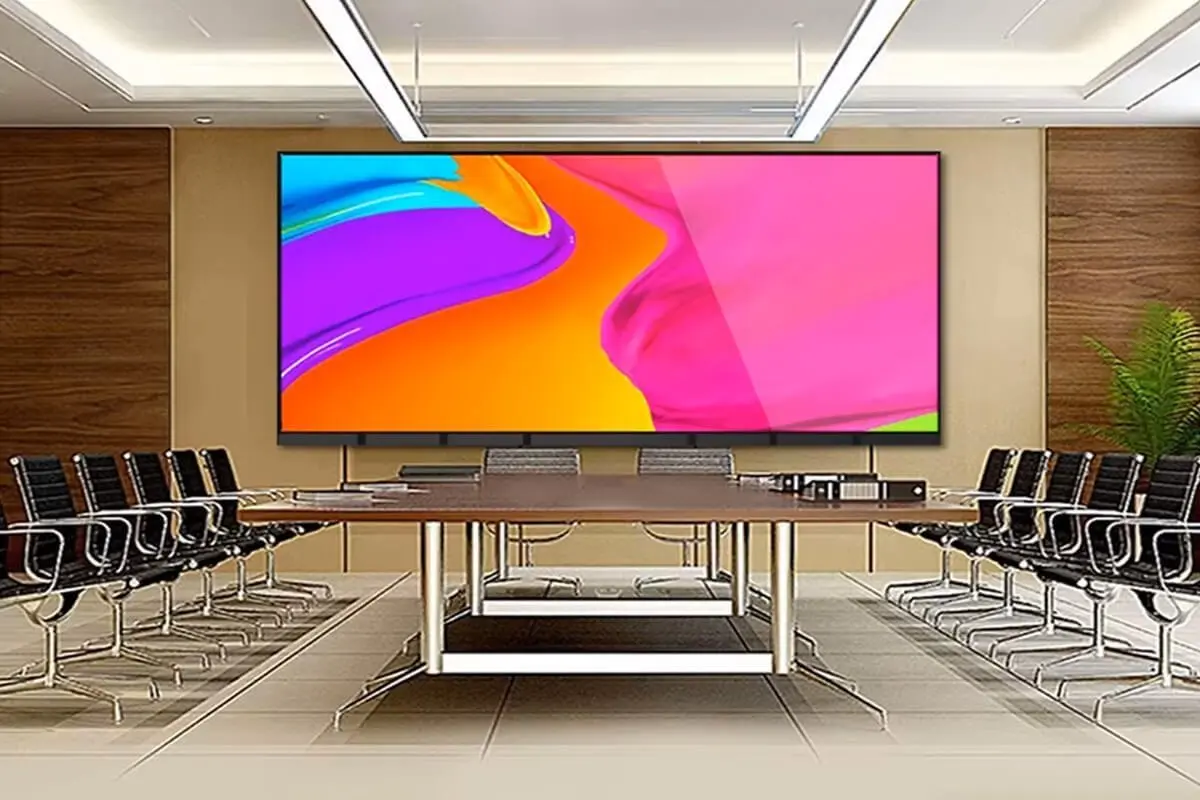
Corporate LED walls have moved beyond reception lobbies. They’re now used in boardrooms for video conferencing, in open offices for company dashboards and KPIs, and in briefing centers for client presentations.
- Reception and lobby branding walls
- Boardroom video walls for hybrid meetings
- Real-time data dashboards on office floors
How Lumn Lab helps: Our corporate installations focus on colour accuracy and seamless tiling — critical when a screen is displaying financial data or client-facing branding. We’ve supported office fit-outs in Gurugram and Bengaluru, where corporate campuses increasingly treat the LED wall as part of the interior design brief, not an afterthought.
3. Events & Weddings
Event LED screens need to go up fast, look flawless under stage lighting, and come down just as quickly.
- Stage backdrop walls for concerts and conferences
- Wedding stage LED screens for décor and live visuals
- Modular rental panels for exhibitions and trade shows
How Lumn Lab helps: We supply rental-grade LED panels built for rapid rigging and de-rigging, with the brightness and refresh rate needed to look clean on camera — important for events that get live-streamed or professionally filmed. This is one of our fastest-growing categories, particularly for weddings and corporate events in the Delhi-NCR belt.
4. Sports & Stadiums
Sports venues use LED displays for scoreboards, perimeter advertising (LED ribbon boards), and giant replay screens.
- Scoreboards and live stats displays
- Perimeter/ribbon LED advertising boards
- Large-format replay screens
How Lumn Lab helps: Stadium environments demand high brightness (often 5,000+ nits for outdoor visibility), a wide viewing angle, and ruggedised, weatherproof builds. We engineer these installations for durability first, since stadium screens run for years with minimal downtime tolerance.
5. Transportation (Airports, Metro, Highways)
Transportation hubs rely on LED displays for real-time, high-visibility communication.
- Flight and train information displays (FIDS/TIDS)
- Digital wayfinding and platform signage
- Outdoor advertising hoardings along highways and near metro stations
How Lumn Lab helps: These environments require displays that operate reliably around the clock in dust, heat, and humidity. We design for IP65-rated outdoor durability and low maintenance access, which matters when a screen is mounted on a highway gantry or metro concourse.
6. Government & Public Institutions
Government use cases range from public information campaigns to command-and-control centers.
- Public announcement and information boards
- Smart city digital signage
- Control room video walls for surveillance and monitoring
How Lumn Lab helps: Control room video walls need pixel-perfect alignment and long operational life, since these screens often run 24/7 for years without replacement. We build to that spec rather than treating government projects as standard commercial installs.
7. Education
Educational institutions are increasingly using LED walls beyond the classroom projector.
- Campus-wide notice and event boards
- Auditorium and seminar hall displays
- Digital signage for admissions and wayfinding
How Lumn Lab helps: We supply mid-size indoor LED walls sized for auditoriums and common areas, prioritising ease of content management so non-technical staff can update information without external support.
8. Hospitality
Hotels, restaurants, and entertainment venues use LED displays to create atmosphere as much as to convey information.
- Lobby and reception feature walls
- Restaurant and bar menu boards
- Banquet hall backdrop screens for events hosted on-site
How Lumn Lab helps: Hospitality clients usually prioritise aesthetics — thin bezels, curved or custom-shaped displays, and precise colour rendering — over raw brightness. We treat these as design-led projects, working closely with interior teams.
9. Broadcasting & Entertainment
Studios and entertainment venues use LED displays as dynamic backdrops, replacing green screens and static sets.
- Virtual production and news studio backdrops
- Concert and event stage visuals
- Entertainment venue ambient displays
How Lumn Lab helps: Broadcast-grade panels need high refresh rates to avoid flicker on camera. We source and configure panels specifically rated for broadcast use, not just general commercial visibility.
Also Read: LED Screen for Events: Types, Sizes, Costs & Setup Guide
LED Display Types Compared
| Industry | Typical Setting | Pixel Pitch Range | Priority |
| Retail | Storefront / in-store | P2.5 – P6 | Daylight visibility, brand impact |
| Corporate | Boardroom / lobby | P1.5 – P2.5 | Colour accuracy, seamlessness |
| Events | Stage / exhibition | P2.9 – P4.8 | Rapid setup, camera-friendly |
| Sports | Stadium | P6 – P10 (outdoor) | Brightness, viewing distance |
| Transportation | Airport / metro / highway | P4 – P10 | Durability, uptime |
| Government | Control room / public signage | P1.2 – P3 | Precision, longevity |
| Education | Auditorium / campus | P2.5 – P4 | Ease of content management |
| Hospitality | Lobby / banquet | P1.5 – P3 | Aesthetics, custom shapes |
| Broadcasting | Studio / stage | P1.9 – P2.9 | Refresh rate, flicker control |
Pixel pitch ranges above are general industry benchmarks; the right spec for a project depends on viewing distance, ambient light, and content type. Explore our pixel pitch calculator for exact recommendations.
Why LED Displays Are Replacing Traditional Signage
- Daylight readability — LED panels are built for high ambient brightness, unlike LCD or projection.
- Lower long-term maintenance — no bulbs to replace, and modern panels are rated for tens of thousands of hours of operation.
- Flexible sizing — modular tiles allow custom shapes and sizes that fixed-panel displays can’t match.
- Content agility — screens update remotely and instantly, unlike printed signage.
Note: exact hour-life ratings and energy savings vary by panel model and manufacturer specification — always confirm figures against the specific product datasheet rather than general industry claims.
How to Choose the Right LED Display for Your Industry
- Define the primary use — is it informational, promotional, or experiential? This shapes brightness and content-update needs.
- Measure the viewing distance — closer viewing distances (boardrooms, retail counters) need finer pixel pitch; longer distances (stadiums, highways) can use coarser, more cost-effective pitch.
- Check the environment — indoor vs. outdoor changes IP rating, brightness, and enclosure requirements entirely.
- Plan for content management — who will update the screen, and how often? This affects the control system you need.
- Confirm installation and after-sales support — an LED wall is a multi-year asset; local installation and service support in your city matters as much as the panel spec.
Conclusion
LED display for industries isn’t a one-size-fits-all category — a retail storefront, a stadium scoreboard, and a corporate boardroom all need fundamentally different specs, even though they’re built on the same underlying technology. Understanding pixel pitch, brightness, and environment requirements for your specific industry is the first step to getting a display that actually performs.
Lumn Lab has been designing, manufacturing, and installing LED displays across India since 2015, working across retail, corporate, events, sports, transportation, government, education, hospitality, and broadcasting projects.
Not sure which pixel pitch or display type fits your industry? Talk to Lumn Lab’s team for a spec recommendation based on your space, budget, and viewing distance.
Frequently Asked Questions
Q. What is an LED display used for in business?
Businesses use LED displays for advertising, information sharing, and creating immersive experiences — from storefront promotions and corporate dashboards to event backdrops and stadium screens.
Q. Which industries use LED displays the most?
Retail, corporate offices, events and weddings, sports and stadiums, transportation, government, education, hospitality, and broadcasting are the industries with the highest LED display adoption in India.
Q. What pixel pitch is best for indoor use?
For indoor viewing at close range (boardrooms, retail counters), a fine pixel pitch of P1.5 to P2.5 is generally recommended for sharp, clear visuals. Larger indoor spaces like auditoriums can use P2.5 to P4.
Q. How is an outdoor LED display different from an indoor one?
Outdoor LED displays are built with higher brightness (to remain visible in direct sunlight), a wider pixel pitch (since viewing distances are usually longer), and weatherproof, IP65-rated enclosures. Indoor displays prioritise finer pixel pitch and colour accuracy over raw brightness.
Q. Why do stadiums use LED screens instead of LCD?
Stadium LED screens are modular and scalable to very large sizes, offer wide viewing angles for large crowds, and are built to handle outdoor brightness and weather conditions — none of which LCD panels can do cost-effectively at that scale.
Q. How much does an LED display cost for a business?
Cost depends on pixel pitch, size, indoor/outdoor rating, and installation complexity. [Placeholder: link to Lumn Lab’s LED video wall cost guide for a detailed breakdown.]
Q. Can LED displays be customised for a specific industry?
Yes. LED displays can be manufactured in custom shapes, curved formats, and specific pixel pitches to match an industry’s viewing distance, environment, and content requirements — this is standard practice for hospitality, corporate, and event installations.
Keep Reading