

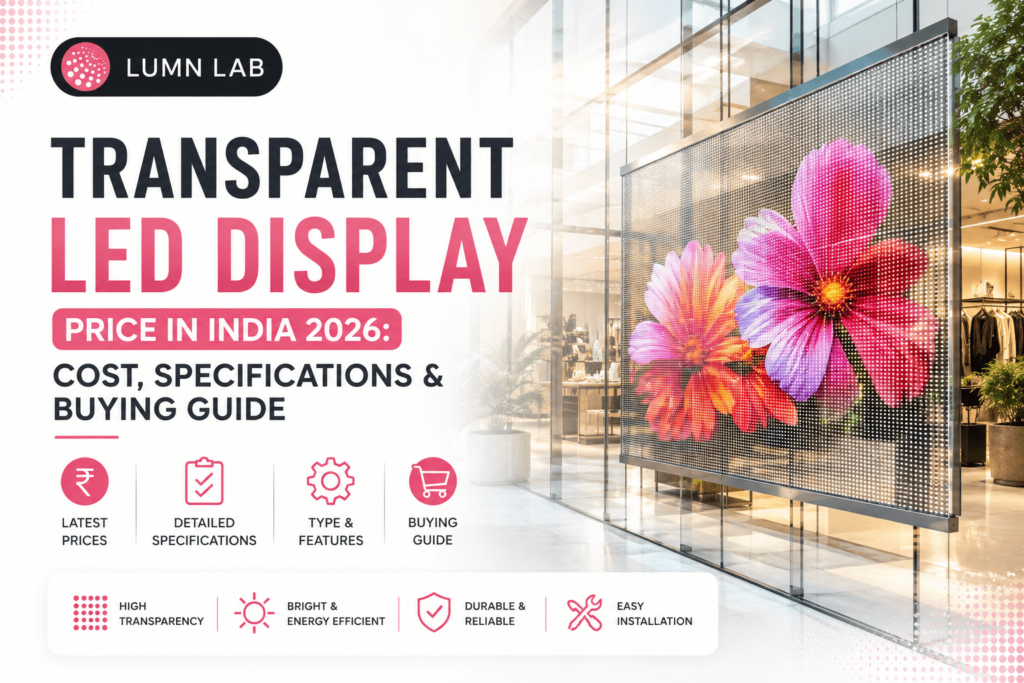

If you’ve been quoted three different prices for a transparent LED display and none of them made sense next to each other, you’re not alone. Storefronts, showrooms, and corporate lobbies across Delhi NCR, Mumbai, and Bangalore are switching to glass-look screens, and pricing in this category swings widely depending on pixel pitch, transparency percentage, and where the panel is installed.
This guide breaks down the actual transparent LED display price in India for 2026, what drives the cost up or down, and how to compare quotes from different manufacturers without getting lost in specs. Whether you’re a retail brand fitting out a flagship store or an architect specifying glass facades, this is the buying guide we wish more clients had before they signed a purchase order.
What Is a Transparent LED Display?
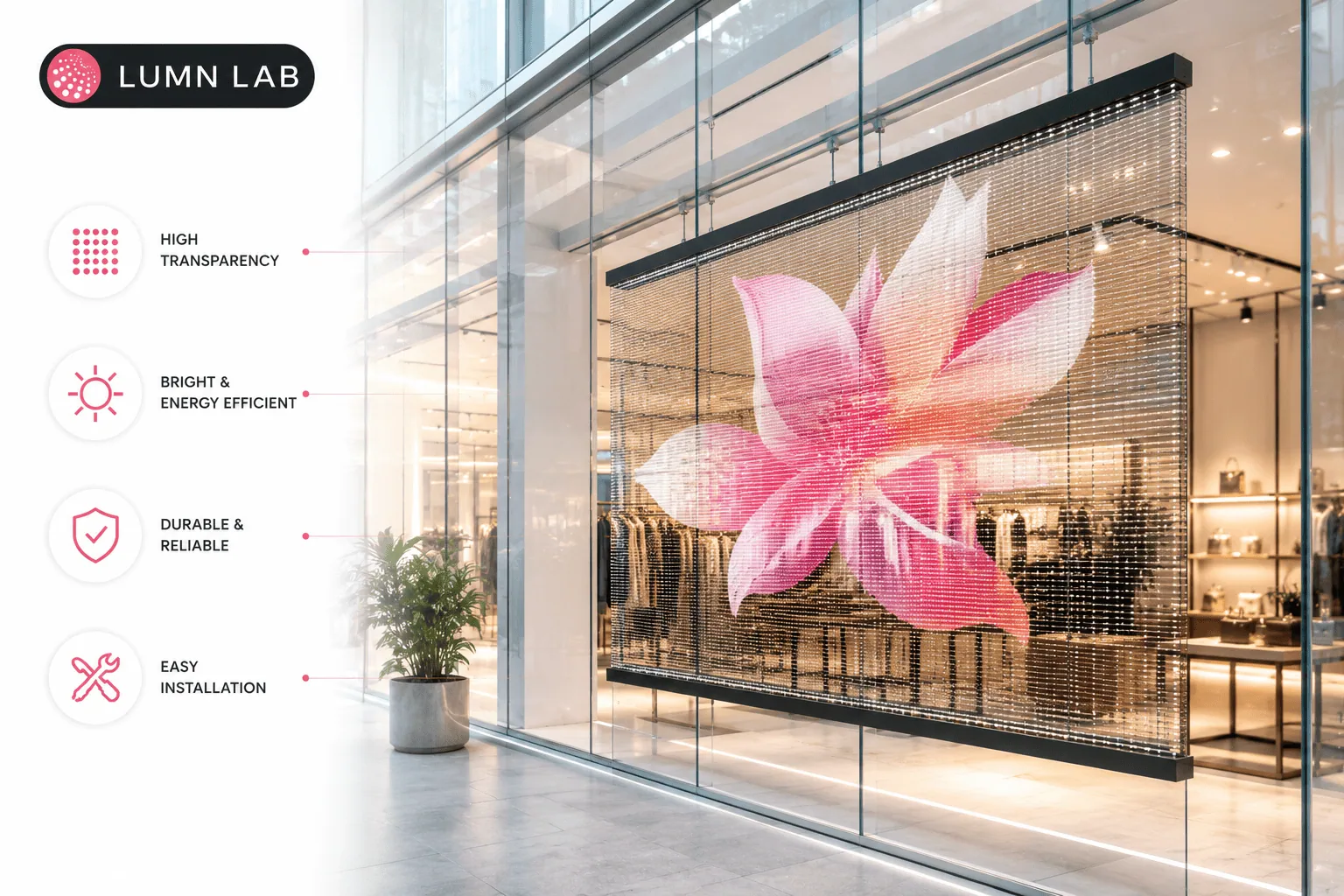
A transparent LED display is built with a mesh-like PCB structure that lets light and, in many cases, visible objects behind the screen pass through while LEDs project images, video, or text on top. Transparency typically ranges between 65% and 90%, depending on the pixel pitch and module design.
Unlike a regular LED video wall, which is a solid, opaque panel, a transparent LED display screen is mounted directly onto glass storefronts, building facades, or showroom windows — so shoppers can see both your product display and your digital content at the same time.
How Does a Transparent LED Screen Work?
A transparent LED screen works by mounting LED strips or diodes onto a slim, see-through PCB grid instead of a solid backplane. The gaps between the LED strips are what allow light and background visibility to pass through the panel, while the LEDs themselves handle image rendering.
Key technical points worth knowing before you buy:
- Pixel pitch determines resolution — lower pitch (P3.9–P6.25) means sharper images but higher cost.
- Transparency rate is usually 65%–90%; higher transparency generally means a slightly lower pixel density.
- Lifespan of a good-quality transparent LED screen is typically 60,000–100,000 hours of operation, roughly 8–10 years of standard commercial use, assuming proper installation and maintenance.
- Power draw is lower than solid LED walls of the same size because there are fewer LEDs per square meter.
If you’re comparing this to an OLED display, it’s worth noting they’re not the same technology. OLED transparency is achieved because each organic pixel emits its own light without a backlight, so the panel can be made genuinely see-through at the material level — but OLED panels are typically smaller, more fragile, and priced for indoor retail or premium consumer applications rather than large-scale glass facades. Transparent LED, by contrast, is built for scale — storefronts, building wraps, and stadium-sized installations.
Transparent LED Display Price in India 2026 (Cost Breakdown)
This is the number everyone actually wants, so here it is upfront.
The cost of a transparent LED display in India in 2026 typically ranges from ₹1.2 lakh to ₹3.5 lakh per square meter, depending on pixel pitch, transparency percentage, brand, and whether it’s indoor or outdoor rated. Below is a working breakdown:
| Pixel Pitch | Typical Use Case | Transparency | Approx. Price (per sq. m.) |
| P3.9 – P4.8 | Retail storefronts, showrooms | 70–75% | ₹1.8 lakh – ₹3.5 lakh |
| P5.9 – P6.25 | Corporate lobbies, malls | 75–85% | ₹1.4 lakh – ₹2.5 lakh |
| P7.8 – P10.4 | Building facades, large glass walls | 80–90% | ₹1.2 lakh – ₹2 lakh |
| Ultra transparent LED display | High-end architectural facades | 85–90%+ | ₹2.5 lakh – ₹4 lakh |
Important note on pricing: These are indicative market ranges for 2026 based on typical project quotes across Indian metros. Actual transparent LED display price for your project depends on square footage, control system, installation complexity (height, structural mounting, curved glass), and after-sales warranty terms. Always request a site-specific quote rather than relying on a flat per-square-meter number.
Get an accurate quote: Request a free site assessment and custom quote from Lumn Lab →
What Affects the Cost of a Transparent LED Display?
Six factors move the price more than anything else:
- Pixel pitch — the tighter the pitch, the more LEDs per module, the higher the cost
- Transparency percentage — ultra transparent LED display panels (85%+) use specialized, thinner PCB strips that cost more to manufacture
- Indoor vs outdoor rating — a transparent led display outdoor unit needs weatherproofing, higher brightness (usually 4,000–6,000 nits vs 800–1,500 nits indoor), and IP-rated enclosures, all of which add to cost
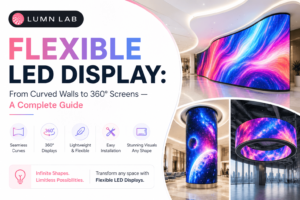
- Flexible vs rigid panels — a transparent led display flexible module that curves around pillars or non-flat surfaces costs more per square meter than a standard flat panel
- Control system and software — sending box, receiving cards, and content management software are usually priced separately from the panel itself
- Installation and structural work — mounting on existing glass facades often requires custom framing, which is a labor cost, not a hardware cost
A quick gut-check: if a vendor quotes a transparent led display screen price that seems 30–40% lower than everyone else’s for the same pixel pitch and transparency, ask what’s being cut — usually it’s the driver IC quality, the PCB grade, or the warranty period.
Transparent LED Display vs Traditional LED Video Wall
| Feature | Transparent LED Display | Traditional LED Video Wall |
| Visibility through panel | Yes (65–90%) | No, fully opaque |
| Typical use | Storefronts, glass facades, showrooms | Stages, control rooms, indoor branding walls |
| Weight | Lighter, mesh-based structure | Heavier, solid cabinet |
| Price per sq. m. (2026, India) | ₹1.2 lakh – ₹4 lakh | ₹80,000 – ₹2.5 lakh |
| Best for | Retail glass fronts, architectural facades | Auditoriums, event stages, command centers |
Where Transparent LED Displays Are Used in India
Real deployments we’ve seen (and built) across Indian cities include:
- Retail flagship stores in Mumbai and Bangalore using transparent panels on storefront glass to run promotions without blocking window merchandising
- Corporate headquarters in Gurgaon and Noida installing transparent walls in reception lobbies as a branding statement
- Hotel entrances in Delhi NCR using transparent LED for ambient branding without obstructing the facade view
- Educational institutions using transparent displays in atriums for event schedules and announcements
- Event companies renting flexible transparent panels for exhibition booths and product launches
This is where a lot of buyers get the specification wrong — a transparent panel that works beautifully in a dim indoor lobby will look washed out on an outdoor facade under direct sun unless the outdoor unit’s brightness and IP rating are specified correctly upfront.
How to Choose the Right Transparent LED Display Panel
If you’re actively looking to buy transparent led display units for a project, work through this checklist before requesting quotes:
- Define the viewing environment — indoor showroom, outdoor facade, or semi-outdoor entrance
- Set your minimum transparency requirement — do you need visibility through the glass at all times, or only when content isn’t playing?
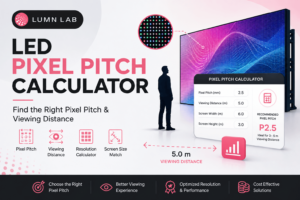
- Match pixel pitch to viewing distance — closer viewing distances (under 3 meters) need tighter pixel pitch
- Ask for IP rating — outdoor installations should carry at minimum IP65 protection against dust and water
- Confirm certifications — BIS and ISO certification, both governed by the Bureau of Indian Standards, indicate the manufacturer follows recognized quality and safety standards.
- Check installation support — transparent led display installation on existing glass structures is specialized work; ask if the vendor handles structural mounting or only supplies hardware
- Compare warranty terms, not just upfront price — a cheaper panel with a 1-year warranty often costs more over its lifespan than a slightly pricier one with 3+ years of coverage
Conclusion
The transparent LED display price in India for 2026 isn’t a single number — it moves based on pixel pitch, transparency percentage, indoor/outdoor rating, and installation complexity, typically landing between ₹1.2 lakh and ₹4 lakh per square meter. The right approach isn’t chasing the lowest quote; it’s matching the specification to your actual space, lighting conditions, and long-term maintenance needs.
If you’re evaluating a transparent LED display for a storefront in Mumbai, a corporate lobby in Gurgaon, or a facade project in Delhi NCR, get a site-specific assessment before you commit to a spec sheet.
Lumn Lab has delivered 1000+ installations since 2015 and can walk you through pixel pitch, transparency, and budget trade-offs specific to your project.
Frequently Asked Questions
Q. What is a transparent LED display?
A transparent LED display is a see-through digital screen built on a mesh PCB structure that lets light and background objects pass through while displaying images or video. It’s commonly used on glass storefronts, showroom windows, and building facades.
Q. How much do transparent LED screens cost in India?
In 2026, transparent LED display price in India typically ranges from ₹1.2 lakh to ₹4 lakh per square meter, depending on pixel pitch, transparency percentage, and indoor/outdoor rating. Ultra transparent LED display panels with 85%+ transparency sit at the higher end of that range.
Q. Are there transparent LED screens available in India?
Yes. Transparent LED screens are actively manufactured, supplied, and installed across India, with strong demand in Delhi NCR, Mumbai, Bangalore, Gurgaon, and Noida for retail, hospitality, and corporate applications.
Q. Is transparent display technology different from a transparent TV?
Yes. Transparent TVs (mostly OLED-based) are designed for small-scale consumer or premium showroom use and are made of self-emitting organic pixels. Transparent LED displays are built for larger-scale commercial use, like storefronts and facades, using an LED mesh structure rather than OLED material.
Q. Is an OLED display transparent?
OLED panels can be made transparent because each pixel emits its own light without needing a backlight, but OLED transparent screens are typically smaller and used for premium indoor or consumer applications, not large architectural installations.
Q. How does a transparent LED screen work?
LEDs are mounted onto a slim, see-through PCB grid instead of a solid backplane. The open spaces between LED strips allow light and background visibility through, while the LEDs handle the visual content.
Q. What is the lifespan of a transparent LED screen?
A quality transparent LED screen typically lasts 60,000–100,000 operating hours, roughly 8–10 years under standard commercial use, provided it’s installed and maintained correctly.
Q. Which type of LED screen is best for storefronts — transparent or standard?
For glass storefronts where you want visibility to the merchandise behind the screen, a transparent LED display board is the better fit. For fully branded, content-only walls (like stages or lobbies without a view requirement), a standard opaque LED video wall is usually more cost-effective.
Keep Reading