

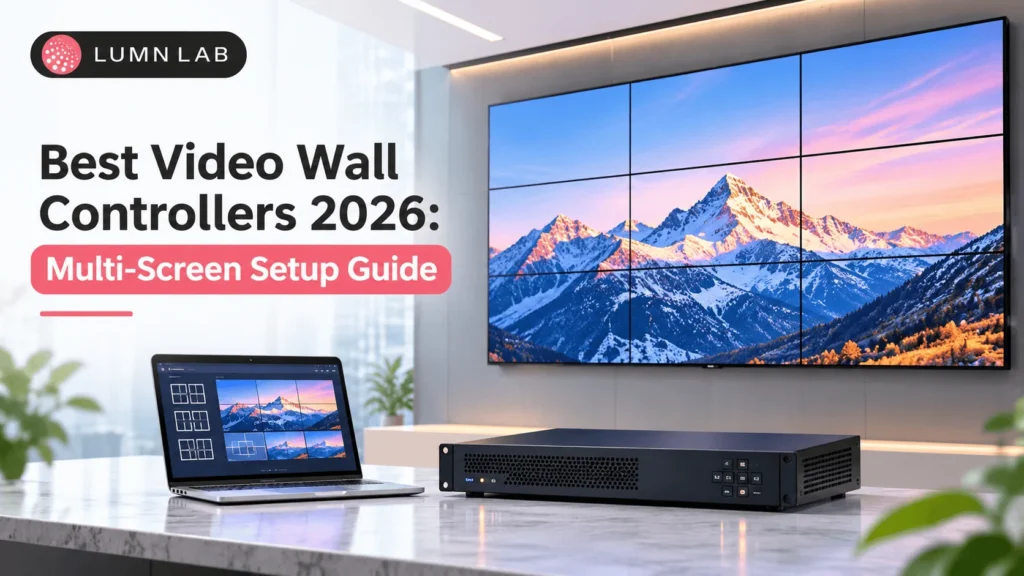

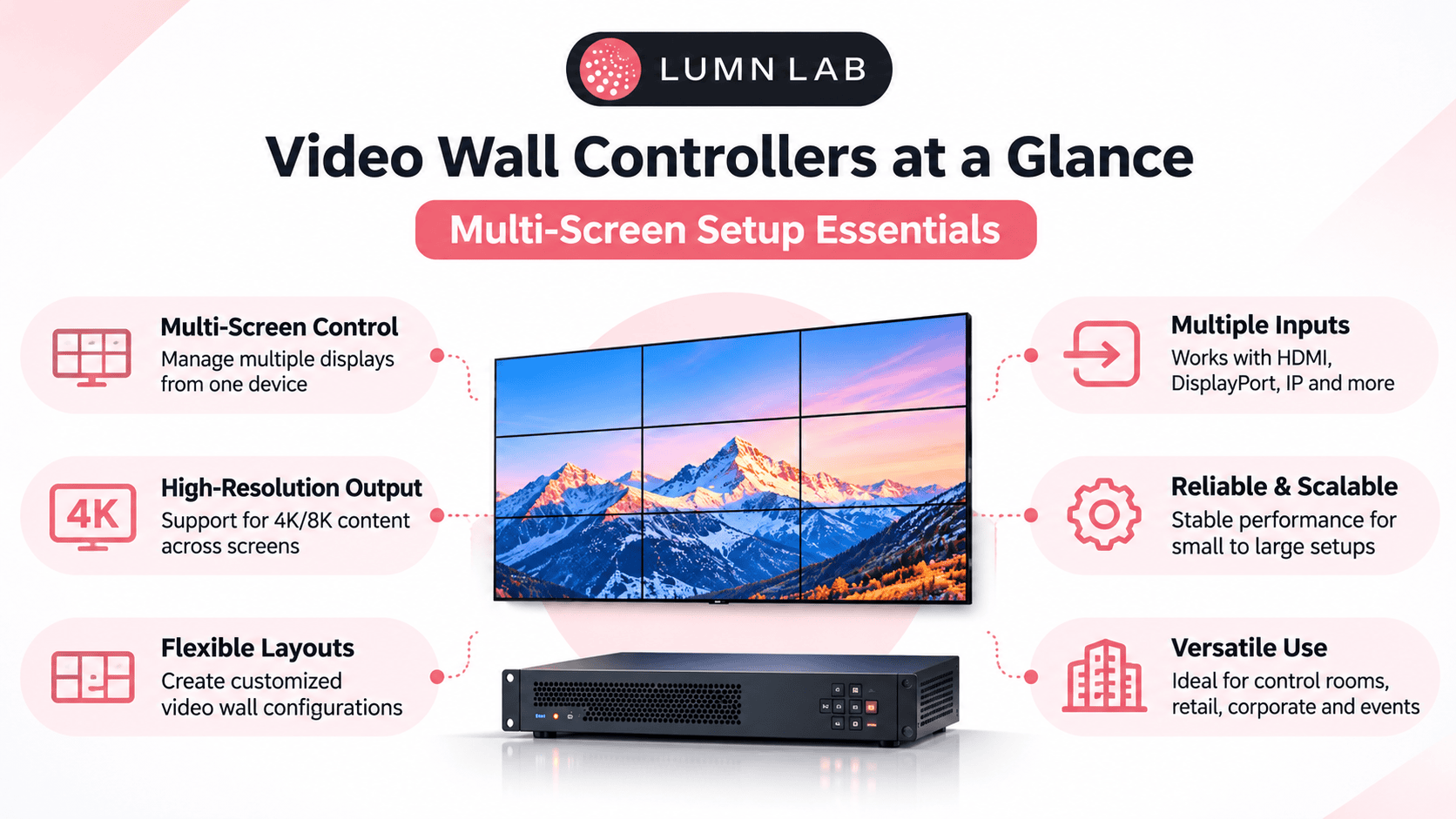
A video wall controller takes one video source and splits it across every screen or LED cabinet in your display, so the whole wall behaves like one canvas. In 2026, the best video wall controllers come from NovaStar, Colorlight, Linsn, Brompton, and Barco or Analog Way at the premium end. They differ mainly in processing power, inputs, and software.
For most Indian businesses, a mid-range LED video wall controller does the job without broadcast-level cost. Pick the wrong one and you get tearing, washed-out colour, or a black screen halfway through a launch.
This guide covers how controllers work, what they cost, and how to choose.
What Does a Video Wall Controller Do?
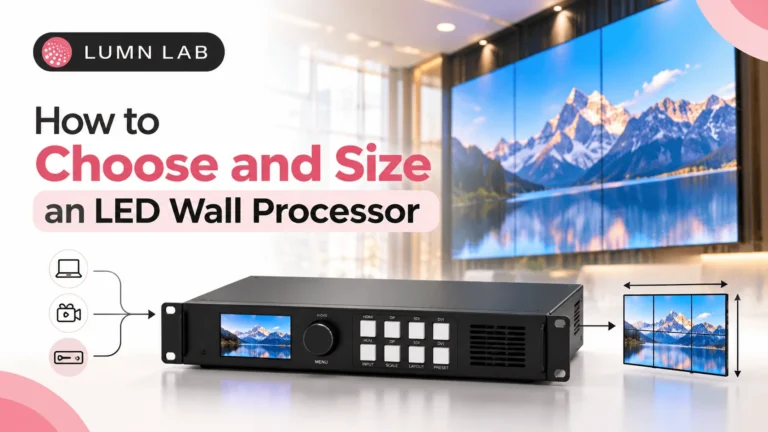
It receives your video signal, scales it to the wall’s resolution, cuts it into sections, and sends each section to the right screen or cabinet. It also keeps every section in sync, so a moving image doesn’t tear across panel edges.
How does a video wall controller work?
In an LED setup, the signal moves in four steps:
- Input: a laptop, media player, camera, or SDI feed connects to the controller.
- Scaling and mapping: the controller fits the image to your pixel count and layout.
- Distribution: a sending card pushes data over Ethernet to receiving cards inside each cabinet.
- Sync and calibration: brightness, gamma, and colour are matched across every module.
Video Wall Controller vs Processor: What’s the Difference?
In LED work, the two terms overlap, and spec sheets use them loosely. The practical split looks like this:
| Controller (sending box and receiving cards) | Video processor | |
| Main job | Moves pixel data to the cabinets | Scales, switches, and manages the image |
| Typical features | Cabinet mapping, calibration | Multi-window layouts, input switching, colour adjustment |
| Needed when | Always | Several sources or windows, or live switching |
Many modern units combine both. For LCD video walls, “controller” usually means a processor that spreads one image across several monitors.
Best Video Wall Controllers in 2026
There’s no single winner. The best controller is the one that matches your cabinets, content, and uptime needs.
| Brand / series | Best for | Strength | Check before buying |
| NovaStar (MCTRL, VX, COEX) | Corporate, retail, rental, control rooms | Wide ecosystem, NovaLCT software | Advanced features sit in higher-tier models |
| Colorlight (X and Z series) | Fixed indoor installations | Good value, LEDVISION software | Confirm cabinet compatibility |
| Linsn | Small to mid-size walls | Simple setup, LED Studio software | Verify multi-window support |
| Brompton Tessera | Virtual production, broadcast | Colour accuracy, camera-friendly output | Premium pricing |
| Barco / Analog Way | Premium events, mission-critical rooms | Seamless switching, redundancy | Highest cost |
| Datapath / Matrox | LCD multi-monitor walls | Many display outputs | Built for monitors, not LED cabinets |
With 1,000+ installations since 2015, Lumn Lab matches the controller to the cabinet and the use case rather than defaulting to one brand. A fixed hotel lobby and a touring event wall need very different gear.
LED Video Wall Controller Software
LED video wall controller software configures your screen layout, cabinet mapping, brightness, gamma, and calibration.
There are two layers, and people often mix them up:
- Configuration software: a technician uses it at setup. Think of it as the wall’s settings menu.
- Content software: your team uses it daily to schedule and play content.
You’ll also see the phrase active LED video wall controller. It usually means a controller built for active-drive LED panels, or one that actively processes and calibrates the image instead of just passing it through. Read the spec sheet, not the label.
How Much Does an LED Video Wall Controller Cost?
These are market estimates. Always get a written quote.
| Equipment | Estimated price in India |
| Entry-level sending box | ₹15,000 – ₹60,000 |
| Mid-range video processor | ₹80,000 – ₹3 lakh |
| High-end multi-window or redundant processor | ₹3 lakh – ₹10 lakh+ |
How much does an LED video wall cost?
The wall itself is the bigger number. Depending on pixel pitch, brand, and cabinet type, expect roughly ₹3,000 to ₹25,000+ per sq ft, installed. The controller is usually a small slice of that.
Why are LED video walls so expensive?
You’re paying for hundreds of precision modules and driver ICs, cabinets and structure, the controller, power and cooling, calibration, and skilled installation. Fine pitch walls cost more because they pack far more LEDs into each square foot.
Planning a wall? Share your size and viewing distance and Lumn Lab will quote the full system, controller included. Request a quote
How to Choose the Right Controller
Count your pixels first
Controllers are rated by total pixels, not screen size. A 10 × 10 ft P4 wall, like our HOCCO Ice Cream storefront in Delhi, works out to roughly 0.58 million pixels. Entry-level units are usually rated around 2 million, so that wall needs nothing exotic. A fine pitch lobby wall can blow past that quickly. Use our pixel pitch guide to run the numbers. . For viewing distance and image quality benchmarks, the AV industry body AVIXA publishes widely used guidance.
Match inputs to your content
HDMI is enough for a lobby loop. Control rooms and events need SDI, DisplayPort, or several simultaneous windows.
Check refresh rate for camera work
If the wall appears on camera, look for a high refresh rate (3,840 Hz or above) and good grayscale at low brightness.
Decide on redundancy
A wall that runs 12 hours a day in a Gurgaon corporate lobby can tolerate a short outage. A 24/7 control room can’t. Ask for dual-link backup. Electrical safety for display and control equipment follows international standards set by the IEC.
Ask about local support
Controllers fail at awkward hours. Confirm who services your wall in Delhi NCR, Noida, Mumbai, or Bangalore, and how fast.
Choosing the Best Video Wall Controller Without Overpaying
The best video wall controllers don’t win on spec sheets alone. They win on fit: your pixel count, your sources, your uptime needs, and who answers the phone when something breaks.
Lumn Lab has served clients across India since 2015, with 1,000+ installations spanning Delhi NCR, Gurgaon, Noida, Mumbai, and Bangalore. We hold BIS and ISO certifications and size the controller and the wall together, so nothing gets over-specified.
Tell us your wall size and use case. We’ll recommend the right controller and send a clear quote. Get a free consultation
Frequently Asked Questions
What does a video wall controller do?
It splits one video source across multiple screens or LED cabinets, scales the image to fit, and keeps every section synchronised so the wall looks like one display.
How does a video wall controller work?
It takes your input signal, maps it to the wall’s pixel layout, and sends each section to the right panel through sending and receiving cards, then syncs and calibrates the output.
What is the difference between a video wall controller and a processor?
A controller moves pixel data to the cabinets. A processor scales, switches, and manages sources and windows. Many units do both.
What is the best video wall controller?
There is no universal best. NovaStar and Colorlight suit most business installs, Brompton suits virtual production, and Barco or Analog Way suit mission-critical rooms.
Who makes the best video wall?
Judge a maker on pixel pitch range, certifications, controller compatibility, installation references, and after-sales support. Lumn Lab has delivered 1,000+ installations across India since 2015.
What is the price of an LED controller?
Entry-level sending boxes are estimated at ₹15,000 to ₹60,000. Mid-range processors run about ₹80,000 to ₹3 lakh, and high-end units can pass ₹10 lakh.
How much does an LED video wall cost?
Estimated at ₹3,000 to ₹25,000+ per sq ft installed, depending on pixel pitch, brand, and cabinet type. Fine pitch walls sit at the top of that range.
Why are LED video walls so expensive?
Cost comes from thousands of precision LEDs and driver ICs, cabinets, controllers, power and cooling, calibration, and installation labour. Finer pitch means more LEDs per square foot.
Keep Reading