


If you’ve ever priced out a digital billboard and closed the tab because the numbers didn’t add up, you’re not the only one. Setting up a digital billboard in India involves more moving parts than most first-time buyers expect — site approval, hardware sizing, content software, and ongoing maintenance all sit between “I want one” and “it’s live.”
This guide walks through what actually goes into setting up a digital billboard in 2026: the types available, what drives the price, the step-by-step process, and how it stacks up against a traditional billboard on returns. Whether you’re a shop owner in Noida looking at a storefront screen or evaluating a DOOH network across Delhi and Mumbai, this is the practical version — not the sales pitch.
What Is a Digital Billboard, and Why Is It Different From a Static One?
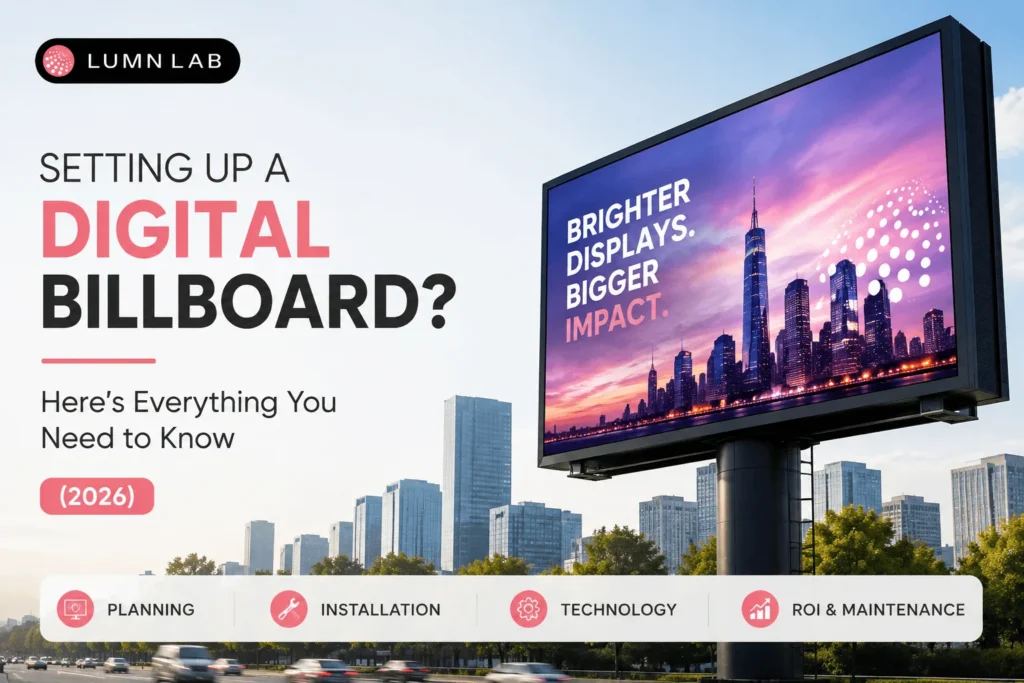
A digital billboard is an outdoor or indoor advertising display built from LED panels instead of printed vinyl or flex. Unlike a static billboard, it can show multiple ads on rotation, update content remotely within minutes, and run different creatives by time of day. That’s the core appeal: one screen, several advertisers, no reprint costs every time a campaign changes.
In India, digital billboards sit under the broader Digital Out-of-Home (DOOH) category — a term defined by the Indian Outdoor Advertising Association and you’ll come across often while researching digital billboard advertising or programmatic ad networks. The shift from static to digital isn’t just a format change. It changes how the media gets sold, usually per slot or per loop rather than per print run, which is also why digital billboards can carry a higher revenue ceiling than a printed hoarding of the same size.
Types of Digital Billboards Available in India
Not every digital billboard is built the same way. The right type depends on where it’s going and what conditions it needs to survive — this is also where most of the “what are the different types of outdoor LED display screens” confusion comes from.
| Type | Where It’s Used | Key Spec to Check |
| Outdoor LED Billboard | Highways, arterial roads, building facades | Pixel pitch P6–P10, 5,000–8,000 nits brightness, IP65 rated |
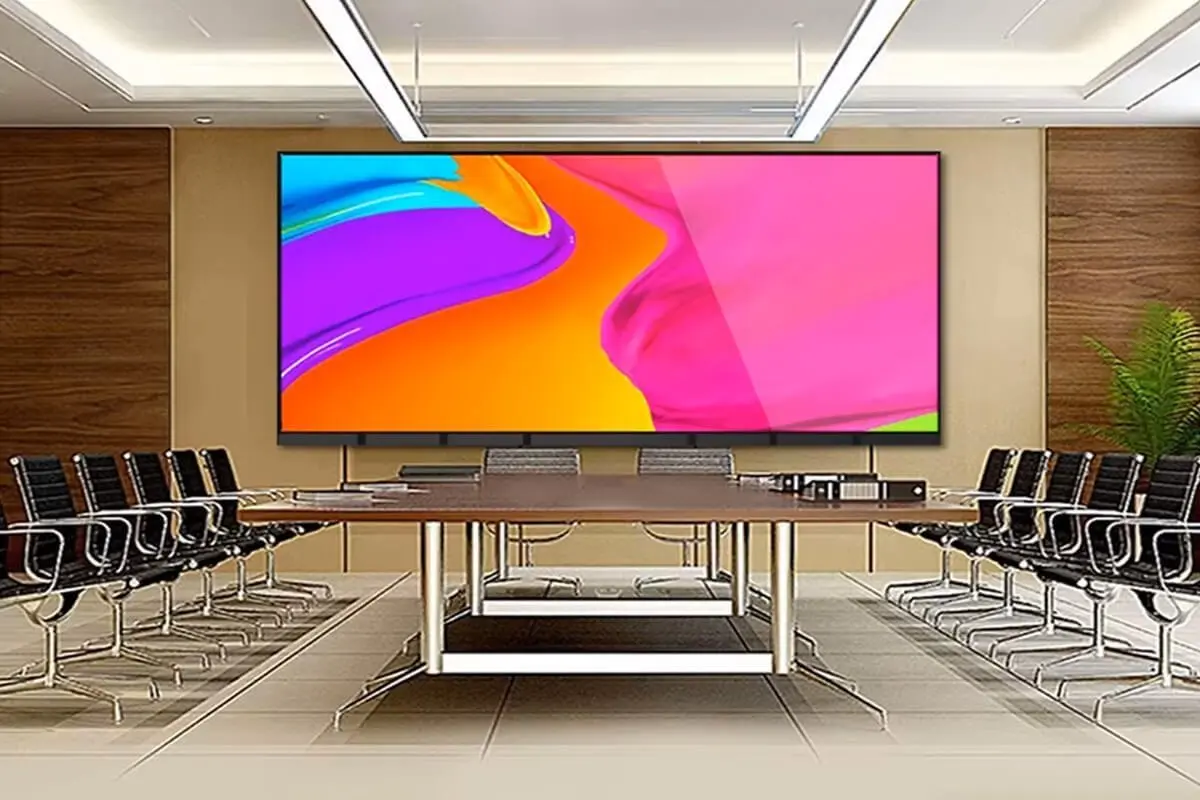
| Indoor LED Display | Malls, lobbies, retail counters | Pixel pitch P1.5–P3, higher resolution, no weatherproofing |
| Rental LED Panel | Events, stadiums, temporary activations | Lightweight cabinets, quick-lock rigging, portability |
| Shopfront Digital Signage | Small retail, storefronts | Compact sizing, budget-friendly, fast install |
| Programmatic DOOH Screen | Ad networks, agency-run inventory | CMS with programmatic/API integration |
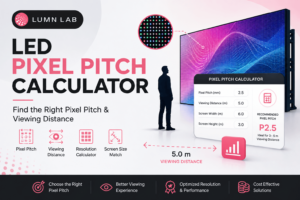
Outdoor LED displays mainly differ on two specs: pixel pitch and brightness. Pixel pitch decides how far away the screen stays readable, and brightness decides whether it holds up against direct sunlight. A digital billboard in a stadium, for instance, needs a different pixel pitch than one mounted on a highway gantry, because viewing distances and ambient light are completely different.
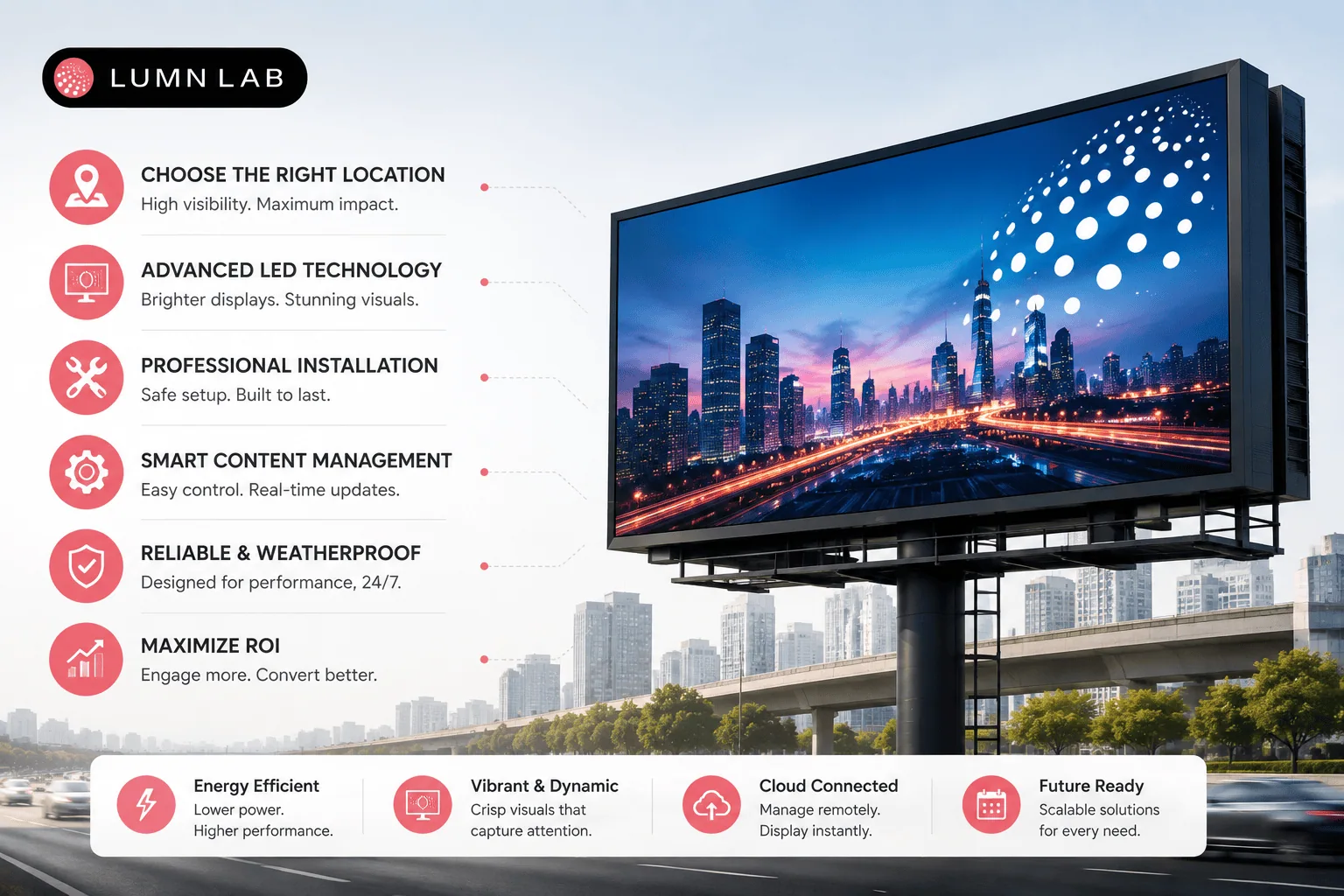
Digital Billboard Price in India: What Actually Drives the Cost
Digital billboard price in India varies more than most first-time buyers expect, because “digital billboard” covers everything from a 6×4 ft shopfront screen to a 40-ft highway hoarding. Rather than quote one number that won’t apply to your project, it’s more useful to know what actually moves the price:
• Screen size and pixel pitch — a finer pixel pitch (higher resolution) costs more per square foot
• Indoor vs outdoor build — outdoor units need weatherproofing, higher brightness, and stronger mounts
• Structure and civil work — pole-mounted, wall-mounted, or ground-based structures carry different fabrication costs
• Content management software — one-time licensing vs subscription-based CMS
• Installation and commissioning — site-specific, especially in dense areas like Gurgaon or Mumbai where crane access and traffic clearances add cost
• Annual Maintenance Contract (AMC) — the ongoing cost most first-time buyers forget to budget for
For exact price bands by size and location, see our detailed breakdown in Digital Billboard Advertising Cost in India (2026 Guide). This section is about what to budget for beyond the screen itself — the line items that usually surprise first-time buyers.
How to Set Up a Digital Billboard in 2026: Step by Step
1. Define the objective
Ad-revenue signage and shop-front signage need different hardware and software — know which one you’re building before you price anything.
2. Site survey and feasibility.
Check viewing angle, sun direction, structural load capacity, and power access before committing to a location.
3. Permits and municipal approval
This step varies by city — Delhi (MCD/NDMC), Noida (Noida Authority), Gurgaon (GMDA/MCG), Mumbai (BMC), and Bangalore (BBMP) each run their own outdoor advertising bylaws and hoarding-license process. Budget several weeks for approvals in most cities.
4. Choose the hardware
Match pixel pitch and brightness to actual viewing distance rather than picking the highest spec available.
5. Structural mounting and installation
Use a certified installer and get the mount load-tested to local structural guidelines.
6. Content management software and connectivity
Decide between on-premise and cloud CMS, and confirm whether content will push over broadband or SIM-based connectivity.
7. Testing, calibration, and launch
Run color calibration, test the auto-brightness sensor, and do a full content dry-run before going live.
8. Ongoing AMC and remote monitoring
Preventive maintenance and an uptime dashboard matter more than most buyers expect once the screen is actually running ads.
Digital Billboard vs Traditional Billboard: Is It More Profitable?
Usually yes, over time — but not for free. A digital billboard costs more upfront than a printed one of the same size, because you’re paying for the panel, the structure, and the software, not just the print. What changes the economics is that a single digital screen can carry several advertisers on a rotating loop, where a static billboard is sold to one advertiser at a time until the next print cycle.
| Factor | Digital Billboard | Traditional Billboard |
| Upfront cost | Higher (hardware + software + structure) | Lower (print + structure only) |
| Ad slots per screen | Multiple, rotating | One, until reprinted |
| Content updates | Remote, within minutes | Requires reprinting and reinstallation |
| Revenue potential | Higher over time (shared inventory) | Fixed per booking |
| Maintenance | AMC required | Minimal |
So are digital billboards more profitable than traditional ones? For a media owner selling ad space, generally yes, because the same physical screen can be resold multiple times a day. For a single shop owner using one screen purely for their own signage, the return is more about visibility and flexibility than direct ad revenue — the profitability question depends on whether you’re the media owner or the advertiser.
Where Digital Billboards Are Used: Real-World Applications
• Retail shopfronts — digital billboards for shops replace static posters with rotating offers and store hours, common in high-street markets across Delhi and Noida
• Stadiums and sports venues — a digital billboard in a stadium runs sponsor rotations and live score overlays during matches
• Corporate campuses and lobbies — indoor LED walls for branding, wayfinding, and event signage
• Programmatic DOOH networks — agencies running ad inventory across multiple screens in cities like Gurgaon, Mumbai, and Bangalore, often booked through a programmatic platform
• Government and transit signage — public information displays at metro stations and civic spaces
Choosing a Digital Billboard Manufacturer or Partner in India
The manufacturer you choose affects the setup process more than most buyers realize. A few things worth checking before signing anything:
• Whether they actually manufacture the panels or resell someone else’s — this affects warranty and repair turnaround
• If they run their own AMC and installation team, or subcontract it out
• Past installations similar to your project size and use case — a stadium screen and a shopfront panel need different expertise
• Whether pixel pitch and brightness are matched to your site, not sold off a fixed catalog size
Conclusion
Setting up a digital billboard in 2026 comes down to a handful of decisions: what you’re building it for, what hardware actually fits your site, which city’s permit process you’re navigating, and who maintains it once it’s running. Get those right and a digital billboard pays for itself faster than a printed one, since a single screen can carry rotating content instead of one fixed message.
Lumn Lab has been designing, manufacturing, and installing LED display systems across India since 2015 — from shopfront panels to large-format outdoor billboards.
If you’re evaluating a site and want a straight answer on feasibility, pixel pitch, and budget before you commit to anything, get in touch with our team for a project-specific quote.
Ready to Set Up a Digital Billboard That Delivers Results?
Whether you’re installing your first digital billboard or replacing a traditional hoarding, Lumn Lab helps you choose the right LED display, pixel pitch, brightness, structure, and installation plan. Get expert guidance and a customized solution tailored to your location, audience, and budget.
Frequently Asked Questions
Q. What is a digital billboard?
A digital billboard is an LED-based outdoor or indoor advertising display that shows rotating digital content instead of a single printed image, updated remotely rather than by physical reprinting.
Q. How much does a digital billboard cost in India?
Digital billboard price in India depends on size, pixel pitch, indoor vs outdoor build, structure, and software licensing — costs range widely from a small shopfront panel to a large highway installation. See our full cost guide for current price bands.
Q. What are the different types of outdoor LED display screens available?
The main types are outdoor billboards (P6–P10 pixel pitch), indoor displays (P1.5–P3), rental panels for events, shopfront signage, and programmatic DOOH network screens — each built for a different viewing distance and use case.
Q. How do I set up a digital billboard for my shop or business?
Start with a site survey to confirm visibility and structural feasibility, secure local municipal permits, choose hardware sized to your viewing distance, then install with a certified team and set up your content management software before launch.
Q. Are digital billboards more profitable than traditional billboards?
For media owners selling ad space, generally yes, since one screen can carry multiple rotating advertisers. For a business using a single screen for its own signage, the value is more about flexibility and visibility than direct ad revenue.
Q. What software do small DOOH billboard businesses need?
At minimum, a content management system (CMS) to schedule and push content remotely, plus proof-of-play reporting if you’re selling ad slots to multiple advertisers. Cloud-based CMS platforms are the standard starting point for small operators.
Q. What are the advantages and disadvantages of digital billboards?
Advantages include remote content updates, multiple ad slots per screen, and dynamic scheduling. Disadvantages include higher upfront cost than print, ongoing maintenance (AMC) requirements, and dependency on power and connectivity uptime.
Q. Where can I find digital billboard manufacturers or networks in Delhi?
Look for manufacturers with in-house production and AMC teams rather than resellers, and check past installations in the NCR region specifically, since permit processes differ between Delhi, Noida, and Gurgaon.
Keep Reading