


Someone in a planning meeting says “let’s put in a video wall” and someone else says “or we could just get digital signage” — and both people mean something slightly different, even though they’re describing screens on a wall. That mix-up costs businesses money. A retail brand that needed a 20-foot brand statement for its flagship store ends up with three mounted LCD panels that look like an airport gate display. A corporate office that only needed a reception screen for visitor announcements gets quoted for a full LED video wall it didn’t need.
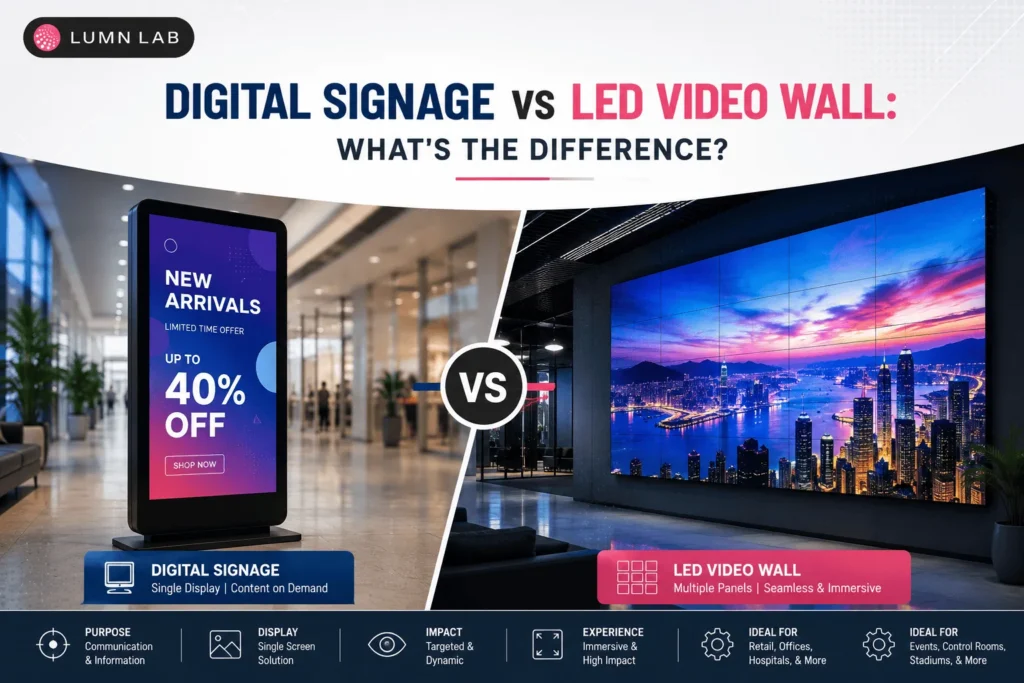
Digital signage is the broader category — any networked screen showing dynamic content, from a single 43-inch display to a multi-screen setup. An LED video wall is one specific way to build a large-format display: individual LED panels tiled together into one seamless surface. Every LED video wall can be part of a digital signage strategy. Not every digital signage screen is an LED video wall.
This guide breaks down what separates the two, what each costs in India, and how to figure out which one actually fits your space.
What Is Digital Signage?
Digital signage is any electronic display used to show scheduled or real-time content — menus, promotions, wayfinding, announcements, live data — instead of a printed poster or banner. It’s usually one screen or a small cluster of standard commercial displays (LCD or LED panels) connected to a content management system (CMS).
You’ll see digital signage in:
- Retail stores, running promotions and pricing updates
- Corporate lobbies and reception areas, showing branding and visitor info
- Hospital and clinic waiting rooms, displaying queue numbers and health information
- Restaurants and QSR chains, running digital menu boards
- Educational institutions, posting notices, timetables, and event updates
Most digital signage installations use LCD or standard LED panels ranging from 32 inches to around 85 inches, and they’re built for one job: deliver information clearly, update it remotely, and keep running with minimal upkeep.
What Is an LED Video Wall?
An LED video wall is a large-format display made by joining multiple LED panels or cabinets into a single, continuous image. There’s no bezel breaking up the picture — the display is the wall. Behind the scenes, a video processor and controller sync the panels so they render one unified image (or split it into zones for multiple content sources).
LED video walls show up where scale and visual impact matter more than compact footprint:
- Auditoriums, corporate town halls, and boardrooms
- Retail flagship stores and brand experience zones
- Airports, metro stations, and transit hubs
- Stadiums and event venues
- Hotel lobbies and banquet spaces
- Outdoor building facades and billboards
Because each LED pixel emits its own light — instead of relying on a backlight, like LCD panels do — video walls hold up better in bright ambient light and can be built in almost any size or shape, including curved and irregular formats.
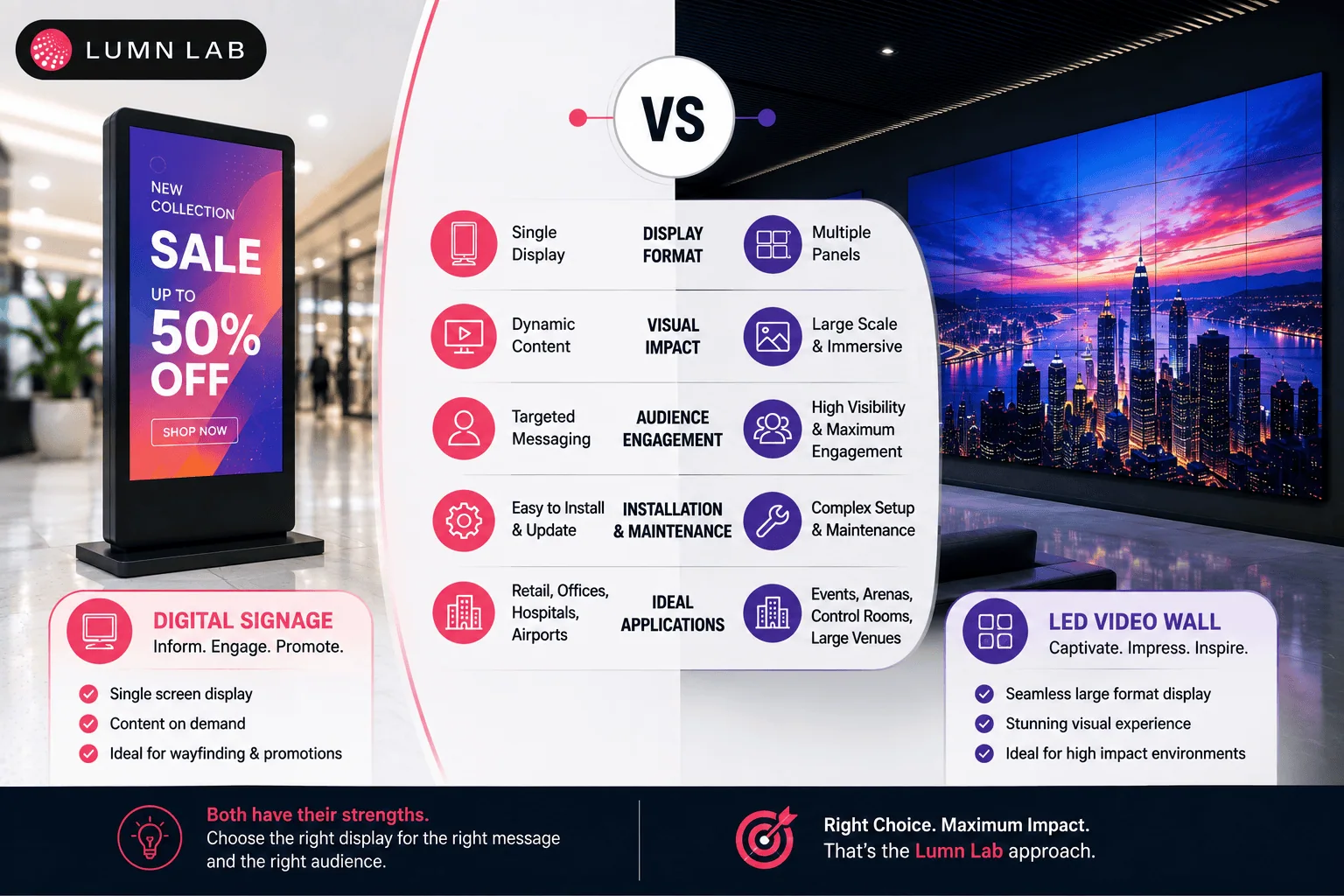
Digital Signage vs LED Video Wall: Key Differences
Cost Comparison
This is usually the first question, and the honest answer is: it depends on scale, not just technology. Standard digital signage — a single commercial display with a media player — is the lower-cost entry point and works well when one or two screens cover the need. LED video walls involve more panels, structural mounting, and a processor, so the investment scales with size and pixel pitch.
| Factor | Digital Signage (LCD/Panel) | LED Video Wall |
| Typical setup | Single screen or small cluster | Multiple LED panels tiled seamlessly |
| Best for | Info, menus, wayfinding, small spaces | Large-scale branding, events, high-impact visuals |
| Brightness (indoor) | Moderate, suited to indoor lighting | Higher, holds up in bright or mixed lighting |
| Outdoor use | Limited, needs weatherproof-rated models | Built for outdoor with IP65-rated panels |
| Bezels/seams | Visible on multi-screen setups | Seamless, no visible joins |
| Maintenance | Simple, screen-level | Panel-level, needs technical calibration |
| Scalability | Fixed screen sizes | Any size or shape, modular |
Generally, indoor LED panels for video walls typically start around ₹8,000–₹15,000 per square foot, while outdoor-rated LED walls start around ₹12,000–₹25,000 per square foot depending on pixel pitch and brightness. Standard commercial digital signage displays, by comparison, are a fraction of that cost per screen since they don’t require custom structural mounting or a processor.
For an exact number, a site-specific quote always beats a general estimate — factors like pixel pitch, cabinet type, and installation complexity move the price more than the brand name on the panel.
Brightness and Visibility
Digital signage panels are built for controlled indoor lighting — office lobbies, retail aisles, waiting areas. Take that same screen outdoors or place it in a sunlit atrium, and it washes out fast. LED video walls, particularly outdoor-rated ones, are engineered to push past ambient light.
A screen that needs to compete with midday sun requires significantly higher brightness than one sitting in a dim corridor — this is where LED technology has a clear structural advantage over LCD-based signage. IP65 refers to a specific point on the IP rating scale for electronic enclosures, indicating full protection against dust and low-pressure water jets.
Installation and Maintenance
Digital signage installation is close to plug-and-play: mount the screen, connect the media player, load the CMS. Most teams can manage content themselves after a short onboarding.
LED video walls need more planning. Panels have to be structurally mounted, calibrated for color and brightness uniformity across every tile, and connected through a processor that keeps the whole surface in sync. Ongoing maintenance is also different — a faulty digital signage screen usually means swapping the whole unit, while a modular LED wall lets you replace or repair individual panels without touching the rest of the display. That’s a real advantage for installations running 24/7, like transit displays or retail flagship walls, where downtime on the entire screen isn’t an option.
Which One Should You Choose?
A rough way to think about it:
- Choose digital signage if you need one or a few screens for information, menus, or wayfinding in a standard indoor space, and budget or footprint is a constraint.
- Choose an LED video wall if the display itself needs to be the focal point — a stage backdrop, a brand wall, an outdoor facade, a control room, or any space where scale and seamless visuals matter more than a compact setup.
Many businesses in Delhi NCR, Mumbai, Bangalore, Gurgaon, and Noida end up using both — standard signage for wayfinding and info screens, and an LED video wall for the space that needs to make an impression.
Expert Recommendations
Before deciding between the two, walk through these questions:
- What’s the viewing distance? Screens viewed from a few feet away (reception desks, retail counters) need finer pixel pitch and don’t require video-wall scale. Screens viewed from 10+ metres (auditoriums, stadiums, facades) benefit from LED video wall’s brightness and size flexibility.
- Is the space indoor, outdoor, or semi-outdoor? This alone often decides the technology — outdoor almost always means LED, IP65-rated, and high-brightness.
- How much downtime can you tolerate? If the screen runs content critical to operations (queue management, live data, wayfinding), modular LED’s panel-level repair reduces risk versus a single failed signage screen.
- What’s the content strategy? If content changes daily across many locations, prioritize a strong CMS regardless of hardware. If the display needs to be a permanent architectural statement, LED video wall build quality matters more than software.
- Get IP and brightness specs in writing. For any outdoor or semi-outdoor project, confirm the IP rating (IP65 for full weatherproofing) and nit rating before signing off — this is where budget installations tend to cut corners. Also check your vendor’s panels meet Bureau of Indian Standards (BIS) certification requirements, which cover electrical safety compliance for display equipment sold in India.
Conclusion
Digital signage and an LED video wall aren’t competing options — they’re different tools for different jobs. Digital signage handles information, wayfinding, and everyday communication efficiently and affordably. An LED video wall handles scale, brand impact, and outdoor visibility in a way standard panels simply can’t. The right call comes down to viewing distance, lighting conditions, budget, and what the screen actually needs to accomplish in that specific space.
If you’re still weighing digital signage against an LED video wall for a project in Delhi NCR, Mumbai, Bangalore, Gurgaon, or Noida, Lumn Lab’s team can walk your site, look at your lighting and viewing distance, and recommend the setup that fits — not the one that’s easiest to sell.
With 1,000+ installations since 2015 and BIS, ISO, and IP65-certified panels, Lumn Lab has built both formats across corporate, retail, hospitality, and event spaces nationwide. Get in touch with Lumn Lab for a free site consultation and quote.
Frequently Asked Questions
Q: Is an LED video wall a type of digital signage?
Yes. Digital signage is the umbrella term for any networked display showing dynamic content. An LED video wall is one format within that category, built specifically for large-scale, seamless visuals.
Q: Which is cheaper — digital signage or an LED video wall?
Standard digital signage is cheaper per screen since it uses off-the-shelf panels and simple mounting. LED video walls cost more because they involve multiple custom panels, structural work, and a video processor — the tradeoff is scale and seamless visual impact that standard signage can’t match.
Q: Can digital signage be used outdoors?
Only if it’s built for it. Standard indoor digital signage panels aren’t weatherproof or bright enough for direct sunlight. Outdoor digital signage needs IP65-rated, high-brightness panels — the same category outdoor LED video walls fall into.
Q: How long does an LED video wall last compared to digital signage?
Both hold up well with proper care. LED panels used in video walls typically run 50,000–100,000 hours before brightness noticeably degrades, similar to the lifespan of LED-based signage panels. LCD-based digital signage screens generally have a shorter usable life due to backlight degradation over time.
Q: What’s the minimum size for an LED video wall?
There’s no fixed minimum — LED video walls are modular, so they can be built as small as a few feet or scaled to cover an entire facade. Most corporate and retail installations start around 8–10 feet wide.
Q: Do LED video walls need special maintenance?
Yes, more than standard signage. Video walls need periodic calibration to keep brightness and color uniform across all panels, plus dust cleaning for outdoor units. The upside is that individual panels can be repaired or swapped without taking down the whole display.
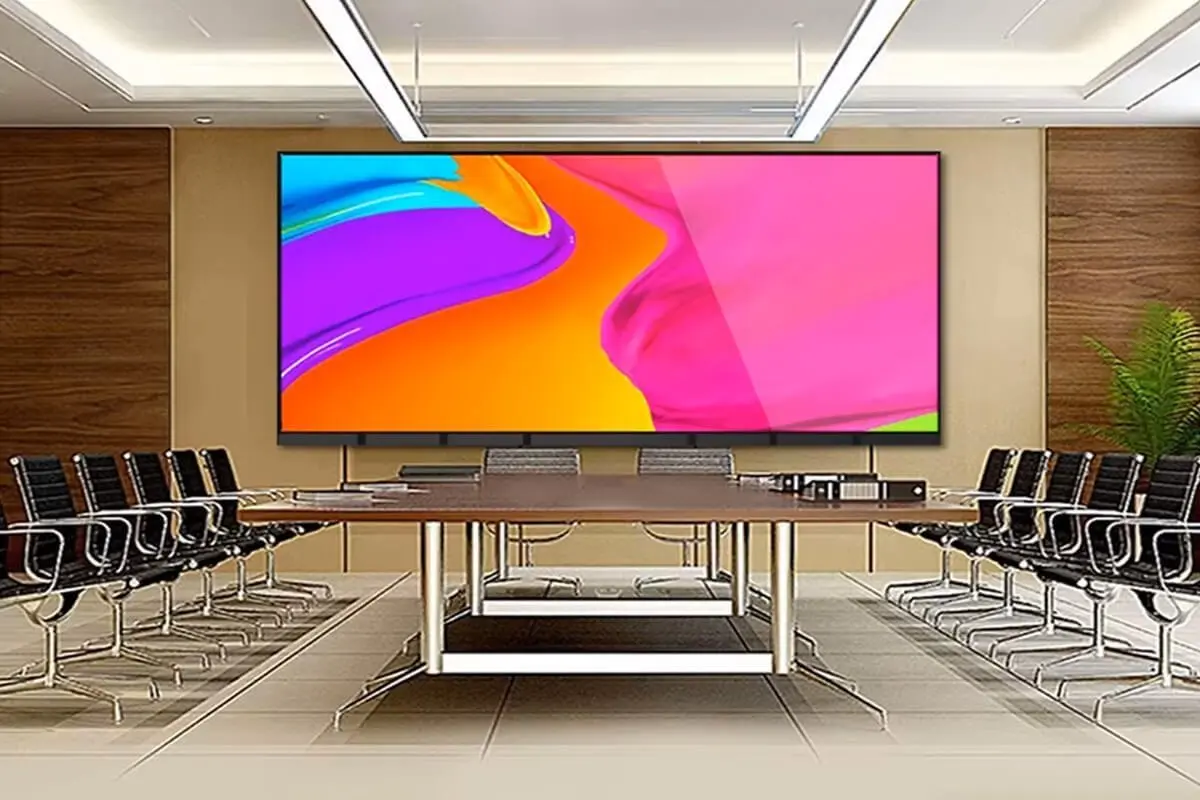
Q: Which is better for a corporate boardroom — digital signage or an LED video wall?
For a single presentation screen, standard digital signage or a commercial display usually does the job. For a boardroom that doubles as a hybrid meeting space or executive briefing room, a fine-pitch indoor LED video wall gives sharper close-range detail and a more seamless look.
Q: Is digital signage or LED video wall better for outdoor advertising?
LED video walls are the standard for outdoor advertising because they’re built for high brightness and direct sunlight visibility. Digital signage in the outdoor advertising space is typically LED-based for this exact reason.
Keep Reading