

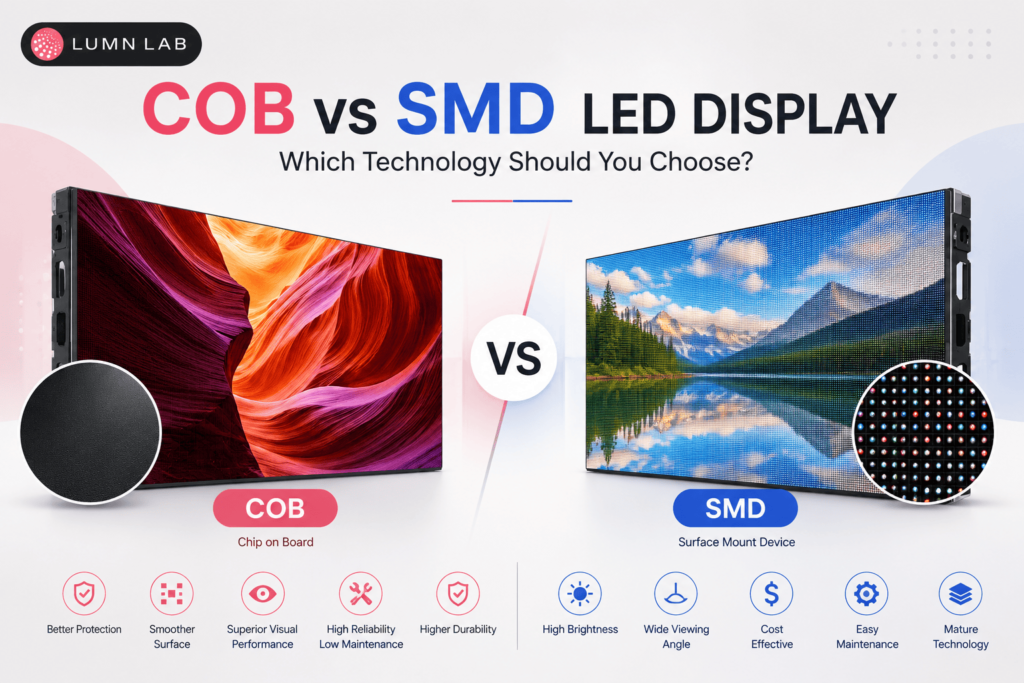

If you’ve spent any time researching LED video walls, you’ve probably run into these two acronyms and wondered which one your project actually needs. COB (Chip-on-Board) and SMD (Surface-Mounted Device) are the two dominant LED packaging technologies used in commercial displays today, and the difference between COB vs SMD LED Display isn’t just technical trivia — it changes how your screen looks up close, how long it lasts, and what you’ll spend on maintenance five years from now.
While wondering which technology you should choose, the honest answer is: neither one wins outright. The right choice depends on your viewing distance, your budget, and where the screen is going. This guide breaks down the real differences — no marketing spin — so you can walk into a vendor conversation already knowing what to ask for.
What Is SMD LED Display Technology?
SMD stands for Surface-Mounted Device. Each pixel is built from individual red, green, and blue diodes mounted as a small package directly onto the display’s PCB. SMD has been the industry standard for over a decade, and most of the LED video walls you’ve seen in malls, offices, and stadiums run on it.
Why it’s popular: it’s a mature, well-understood manufacturing process, repair is straightforward because individual modules can be swapped, and pricing is competitive across a wide range of pixel pitches.
What Is COB LED Display Technology?
COB stands for Chip-on-Board. Instead of mounting individual diode packages, bare LED chips are bonded directly onto the PCB and then sealed under a protective epoxy layer. This construction removes the individual plastic housing SMD relies on, which is what gives COB its two headline advantages: it can pack pixels much closer together, and the sealed surface is far more resistant to knocks, dust, and moisture.
COB is the newer technology in mainstream commercial use, and it’s what’s driving the current push toward sub-P1.0 pixel pitches for close-viewing applications like control rooms and premium retail.
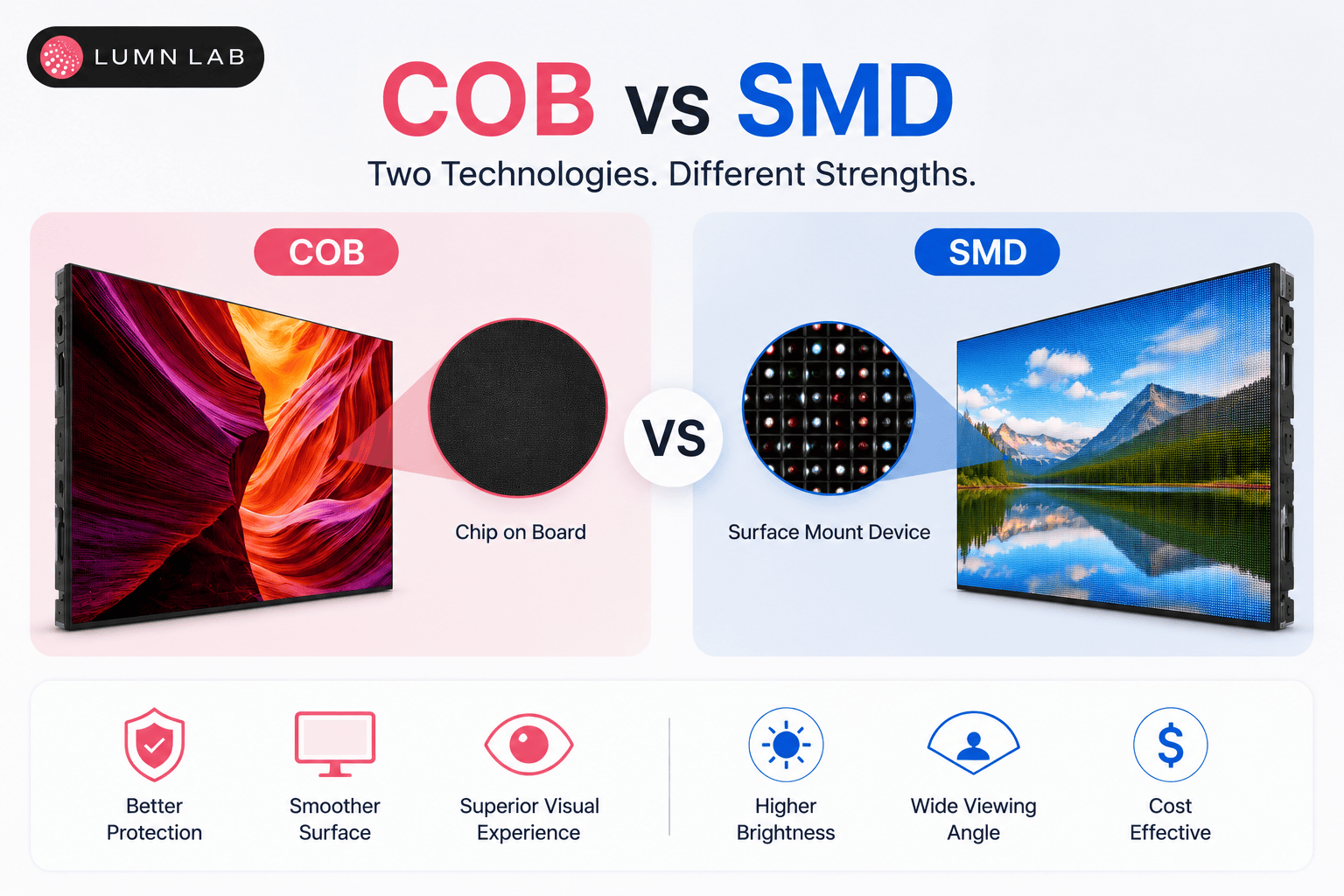
COB vs SMD: Key Differences at a Glance
| Factor | SMD LED Display | COB LED Display |
| Pixel construction | Individual diode packages | Chips bonded directly to PCB |
| Typical pixel pitch | P1.2 and above | Down to P0.7 and finer |
| Viewing angle | Wide (140°–160°) | Wider (up to 170°+) |
| Surface protection | Exposed diode packages | Epoxy-sealed, dust/moisture resistant |
| Repair method | Module or diode swap | PCB-level replacement |
| Upfront cost | Lower | Higher |
| Best viewing distance | 2m and above | Sub-1m to 2m |
| Physical durability | Good | Better — resistant to impact |
Also Read: Transparent LED Display Price in India 2026: Cost, Specifications & Buying Guide
Which Has Better Viewing Angles — COB or SMD?
Both technologies offer wide viewing angles suitable for commercial use, but COB generally holds color consistency better at extreme angles because the sealed, flush surface scatters light more evenly than SMD’s raised diode packages. SMD panels typically deliver 140°–160° horizontal viewing angles, while COB panels commonly reach 170° or beyond with less color shift as viewers move off-center.
For applications like a reception lobby wall or a retail storefront screen where people walk past at sharp angles, this difference is noticeable. For a boardroom screen viewed mostly head-on, it matters far less.
Lifespan and Durability: COB vs SMD
This is where COB’s construction really pays off. Because the LED chips sit under a continuous epoxy seal rather than individual plastic housings, COB panels are significantly more resistant to physical impact, dust ingress, and accidental knocks — which matters in high-traffic public spaces, transit stations, and outdoor-adjacent installations.
On raw lifespan, both technologies are rated in the 100,000-hour range under standard operating conditions, but COB tends to hold pixel uniformity longer because there’s no individual diode packaging to degrade or discolor unevenly over time. SMD panels, when properly manufactured and maintained, are also long-lasting — the gap shows up more in physical robustness than in pure hour-count.
Bottom line: if your installation is in a high-footfall public area — a metro station display, a stadium concourse, a school corridor — COB’s sealed surface reduces your long-term maintenance calls. If it’s a controlled indoor environment like an office or studio, SMD’s lifespan is perfectly adequate.
Power Consumption Compared
COB panels generally run 10–20% more power-efficient than comparable SMD panels at the same brightness output, largely because the chip-on-board design reduces energy loss between the diode and the circuit board. For large-format installations running 12–16 hours a day — retail storefronts, transit displays, corporate lobbies — this difference adds up on the electricity bill over a year, though it’s rarely the deciding factor on its own.
Best Applications for COB vs SMD
Choose SMD when:
- Viewing distance is 2 meters or more (auditoriums, stage backdrops, large lobby walls)
- Budget is a primary constraint
- The display is in a controlled indoor environment with limited foot traffic
- You need a proven, widely-serviceable technology
Choose COB when:
- Viewers stand close to the screen — control rooms, boardrooms, premium retail counters
- The installation is in a high-traffic public space prone to accidental contact
- You need the finest available pixel pitch for sharp close-up detail
- Long-term maintenance cost matters more than upfront price
Real-world example: a bank’s customer-facing branding wall in a busy Gurgaon branch, where customers stand within a meter of the screen and foot traffic is constant, is a textbook COB use case. A conference hall screen in Bangalore viewed from rows of seating 4–5 meters back doesn’t need COB’s premium pitch — SMD does the job at a lower cost.
COB vs SMD LED Strips (Not the Same as Display Panels)
Worth a quick clarification: if you’re searching “which is better, SMD or COB LED” in the context of LED strip lighting for interiors or architectural lighting, that’s a different product category from commercial LED display panels, though the same packaging principle applies. COB LED strips produce a more even, dot-free light output and run cooler at lower wattages, which is why they’re popular for cove lighting and under-cabinet applications. SMD strips are brighter per LED and better suited for task lighting or color-changing effects. Neither is objectively “the best LED strip” — it depends on whether you want a smooth wash of light (COB) or punchy, controllable output (SMD).
Lumn Lab’s focus is commercial video wall and digital signage installations rather than decorative strip lighting, so if that’s your specific need, a dedicated lighting specialist is the better fit.
Expert Recommendations
After 1000+ installations since 2015, here’s what we tell clients before they commit to either technology:
- Measure your minimum viewing distance first. This single number eliminates half the decision. Under 1.5 meters, lean COB. Beyond 2.5 meters, SMD is usually the more cost-effective choice.
- Factor in your environment, not just your budget. A slightly higher upfront cost for COB in a high-traffic public installation often works out cheaper over five years once you account for reduced repair visits.
- Ask vendors for pixel pitch options in both technologies, not just their default recommendation — some suppliers push whichever stock they’re carrying.
- Don’t ignore serviceability. SMD’s module-based repair is simpler and faster for teams without in-house technical staff. COB repairs typically require PCB-level replacement.
- Request a live panel demo when possible. Specification sheets don’t capture how a screen actually looks at your specific viewing angle and ambient lighting.
- Check compliance credentials, not just spec sheets. Any LED display vendor operating in India should be able to speak to how their products align with BIS-notified product categories for electronics — ask directly rather than taking a website badge at face value
Conclusion
There’s no universal winner in the COB vs SMD LED display debate — the right technology depends entirely on where the screen goes and who’s standing in front of it. SMD remains a reliable, budget-friendly choice for displays viewed from a distance, while COB earns its premium in close-viewing, high-durability, and fine-pitch scenarios.
If you’re still weighing which technology fits your specific space — whether it’s a corporate lobby in Gurgaon, a retail counter in Mumbai, or a control room in Bangalore — Lumn Lab has spent since 2015 helping businesses across India make this exact call, backed by 1000+ completed installations. Get in touch with our team for a site assessment and a straight recommendation on COB or SMD for your project.
Not sure whether COB or SMD fits your space?
Talk to Lumn Lab’s display specialists — get a free site assessment and a clear recommendation based on your viewing distance, environment, and budget.
Frequently Asked Questions
Q. What are the main differences between COB and SMD LED displays?
SMD mounts individual diode packages onto the PCB, while COB bonds bare chips directly to the board under a sealed epoxy layer. This gives COB finer achievable pixel pitch, better durability, and wider viewing angles, while SMD remains more affordable and easier to repair module-by-module.
Q. Which technology offers better durability for public installations?
COB is generally more durable for high-traffic public spaces because its sealed, flush surface resists dust, moisture, and accidental impact better than SMD’s exposed diode packages.
Q. How does the lifespan of COB LED displays compare to SMD?
Both are typically rated around 100,000 operating hours. COB tends to maintain pixel uniformity longer over that lifespan due to its sealed construction, while SMD’s lifespan depends more heavily on build quality and operating environment.
Q. What is the typical power consumption of COB LED panels?
COB panels are usually 10–20% more power-efficient than comparable SMD panels at the same brightness level, which adds up on running costs for displays operating long daily hours.
Q. Is COB or SMD better for high-resolution indoor video walls?
COB is generally the better choice for high-resolution indoor video walls viewed at close range, since it supports finer pixel pitches and sharper detail. For indoor walls viewed from a distance, SMD delivers comparable visual quality at a lower cost.
Q. Do SMD LEDs run hotter than COB LEDs?
SMD packages can run slightly warmer per diode due to less efficient heat dissipation through individual housings, while COB’s direct chip-to-board contact and epoxy layer generally dissipate heat more evenly across the panel.
Q. Which manufacturers offer COB LED displays in India?
Several Indian LED display manufacturers and system integrators, including Lumn Lab, now offer COB panels alongside SMD, reflecting growing demand for fine-pitch displays in control rooms, corporate offices, and premium retail across Delhi NCR, Gurgaon, Noida, Mumbai, and Bangalore. When evaluating suppliers, ask specifically about their COB pixel pitch range and after-sales service network, since not every vendor stocks both technologies.
Q. Where can I buy SMD LED display panels for a commercial project?
For commercial and corporate installations, it’s worth working directly with a manufacturer or system integrator who can assess your space, viewing distance, and content needs rather than buying panels off a generic online marketplace. Lumn Lab supplies and installs SMD LED display panels across India — reach out with your project details for a tailored recommendation.
Keep Reading